

European Private Credit: Navigating Direct Lending & Fund Strategies
The european private credit market offers flexible financing and robust returns for institutional investors and corporate borrowers. This guide details direct lending mechanics, evolving market dynamics, and the critical impact of AIFMD II on fund structuring. It provides actionable insights for general partners on deal origination, asset-backed finance, and navigating regional nuances. Understanding regulatory compliance and strategic fund structuring is crucial for maximizing opportunities in this expanding asset class.
DD Talks specializes in facilitating high-value deal-making and industry networking within European private credit and structured finance markets. Our events connect top-tier GPs and LPs, providing essential insights into market trends and regulatory updates.
To explore your options, contact us to schedule your consultation. You can also reach us via: Request Agenda
The european private credit market is a flexible, scalable financing alternative for businesses and offers risk-adjusted returns for investors. This guide covers the mechanics of direct lending, market dynamics, the impact of AIFMD II, and strategies for deal origination and fund structuring in 2026 for institutional investors, general partners, and corporate borrowers.
What is European Private Credit & Direct Lending?
European private credit is non-bank lending where specialized funds provide debt directly to companies. The asset class includes multiple debt strategies, with direct lending being the largest component. It is a source of capital for middle-market companies that find bank financing too rigid or inaccessible.
Defining Private Credit and Direct Lending in Europe
Private credit involves institutional investors, such as pension funds and insurance companies, allocating capital to funds that originate and underwrite loans. Direct lending is when these funds lend directly to corporate borrowers, bypassing public debt markets and traditional banking intermediaries for more bespoke, flexible financing.
Typical loan structures include senior secured loans, which hold the first claim on a company’s assets, and unitranche facilities, which blend senior and subordinated debt into a single instrument. Borrowers range from private equity-sponsored companies seeking acquisition financing to family-owned businesses needing capital for growth or refinancing.
Navigating the European Private Credit Landscape: Market Dynamics & Key Players
The European private debt market has grown, driven by institutional investor demand for yield and diversification and a structural shift from traditional bank lending. This expansion is not uniform, with distinct characteristics across regions.
Market Size, Growth, and Regional Nuances (2026 Outlook)
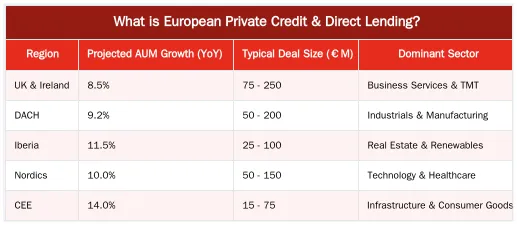
Assets under management (AUM) in European private debt have climbed, reflecting capital inflows and a pipeline of opportunities. While markets like the UK, France, and Germany dominate deal volume, other regions show growth prospects. For a deeper analysis, see our report on European private credit market size and growth projections.
The Iberian Peninsula shows increasing activity in real estate and renewable energy financing. The DACH region (Germany, Austria, Switzerland) is a stronghold for middle-market industrial lending, while the Nordics exhibit sophisticated deal structures. Central and Eastern Europe (CEE) is an emerging market, offering higher potential yields with different risk profiles.
The Ecosystem of Institutional Investors, GPs, and LPs
Limited Partners (LPs), such as pension funds, sovereign wealth funds, and insurance companies, are the primary capital allocators. They commit capital to funds for objectives like stable income and low correlation to public markets.
General Partners (GPs) are the fund managers who raise capital from LPs. They are responsible for the investment lifecycle: sourcing and evaluating deals (origination), due diligence, structuring transactions, monitoring portfolio companies, and returning capital to investors. The alignment of interests between GPs and LPs through management and performance fees is fundamental to the model.
Structuring & Origination: Strategies for European Direct Lending
Success in European direct lending depends on sourcing proprietary deals and structuring resilient financing. This requires a strong network, sector expertise, and a disciplined underwriting process.
Effective Deal Origination and Fund Structuring
Deal origination channels are diverse. Many deals are “sponsored,” brought by private equity firms seeking debt to finance leveraged buyouts. Non-sponsored deals, sourced directly from companies or their advisors, are often less competitive and can offer better terms. Building relationships with M&A advisors, law firms, and industry executives is crucial for consistent deal flow.
Fund structuring is critical. Managers must select a domicile (e.g., Luxembourg, Ireland) and legal structure (e.g., SICAV, FCP) that aligns with the target investor base and complies with European regulations. The structure must accommodate the tax and legal requirements of LPs from different jurisdictions.
Asset-Backed Finance and Covenant-Lite Loans
Strategies like asset-backed finance (ABF) are gaining traction. ABF allows companies to secure financing against specific asset pools, such as trade receivables, inventory, or equipment leases. This provides a flexible source of working capital and is often less dilutive than equity financing.
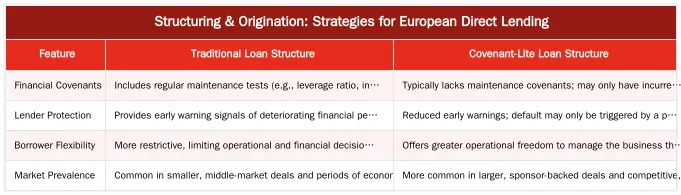
The market has also seen a rise in covenant-lite loans, which have fewer financial maintenance tests required of the borrower. While this provides companies with greater operational flexibility, it reduces early warning signals for lenders and requires more intensive monitoring of a borrower’s performance.
AIFMD II & Regulatory Compliance: Shaping European Private Credit Funds
The regulatory environment defines the European private credit landscape. The Alternative Investment Fund Managers Directive (AIFMD) and its update, AIFMD II, establish a harmonized framework for fund managers, impacting fund structuring and investor reporting.
Understanding AIFMD II’s Influence on Fund Management
AIFMD II introduces rules for loan-originating funds to enhance market stability and investor protection. Key provisions include requirements for risk diversification, leverage limits, and policies to manage conflicts of interest. The European Securities and Markets Authority (ESMA) states these rules ensure loan-originating funds operate prudently.
General partners must adapt fund structures and investment strategies to comply. The directive impacts how funds are marketed across the EU and imposes stricter governance standards. For details, see our analysis of the impact of AIFMD II on European funds.
Navigating Regulatory Reporting and Operational Challenges
AIFMD II imposes significant operational and reporting obligations. Managers must provide detailed information to national regulators through Annex IV reporting, including principal exposures, risk profiles, and liquidity management. This requires robust data management systems and a dedicated compliance function.
The directive mandates funds implement liquidity management tools to handle redemption requests, particularly for open-ended funds. These challenges require investment in technology and expertise for compliance.
Why European Private Credit Conferences are Essential for Deal-Making
In a market driven by relationships and information, B2B conferences are indispensable. They are hubs to share intelligence, originate deals, and build strategic partnerships.
Facilitating High-Value Deal-Making and Strategic Partnerships
Events like DDTalks’ Private Credit Days Europe in London and Private Credit Day Iberia in Madrid facilitate these interactions. They are environments where GPs connect with LPs seeking to allocate capital. Investment bankers and legal advisors attend to source mandates and connect with decision-makers. This concentration of participants allows for initiating transactions and forming alliances. You can book your ticket to secure a place.
Accessing Expert Insights and Market Intelligence
Agendas feature panel discussions and presentations from executives at institutions like Blackstone, Ares Management, and Goldman Sachs. These sessions provide insights into market trends, regional opportunities, and the implications of regulatory changes like AIFMD II.
Attendees access data-driven analysis and peer-to-peer discussions on topics from direct lending strategies to asset-backed finance.
Unlock Your Potential in European Private Credit with DDTalks
Success in the European private credit market demands expertise, a strong network, and an understanding of the regulatory landscape. Staying informed and connected is necessary for middle-market lending and fund management.
DDTalks brings together industry leaders, providing a platform to build relationships and gain insights. Engage with market players and position your organization.
Conclusion
European private credit is a maturing asset class integral to corporate finance. For institutional investors, it offers diversified returns; for businesses, it provides flexible capital. Success requires understanding deal origination, fund structuring, and the AIFMD II regulatory framework. Join industry figures at our events to gain market intelligence and connections. Contact us for more information or Request Agenda for our speaker lineup.
Frequently Asked Questions
What is the primary focus of this guide to european private credit?
This guide provides a comprehensive overview of the european private credit and direct lending landscape, designed for institutional investors, fund managers, and advisors. It covers core concepts, market dynamics, key players, and regulatory frameworks like AIFMD II. The content is tailored for professionals navigating this complex asset class.
How does direct lending in Europe differ from traditional banking?
Direct lending in Europe offers borrowers more flexible, bespoke financing solutions and faster execution compared to traditional banks, which face stricter capital requirements. This has made private debt a critical source of capital for mid-market companies. It effectively fills a funding gap left by banks post-financial crisis.
What is the impact of AIFMD II on the european private credit market?
The Alternative Investment Fund Managers Directive II (AIFMD II) introduces new rules affecting fund structuring, marketing, and operations within the european private credit market. Key changes impact delegation, liquidity management, and reporting requirements for fund managers. Understanding these regulations is crucial for compliance and strategic planning.
Who are the key players in the european private credit ecosystem?
The ecosystem includes General Partners (GPs) who manage the funds and Limited Partners (LPs), such as pension funds and insurance companies, who provide the capital. Other key players are investment banks, legal advisors who facilitate transactions, and mid-market corporate borrowers. DDTalks conferences bring these participants together to foster deal-making.
Why are conferences important for the european private credit industry?
Specialized conferences are essential hubs for the european private credit industry, connecting top-tier institutional investors, GPs, and LPs for high-level networking. These events allow attendees to discuss market trends, originate deals, and gain visibility among key decision-makers. They provide a unique platform for face-to-face engagement that virtual meetings cannot replicate.
How can I learn more about upcoming private credit conferences in Europe?
To stay informed about the latest trends and connect with industry leaders, you can explore the agendas for our upcoming events in key financial centers like London and Madrid. You can request the full agenda to see detailed session topics and speaker lineups for our next forum.



0 Comments