

NPL Workout Playbooks: Maximizing Distressed Asset Recovery
NPL workout playbooks provide structured frameworks for managing non-performing loans, guiding institutions through the entire distressed debt lifecycle. This article details the systematic approach to maximize recovery from underperforming assets, covering early intervention strategies like loan modification and forbearance agreements. It further explores advanced techniques such as complex capital restructuring, special servicing, and asset recovery. Readers will gain insights into optimizing NPL management processes, enhancing operational efficiency, and achieving predictable financial outcomes for distressed portfolios.
DDTalks specializes in European private credit and NPL markets, providing expert insights into distressed debt and capital restructuring. Our content reflects the deep industry knowledge shared at our premium B2B financial conferences, facilitating high-value deal-making and strategic networking.
To explore your options, contact us to schedule your consultation. You can also reach us via: Request Agenda
NPL workout playbooks provide the framework for managing distressed debt, offering a structured approach to maximize recovery from underperforming assets. This article details the loan workout process, from early intervention to complex capital restructuring, for institutional investors, servicers, and financial institutions.
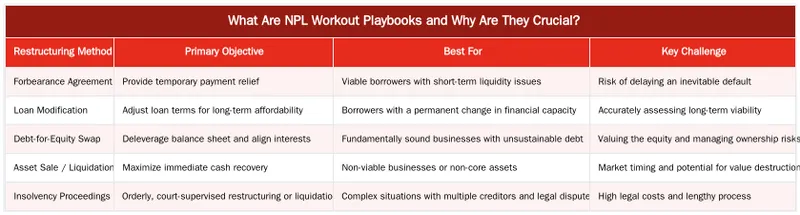
What Are NPL Workout Playbooks and Why Are They Crucial?
An NPL workout playbook is a predefined set of procedures and strategies to manage and resolve non-performing loans. It provides a systematic, data-driven approach for proactive management of distressed assets to minimize losses and optimize recovery value for creditors and investors.
These frameworks introduce consistency and discipline to managing distressed debt. By standardizing assessment, intervention, and resolution processes, institutions ensure decisions are based on clear criteria, not ad-hoc judgments. This improves operational efficiency, risk management, and leads to more predictable financial outcomes.
Defining the Core Objective of a Distressed Debt Playbook
The goal of a distressed debt playbook is to maximize the net present value of a non-performing asset. It outlines specific actions, decision trees, and key performance indicators for each workout stage. The framework facilitates early intervention, mandates collateral and borrower analysis, and guides the use of resolution tools, from loan modifications to capital restructuring solutions.
What Are the Key Stages of an NPL Workout Process?
The NPL workout process begins with identifying and classifying a loan as non-performing based on triggers like payment delinquency. This is followed by an assessment of the borrower’s financial situation, collateral value, and the loan’s legal framework.
The next phase is intervention and negotiation to find a consensual solution viable for both borrower and creditor. If these solutions fail, the process escalates to resolution strategies like legal action or asset disposition.
Early Intervention Strategies for Distressed Loans
Early intervention aims to stabilize the situation before value erodes. Common strategies include loan modification, where terms like interest rates or amortization periods are adjusted, and forbearance agreements, which provide temporary payment relief. These tools help viable borrowers overcome short-term difficulties and return loans to performing status. For more, explore our guide to mastering NPL workout strategies.
Transitioning to Resolution: Special Servicing and Asset Recovery
If early interventions fail, the loan is transferred to a special servicing unit. These teams manage highly distressed assets using intensive resolution tactics, shifting the focus from loan rehabilitation to direct asset recovery. Pathways include negotiating a discounted payoff, selling the collateral, or selling the loan to another investor. These recovery strategies are critical for portfolio health.
Complex Capital Restructuring: Advanced Strategies for Distressed Assets
When loan modifications are insufficient for severely distressed assets, complex capital restructuring is necessary. This involves reorganizing a borrower’s debt and equity structure to create a sustainable financial foundation. These strategies require financial modeling, legal negotiations, and turnaround management. The goal is to realign stakeholder interests—creditors, equity holders, and management—toward long-term value creation.
These solutions are relevant for corporate NPLs where a viable business has an unsustainable capital structure. The process can involve new capital, converting debt to equity, or altering the seniority and terms of debt tranches. Success requires precise execution and creditor negotiations.
Debt-for-Equity Swaps and Creditor Negotiations
In a debt-for-equity swap, a creditor cancels debt in exchange for an equity stake in the company. This deleverages the balance sheet, reduces cash interest payments, and allows the creditor to participate in the company’s future upside, though it involves ownership risk. The process is often part of complex, multi-party creditor negotiations involving different debt classes with competing interests. These topics are central to distressed investments and corporate restructuring.
Comparing Capital Restructuring Options for NPLs
The choice of strategy depends on the asset’s circumstances. The table below compares common capital restructuring options.
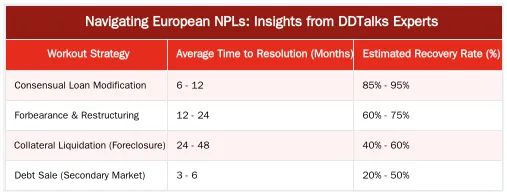
Navigating European NPLs: Insights from DDTalks Experts
The European NPL market comprises diverse legal jurisdictions, economic conditions, and regulatory frameworks, so strategies effective in one country may fail in another. For instance, collateral enforcement and insolvency proceedings vary significantly between Spain, Italy, and Germany. This requires localized expertise and NPL workout playbooks tailored to specific markets.
DDTalks events focus on these nuances, convening institutional investors, servicers, and advisors to share insights. Discussions center on cross-border transactions and adapting workout strategies to local regulations, such as those from the European Banking Authority (EBA).
The European Landscape: Market Trends and Regulatory Impact
Southern European markets, particularly the Iberian Peninsula, have been active hubs for NPL transactions. Regulatory pressure has prompted banks to deleverage their balance sheets, creating a flow of distressed asset portfolios for investors. Current trends show growing interest in asset classes beyond real estate, including unsecured consumer debt and SME loans. Understanding these market dynamics is essential for identifying investment opportunities, as explored in our analysis of European private credit.
DDTalks’ Role in Facilitating Distressed Debt Deal-Making
DDTalks conferences are a nexus for the distressed debt community. Our forums in London and Madrid bring together stakeholders—GPs like Blackstone and Oaktree, specialized servicers, and legal advisors—to facilitate networking and deal origination. The environment allows workout professionals and institutional investors to exchange knowledge on strategies, navigate regulatory changes, and build partnerships to execute complex transactions in the European NPL and distressed debt space.
Maximizing Recovery: The Impact of Strategic NPL Management
NPL workout playbooks and capital restructuring strategies directly impact financial outcomes. For banks, this leads to stronger balance sheets, reduced provisioning needs, and improved regulatory compliance. For institutional investors, a disciplined approach to asset recovery is fundamental to achieving target returns and mitigating risk in the distressed debt asset class.
Future-Proofing Portfolios Through Proactive NPL Strategies
Strategic NPL management builds resilience beyond resolving past-due loans. By embedding proactive, data-driven workout processes, financial institutions can better anticipate and manage credit cycles. This contributes to long-term portfolio health and stability, preparing them for future economic shifts.
Conclusion
Managing non-performing loans requires a disciplined, strategic approach. Workout frameworks and an understanding of capital restructuring are essential for maximizing asset recovery in the European distressed debt market. Expert insights and industry connections help investors and servicers unlock value. To connect with industry leaders, explore our upcoming events and Request Agenda. Contact us to learn more.
Frequently Asked Questions
What is the primary goal of npl workout playbooks?
The primary goal of npl workout playbooks is to provide a structured framework for maximizing recovery value from non-performing loans. This involves early intervention, detailed asset analysis, and the strategic application of resolution tools like loan modifications or complex capital restructuring. This systematic approach ensures consistent and effective management of distressed assets.
What are the first steps in developing effective npl workout playbooks?
The first steps involve segmenting the NPL portfolio by risk profile, collateral type, and jurisdiction. This is followed by a thorough due diligence process for each asset to understand its underlying value and legal standing. This initial analysis is crucial for creating effective npl workout playbooks that inform the selection of the most appropriate resolution strategy.
How do npl workout playbooks incorporate complex capital restructuring?
Advanced npl workout playbooks outline scenarios for complex capital restructuring when simple loan modifications are insufficient. This involves reorganizing a debtor’s balance sheet to restore viability, often using mechanisms like debt-for-equity swaps or new capital injections. The playbook provides a decision tree to guide when these more intensive strategies are necessary to preserve enterprise value.
Why is an “early workout” strategy so critical for managing non-performing loans?
An early workout strategy is critical because it allows creditors to intervene before asset value erodes significantly. Prompt action can preserve the borrower’s operational viability, making a consensual restructuring more likely. This proactive approach ultimately leads to higher recovery rates compared to a delayed liquidation scenario.
How do you balance stakeholder interests during a complex NPL restructuring?
Balancing the interests of different creditor classes and equity holders requires transparent communication and skilled negotiation. The workout plan must present a clear path to value recovery that is demonstrably better for all parties than the alternative, which is often a costly and uncertain insolvency proceeding. A well-defined governance process is essential for managing these competing interests effectively.
How can I learn more about the latest strategies in NPL management?
Gaining insights from industry leaders is key to refining your approach to distressed debt. Attending specialized forums, such as DDTalks’ NPL and Distressed Debt events, provides direct access to expert-led discussions on workout strategies and capital restructuring. You can request the full agenda to see the specific topics and speakers at our upcoming European summits.




0 Comments