

Speaking at Financial Conference: Crafting Winning Proposals
Securing a slot speaking at financial conference events is crucial for establishing industry authority and expanding professional networks. This guide outlines how to craft compelling proposals that resonate with elite organizers, focusing on content relevance and unique expertise. Readers will learn to align their pitch with specific event themes, such as European private credit or NPL strategies, and demonstrate practical value for senior decision-makers. Mastering the application process for a financial summit speaker role enhances thought leadership and opens pathways to high-value deal-making in structured finance markets.
DD Talks specializes in organizing premier B2B financial conferences across Europe, focusing on private credit, NPL, and structured finance markets. Our events facilitate high-value deal-making and industry networking, connecting top-tier GPs and LPs with actionable market insights.
To explore your options, contact us to schedule your consultation. You can also reach us via: Request Agenda
Why Speaking at a Premier European Financial Conference Matters
Securing a speaking role at a premier European financial conference establishes authority, influences industry dialogue, and gains visibility among senior decision-makers. It positions you and your firm at the center of conversations, from private credit trends in the DACH region to NPL strategies in the Iberian Peninsula.
Public speaking opportunities are catalysts for networking and deal-making. For professionals speaking at financial conference events, the benefits create pathways to new partnerships and investment opportunities.
Elevating Your Thought Leadership and Industry Influence
Presenting analysis on topics like the impact of AIFMD II or the evolution of asset-backed finance solutions demonstrates expertise and solidifies your status as a thought leader. Delivering data-driven insights to an audience of institutional investors, general partners (GPs), and limited partners (LPs) shapes the market’s perspective. This influence helps build a reputation for foresight and authority that attracts capital and talent in the European financial landscape.
What Do Elite Conference Organizers Seek in a Speaker Proposal?
Conference organizers prioritize content that delivers tangible value. They seek fresh, relevant, and actionable insights addressing attendee challenges and opportunities. A successful pitch aligns with the event’s themes and demonstrates understanding of the delegate profile.
Aligning with Event Themes and Audience Profile
The most common reason for rejection is a lack of relevance. A generic proposal on “The Future of Finance” will be overlooked for a specific pitch like “Navigating Covenant-Lite Structures in European Direct Lending post-2026.” Before submitting, research our upcoming event themes, past agendas, and attendee roles. Our events cater to senior professionals in private credit, NPLs, and structured finance who expect granular, forward-looking content. Your proposal must prove you understand their objectives.
Demonstrating Unique Expertise and Practical Value
Organizers seek speakers with a unique perspective backed by experience, such as a novel approach to risk management in distressed debt, proprietary data on NPL market flows, or a case study on a complex securitisation deal. Your pitch must articulate what makes your content different and why delegates need to hear it. Vague promises are insufficient; concrete takeaways are mandatory.
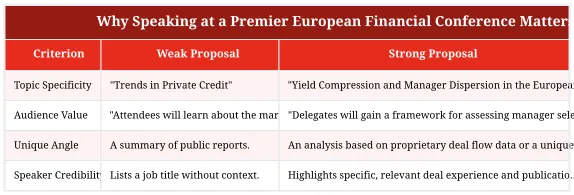
View data as table
| Criterion | Weak Proposal | Strong Proposal |
|---|---|---|
| Topic Specificity | “Trends in Private Credit” | “Yield Compression and Manager Dispersion in the European Mid-Market Direct Lending Space” |
| Audience Value | “Attendees will learn about the market.” | “Delegates will gain a framework for assessing manager selection amidst tightening credit spreads.” |
| Unique Angle | A summary of public reports. | An analysis based on proprietary deal flow data or a unique legal interpretation of new regulations. |
| Speaker Credibility | Lists a job title without context. | Highlights specific, relevant deal experience and publications that establish authority on the topic. |
Crafting Your Winning Pitch: A Step-by-Step Guide for Financial Experts
A conference speaker proposal is a concise document showcasing your expertise and value. It requires three components: the topic and abstract, your professional bio, and the session’s benefits for the audience. This approach helps your pitch stand out.
Developing a Compelling Topic and Abstract
Your topic must be timely, specific, and relevant to the conference agenda to capture the review committee’s attention. The abstract (150-200 words) should outline the core argument, key points, and learning outcomes. Avoid jargon and focus on clarity.
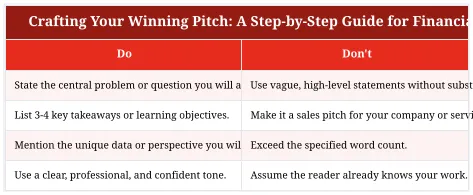
View data as table
| Do | Don’t |
|---|---|
| State the central problem or question you will address. | Use vague, high-level statements without substance. |
| List 3-4 key takeaways or learning objectives. | Make it a sales pitch for your company or services. |
| Mention the unique data or perspective you will bring. | Exceed the specified word count. |
| Use a clear, professional, and confident tone. | Assume the reader already knows your work. |
Building an Impactful Speaker Bio and Credentials
Your speaker biography is a marketing tool to establish credibility on the proposed topic. Tailor it to highlight relevant experience and achievements. If pitching a talk on NPL workouts in Italy, emphasize your experience managing portfolios in that market. Mention institutional affiliations, leadership roles, publications, or previous speaking engagements at respected forums. This demonstrates your authority and capability.
Insider Strategies: Leveraging Your Expertise for DD Talks’ Elite Events
Submitting a proposal to a DD Talks event requires understanding our focus on high-level, deal-making conversations. Our agendas address pressing issues for senior practitioners in European private credit, distressed debt, and structured finance. A successful pitch resonates with this commercial and intellectual environment.
Navigating the DD Talks Selection Process
The DD Talks Research and Event Committee evaluates submissions based on market relevance, speaker authority, and B2B audience value. We prioritize topics central to current investment strategies and operational challenges. For example, the practical implications of the Alternative Investment Fund Managers Directive (AIFMD) review is more compelling than a general economic overview. We cross-reference a speaker’s credentials with their proposed topic to ensure expertise. We ask: “Will this session provide our delegates—GPs, LPs, and advisors—with insights they can use to make better decisions?”
Maximizing Visibility: Solo Presentations vs. Panel Participation
Choosing the right format is a strategic decision. A solo presentation or keynote is ideal for unveiling new research, presenting a complex case study, or delivering a singular viewpoint. This format offers maximum visibility and positions you as an authority, but these slots are highly competitive.
A panelist submission allows engagement in industry conversations. When pitching for a panel, suggest a specific or contrarian viewpoint. For instance, instead of offering to speak on “Direct Lending,” propose to argue why specialized, niche strategies will outperform broad-based senior secured funds. This shows the committee you can contribute to an informative debate, a hallmark of our in-depth panels.
Avoiding Common Pitfalls in Your Conference Speaker Application
Many speaker applications are declined due to avoidable errors like generic content or poor timing. Understanding these mistakes increases your chances of selection. These pitfalls signal a lack of preparation for the competitive selection process.
Overcoming Generic Pitches and Lack of Specificity
The most frequent mistake is a generic proposal. Specialized event organizers discard pitches that lack focus. Your application must show you have studied the event, its audience, and themes. Propose a session that fills a gap in the agenda or offers a fresh take on an issue. Infuse your abstract with specific data points, regional focus (e.g., CEE, Nordics), and niche terminology.
Timing Your Submission: Why Early is Always Better
Conference agendas are planned months or a year in advance. Submitting your proposal when the call for papers opens is an advantage. Early submissions receive more attention from the review committee. A last-minute submission may arrive after key slots are filled. Proactive engagement, including professional follow-up, shows you are a committed partner. Industry leaders and policymakers often plan engagements far in advance.
Ready to Share Your Insights? Pitch Your Expertise to DD Talks
Presenting at a DD Talks conference connects you with a network of industry leaders in European financial markets. If you have a unique perspective on private credit, NPLs, or structured finance, contribute to the conversation. Speaking at financial conference events like ours elevates your professional profile.
Join the Ranks of Industry Leaders at DD Talks
Our stages host experts from leading investment banks, asset managers, and advisory firms. By joining them, you contribute to a dialogue that shapes investment strategies and facilitates deal-making across Europe. Review our upcoming events and submit your proposal.
Conclusion
Pitching to speak at a financial conference hinges on relevance. Tailor your expertise to the event’s themes and the needs of its senior-level audience. Move beyond generic statements and offer unique, actionable insights with tangible value. Identify the right event and align your knowledge with its agenda. To explore opportunities, contact us or Request Agenda for our upcoming European summits.
Frequently Asked Questions
How specific should my topic proposal be for a European private credit conference?
Your proposal must be highly specific and targeted. Instead of a general topic like “Private Credit Trends,” propose a niche subject such as “The Impact of AIFMD II on Fund Structuring in the DACH Region” or “Workout Strategies for Spanish Real Estate NPLs.” The DDTalks Research and Event Committee prioritizes proposals that promise fresh, granular data relevant to our senior-level GP and LP audience.
What are the chances of securing a solo keynote versus a panelist role?
For new speakers, the probability of securing a panelist role is significantly higher. Solo keynote slots are exceptionally rare and typically reserved by invitation for globally recognized industry figures from institutions like Blackstone or Goldman Sachs. Proposing to join a panel on a specific aspect of distressed debt or securitisation is the most effective strategy for getting on the agenda.
Besides a sales pitch, what is the most common reason a speaker proposal is rejected?
A common reason for rejection is a lack of timeliness or relevance to the current market cycle. A proposal that rehashes widely known information or uses data that is more than 6-12 months old will be discarded. Our audience expects forward-looking analysis that addresses immediate challenges and opportunities in European markets, from London to Milan.
Does a pitch carry more weight coming directly from a senior partner versus their PR agency?
While we review all submissions, a direct pitch from a senior-level practitioner often has a greater impact. It signals a personal investment in the topic and a deep command of the subject matter, which is essential for speaking at financial conference events of our caliber. This direct engagement is valued by our event committee when curating panels with experts from firms like PIMCO and Oaktree.
What kind of data is most compelling for an audience of institutional investors?
Our audience of institutional investors and fund managers values proprietary, predictive data over historical summaries. Compelling submissions often include anonymized case studies on recent direct lending deals, forward-looking models on NPL recovery rates, or unique analysis of asset-backed finance (ABF) performance. The goal is to provide actionable intelligence that can inform real-world investment strategies.
How far in advance should I submit a proposal for an annual conference?
For our premier annual events in cities like London and Madrid, you should submit your speaking proposal at least 6 to 9 months in advance. Agendas are often finalized half a year before the event date to allow for thorough curation and marketing. A single, polite follow-up with the programming team 3-4 weeks after submission is acceptable if you have not received an acknowledgement.

0 Comments