

Asset-backed Finance Europe: Navigating Distressed Debt Markets
Asset-backed finance Europe provides institutional investors with structured opportunities to deploy capital against diverse collateral, from trade receivables to real estate. This guide explores the intricate landscape of European distressed debt and non-performing loan (NPL) markets, detailing strategies for acquisition and value creation. Readers will gain insights into securitisation, asset-backed securities (ABS), and effective risk management within European debt markets. Understanding these mechanisms is crucial for maximizing returns and navigating regulatory complexities in asset-backed finance Europe.
DDTalks specializes in facilitating high-value deal-making and industry networking within European private credit, NPL, and structured finance markets. Our conferences connect institutional investors with market leaders, offering deep dives into asset-backed finance and distressed debt strategies.
To explore your options, contact us to schedule your consultation. You can also reach us via: Request Agenda
What is Asset-Backed Finance and Distressed Debt in Europe?
Asset-backed finance and distressed debt are two distinct but interconnected segments of Europe’s credit markets. Asset-backed finance (ABF) involves raising capital using cash flows from a pool of underlying assets as collateral. Distressed debt investing focuses on acquiring the debt of financially troubled entities at a discount, anticipating value creation through recovery or restructuring. Both fields offer institutional investors opportunities beyond traditional corporate credit.
Understanding Asset-Backed Finance (ABF) and its European Context
ABF provides funding secured against cash-flow-generating assets. In Europe, this includes collateral from trade receivables and equipment leases to inventory and commercial real estate. For institutional investors, financing these real economy assets offers stable, secured returns often delinked from broader corporate market volatility.
This financing provides liquidity to businesses and creates a diversified investment class for capital providers. An ABF investment’s performance is tied directly to the underlying asset pool’s quality and cash flow, not the originating company’s creditworthiness, which provides structural protection.
Distressed Debt Investing: A European Perspective
Distressed debt investing involves purchasing debt instruments of companies or governments in or near bankruptcy. The investment thesis is acquiring these instruments at a significant discount to their face value. Investors aim to profit when the entity’s financial situation improves through restructuring, a merger, or a turnaround.
Unlike traditional private credit, which involves lending to healthy companies, distressed investing is event-driven and often involves active participation in a company’s reorganization. Substantial capital appreciation requires expertise in legal frameworks, corporate restructuring, and valuation of troubled assets. Explore the opportunities and challenges in corporate restructuring.
Navigating European Distressed Debt and NPL Markets
Navigating Europe’s distressed debt landscape requires understanding its largest component: non-performing loans (NPLs). NPLs are loans on which the borrower is not making scheduled payments. Banks are often incentivized to sell NPLs to specialized investors to clean up their balance sheets.
Strategies for Distressed Debt Investing and NPL Acquisition
Investors employ several strategies, including acquiring large portfolios of NPLs from financial institutions. This requires extensive due diligence on the underlying collateral and borrower profiles. Specialized NPL servicers are engaged to manage the collection process, workout solutions, or asset repossession.
Another strategy is “loan-to-own,” where an investor buys a company’s distressed debt to convert it into equity during a restructuring and gain control of the business. This approach demands a combination of credit analysis, legal expertise, and operational capabilities. Understanding these distressed investment strategies is essential.
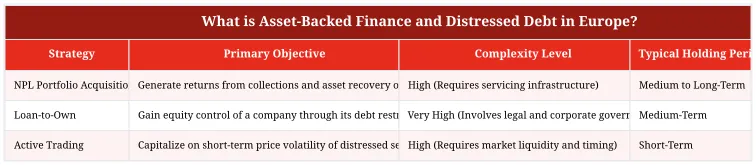
View data as table
| Strategy | Primary Objective | Complexity Level | Typical Holding Period |
|---|---|---|---|
| NPL Portfolio Acquisition | Generate returns from collections and asset recovery on a pool of loans. | High (Requires servicing infrastructure) | Medium to Long-Term |
| Loan-to-Own | Gain equity control of a company through its debt restructuring. | Very High (Involves legal and corporate governance) | Medium-Term |
| Active Trading | Capitalize on short-term price volatility of distressed securities. | High (Requires market liquidity and timing) | Short-Term |
Key European NPL Markets and Opportunities
The European NPL market varies by region. Southern European countries like Italy, Spain, and Greece hold the largest volumes of NPLs, creating a mature market for portfolio transactions. Markets in the DACH (Germany, Austria, Switzerland) and Nordic regions have lower NPL ratios but present opportunities in specific sectors or single-name situations.
Central and Eastern Europe (CEE) has growing economies and evolving legal frameworks. Investor success depends on local partnerships and understanding jurisdictional nuances in insolvency law and asset recovery processes. See our analysis of the European NPL market’s challenges and opportunities.
Asset-Backed Securities (ABS) and Securitisation in Europe
Securitisation is pooling contractual debt (such as mortgages, auto loans, or credit card debt) and selling its cash flows to investors as securities. This process is fundamental to asset-backed finance and managing loan portfolios, including NPLs.
Types of European Asset-Backed Securities and Their Structures
Key types of European asset-backed securities (ABS) include:
- Residential Mortgage-Backed Securities (RMBS): Secured by pools of residential mortgages.
- Commercial Mortgage-Backed Securities (CMBS): Backed by mortgages on commercial properties.
- Collateralized Loan Obligations (CLOs): Supported by a portfolio of leveraged corporate loans.
- Esoteric ABS: Backed by a wider range of assets, including auto loans, credit card receivables, trade finance, and even intellectual property rights.
Each structure is tranched, split into different risk levels. Senior tranches offer lower yields but higher credit protection, while junior (or equity) tranches offer higher potential returns but absorb initial losses.
Securitisation as a Tool for Capital Management and Risk Transfer
For banks and financial institutions, securitisation is a tool for capital management. By packaging and selling assets, they transfer credit risk to investors, freeing up regulatory capital for new lending. This process, known as credit risk transfer (CRT), improves capital allocation efficiency across the financial system.
For institutional investors, securitisation provides access to a broad range of credit exposures. The structured nature of ABS allows investors to target a desired risk-return profile, making it a cornerstone of fixed-income portfolio management. The market for asset-backed finance europe evolves with new structures for investors and originators.
Regulatory Landscape and Risk Management in European ABF
The European Union has a regulatory framework governing structured finance and distressed debt. Navigating these rules is essential for investors and is a topic addressed by experts at DDTalks events.
Key EU Regulations Shaping Asset-Backed Finance and Distressed Debt
The Alternative Investment Fund Managers Directive (AIFMD II) introduces new requirements for funds originating loans, impacting direct lending and private credit strategies. The EU’s NPL Directive establishes a framework for the sale and servicing of non-performing loans to create a more integrated secondary market.
The Capital Requirements Regulation (CRR) and the Securitisation Regulation set standards for how banks and investors must treat these assets. According to the European Banking Authority (EBA), these rules promote transparency and stability. Understanding their implications on fund structuring, due diligence, and reporting is critical.
Assessing and Mitigating Risks in European Special Situations
Investment in these asset classes has inherent risks. For distressed debt, risks include legal challenges to restructuring plans, market risk, and liquidity risk, as these assets can be difficult to sell quickly. In asset-backed finance, primary risks are the credit performance of the underlying assets and prepayment risk, where borrowers repay loans earlier than expected, affecting investor returns.
Risk management involves asset-level due diligence, cash flow modeling, and an understanding of the legal and insolvency regimes in each European jurisdiction. Investors must also account for counterparty risk related to servicers and other transaction parties.
Investment Strategies for European Debt Markets
Institutional investors access European debt markets through several strategies, each with a distinct risk-return profile. Special situations funds and direct lending platforms are prominent channels for deploying capital into these asset classes.
Direct Lending and Special Situations Funds in Europe
Direct lending funds provide credit directly to companies, often filling a gap left by traditional banks. Although focused on performing credit, some funds have flexible mandates to participate in stressed or special situations. This involves providing rescue financing or acquiring debt of companies undergoing operational turnarounds.
Special situations funds focus on event-driven opportunities, including distressed debt. These funds handle complex restructurings and take an active role in a company’s recovery. Their growth has increased capital available for European companies facing financial challenges. These managers focus on effective strategies for navigating NPL portfolios.

View data as table
| Region | Key Market Driver | Regulatory Focus | Servicing Intensity |
|---|---|---|---|
| Southern Europe (Italy, Spain) | High volume of legacy NPLs on bank balance sheets. | Streamlining insolvency and foreclosure processes. | High; requires large-scale, specialized servicers. |
| DACH & Nordics | Sector-specific distress (e.g., commercial real estate, retail). | Robust creditor rights and predictable legal frameworks. | Lower; often focused on single-name or smaller portfolios. |
| Central & Eastern Europe (CEE) | Economic growth cycles and evolving banking sector. | Harmonization with EU standards and investor protection. | Moderate to High; requires strong local partnerships. |
Real Estate Owned (REO) Opportunities
A component of distressed debt, particularly from NPL portfolios, is linked to real estate. Real Estate Owned (REO) assets are properties repossessed by a lender after a borrower defaults on a mortgage. For investors, REO portfolios are a tangible asset class whose value can be unlocked through active management.
REO strategies involve acquiring portfolios at a discount and adding value through refurbishment, repositioning, or completing development projects before selling the assets. This requires a combination of credit investment skills and real estate operational expertise, making it a specialized niche within the distressed debt market.
Connect with European Market Leaders at DDTalks Events
Executing successful investments in asset-backed finance europe and distressed debt requires current market intelligence, industry relationships, and access to deal flow. Targeted industry gatherings provide this.
European Private Credit and Distressed Debt Deal-Making
DDTalks events, such as Private Credit Days Europe in London and Private Credit Day Iberia in Madrid, are for institutional investors, GPs, and LPs. Attendees access panel discussions on regulatory changes, fund structures, and regional opportunities. The networking environment facilitates connections and deal-making among leading financial institutions. To connect with market leaders, explore our upcoming conferences.
Gain the insights needed to navigate Europe’s credit markets. Request Agenda for our next event or contact us to learn about delegate and sponsorship opportunities.
Conclusion
The European asset-backed finance and distressed debt landscape in 2026 is shaped by regulatory pressures, economic cycles, and investor appetites. Institutional investors must strategically allocate capital while managing jurisdictional and operational complexities. Success requires domain expertise, due diligence, and a network of local partners. Investors should engage with market players for real-time insights. To stay ahead of market trends and build connections, Request Agenda for our specialized forums. Learn more by visiting DDTalks.
Frequently Asked Questions
Which asset classes currently show the most potential in European asset-backed finance?
Beyond traditional trade receivables and equipment leases, significant opportunity exists in financing more specialized assets. These include recurring revenue streams from software-as-a-service (SaaS) contracts, intellectual property rights, and inventory finance, areas where traditional bank lending has pulled back, creating a gap for private credit funds.
How do insolvency frameworks in Spain and Italy impact distressed debt recovery?
The legal frameworks are distinct and heavily influence strategy. Italy’s market has been shaped by state-backed initiatives like the GACS scheme to facilitate NPL securitisations, while Spain’s framework includes well-defined pre-insolvency proceedings (“pre-concurso”) that can offer different restructuring opportunities for investors before a formal bankruptcy.
What are the key differences between public securitisation and private asset-backed finance in Europe?
Public securitisation involves issuing rated, publicly traded securities that must comply with strict transparency rules under the EU Securitisation Regulation. In contrast, private asset-backed finance europe typically involves unrated, bilateral or club-style deals negotiated directly between an originator and institutional investors, offering more structural flexibility but less liquidity.
How did the EU’s STS Regulation affect the market for asset-backed securities?
The Simple, Transparent and Standardised (STS) framework, part of the EU Securitisation Regulation, was designed to restore investor confidence post-2008. It created a quality label for securitisations meeting specific criteria, which can result in preferential regulatory capital treatment for institutional investors like banks and insurance companies under frameworks such as Solvency II.
What discount to face value is common for non-performing loan (NPL) portfolios in Southern Europe?
Pricing varies dramatically based on the underlying collateral and jurisdiction. Unsecured consumer NPL portfolios often trade at low single-digit percentages of their gross book value (GBV). In contrast, portfolios of loans secured by commercial real estate trade at significantly higher, more variable prices that depend on asset quality and the expected legal recovery timeline.
Can distressed debt itself be used as collateral in an asset-backed structure?
Yes, this is a common strategy known as Non-Performing Loan (NPL) securitisation. In this structure, an investor acquires a portfolio of distressed loans and then issues notes backed by the anticipated cash flows from the recovery and workout process. This allows funds to leverage their workout expertise and is a frequent topic among specialists from firms like Ares Management at industry events.




0 Comments