

Approaching Lps at Conferences: Maximizing Networking for Capital Raising
Approaching LPs at conferences is a strategic imperative for General Partners seeking capital. This guide details how to effectively identify and engage limited partners during crucial networking breaks. Learn to leverage pre-event intelligence to target high-value institutional investors like pension funds and endowments, aligning their mandates with your fund’s strategy in sectors such as European private credit and distressed debt. The article outlines mastering the initial approach, understanding what LPs seek, and securing follow-up discussions, transforming brief interactions into meaningful capital raising opportunities. Effective approaching LPs at conferences maximizes fundraising efficiency.
DD Talks specializes in organizing elite B2B financial conferences across Europe, facilitating high-value deal-making and networking between top-tier GPs and LPs. Our events provide direct access to key decision-makers in private credit, NPL, and distressed debt markets.
To explore your options, contact us to schedule your consultation. You can also reach us via: Request Agenda
The Strategic Imperative of Approaching LPs at Conferences
For General Partners (GPs), approaching LPs at conferences is key to capital raising. These events condense months of outreach into days, offering direct access to decision-makers from pension funds, endowments, and family offices seeking allocations in markets like European private credit and distressed debt.
Unstructured time during coffee and lunch breaks is the most valuable opportunity for these interactions. These moments allow for dialogue and rapport-building. Success requires preparation, strategy, and understanding the LP’s perspective. The goal is to start a conversation that warrants a follow-up, not to close a deal.
Key objectives for GPs during networking breaks include:
- Validating Interest: Gauge if an LP’s mandate aligns with your fund’s strategy.
- Building Rapport: Establish a personal connection.
- Demonstrating Expertise: Convey market knowledge and a differentiated investment thesis.
- Securing the Next Step: End the conversation with a plan for a future discussion.
How Do GPs Identify High-Value LPs Before an Event?
Productive conference interactions are not accidental; they result from pre-event research and targeting. GPs with a prioritized list of LPs outperform those relying on chance. This preparation makes networking breaks efficient capital raising opportunities.
The process begins when the attendee list is available. This list is a strategic map for fundraising. Systematic analysis identifies relevant allocators. This is a critical step in a GP’s playbook for sourcing deals at distressed debt conferences and raising capital.
Leveraging Pre-Event Intelligence for LP Targeting
Segment the attendee list. Filter for target organizations: pension funds, endowments, foundations, insurance companies, and family offices. Within these organizations, identify decision-makers by titles like ‘Head of Private Assets,’ ‘Portfolio Manager, Alternatives,’ or ‘Director of Private Credit.’ Then, research each individual and their institution to understand their investment focus, allocation size, and recent sector activity.
Aligning Investment Mandates with Fund Strategy
Cross-reference an LP’s mandate with your fund’s strategy. An LP focused on pan-European large-cap buyouts will not fit a fund specializing in Iberian non-performing loans (NPLs). This alignment check prevents wasted time and shows respect for their mandate.
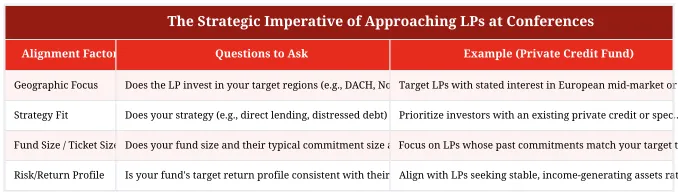
View data as table
| Alignment Factor | Questions to Ask | Example (Private Credit Fund) |
|---|---|---|
| Geographic Focus | Does the LP invest in your target regions (e.g., DACH, Nordics, Iberia)? | Target LPs with stated interest in European mid-market or specific countries like Spain/Portugal. |
| Strategy Fit | Does your strategy (e.g., direct lending, distressed debt) match their allocation bucket? | Prioritize investors with an existing private credit or special situations allocation. |
| Fund Size / Ticket Size | Does your fund size and their typical commitment size align? | Focus on LPs whose past commitments match your target ticket size to ensure relevance. |
| Risk/Return Profile | Is your fund’s target return profile consistent with their objectives? | Align with LPs seeking stable, income-generating assets rather than high-risk venture returns. |
The Initial LP Approach During Networking Breaks
Coffee breaks are high-stakes. With many GPs vying for LP attention, your approach must be polished, respectful, and concise. Success in approaching LPs at conferences requires shifting from “pitching” to “connecting.” The goal is to build rapport to earn a formal post-conference conversation.
Crafting Your Concise Value Proposition
Know what you want to convey. Develop a 30-second introduction stating your name, firm’s focus, and a relevant market insight. This “conversational opener” should pique interest. For instance, mention a trend in the European securitisation market instead of your AUM. Resources from publications like Harvard Business Review offer guidance on crafting pitches.
Navigating Networking Breaks
Body language and situational awareness are critical. Avoid interrupting conversations. Look for open groups or individuals. “Mind if I join you?” is often the best entry. Once engaged, focus on active listening. Ask about their views on a panel or the market before introducing your fund. This shows interest and builds a foundation for dialogue.
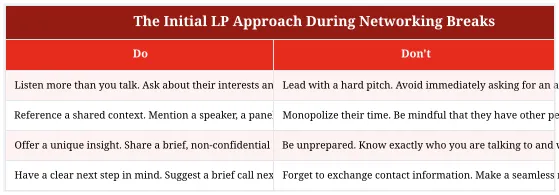
View data as table
| Do | Don’t |
|---|---|
| Listen more than you talk. Ask about their interests and perspective first. | Lead with a hard pitch. Avoid immediately asking for an allocation or launching into a full presentation. |
| Reference a shared context. Mention a speaker, a panel, or a market trend discussed at the event. | Monopolize their time. Be mindful that they have other people to meet. Keep the initial chat to 5-7 minutes. |
| Offer a unique insight. Share a brief, non-confidential observation about your niche market. | Be unprepared. Know exactly who you are talking to and why their mandate is a potential fit. |
| Have a clear next step in mind. Suggest a brief call next week to continue the discussion. | Forget to exchange contact information. Make a seamless request to connect on LinkedIn or exchange cards. |
What Do Institutional Investors Seek in a General Partner?
Beyond strategy, institutional investors evaluate a GP’s team, process, and culture. A successful first meeting builds trust in these areas. LPs allocate capital for a decade or more and seek long-term partners, not just a financial product. Understanding their due diligence priorities helps frame your conversation.
At DDTalks events, where LPs and GPs converge, conversations move beyond surface-level metrics. Investors test a manager’s expertise and operational robustness from the first interaction. They want a clear, repeatable process for sourcing, execution, and risk management.
Key Criteria for LP Due Diligence
LP core evaluation criteria are consistent. They seek evidence of a durable competitive advantage. This includes a stable, experienced team with a history of working together, a differentiated investment strategy, and operational infrastructure for compliance and reporting. A well-defined ESG integration policy is also a critical due diligence component, as noted by the Institutional Limited Partners Association (ILPA).
Building Trust and Demonstrating Expertise
In specialized fields like NPLs or asset-backed finance, demonstrating domain expertise is paramount. Be prepared to discuss specific deals (on a no-names basis), navigate regulatory questions like AIFMD II, and articulate your view on market dislocations. This proves you are not a generalist. An investor must be confident you have an informational or operational edge in your niche. This is true when discussing institutional investor allocation to European private credit, where specialization is valued.
Post-Conference Follow-Up & Relationship Building
The post-event follow-up is a critical phase of capital raising. A prompt, professional, and personalized follow-up solidifies your impression and moves the conversation to the due diligence pipeline. Failure to follow up can negate your conference efforts.
The goal is to build a long-term relationship from a brief encounter. This requires a systematic approach to investor relations. Platforms like DDTalks facilitate these connections, providing a forum for GPs and LPs to deepen relationships in European hubs like London and Madrid.
Strategic Follow-Up for Lasting Connections
Send a follow-up email within 24-48 hours. Personalize it by referencing your conversation. Keep it concise and focused on the next step: a call, a one-pager, or data room access. Avoid generic emails or large attachments.
Transforming Conference Interactions into Partnerships
Capital raising is a marathon, not a sprint. The initial conference contact is the first touchpoint in a relationship that may take months or years to cultivate. Use the follow-up to provide value. Share a relevant article, offer an introduction, or provide an update on a market trend you discussed. This long-term approach shows you are focused on building a partnership, not just securing a commitment. Consistent engagement is key to moving from a first meeting to a closing.
Secure Your Spot at Premier European Events
Practicing in a high-value environment is the most effective way to approach LPs at conferences. Our events, from Private Credit Days Europe in London to our NPL and Distressed Debt forums in Madrid, bring together active institutional investors and leading General Partners. These events provide a platform to implement these strategies, build relationships, and accelerate your capital raising. Connect with decision-makers in European private markets.
Explore our upcoming events to find the right venue for your fund. You can also apply for securing an LP or borrower pass for our exclusive gatherings. Request Agenda
Conclusion
Success connecting with LPs at events requires preparation, professionalism, and persistence. GPs should prioritize quality of interaction over quantity. A few meaningful, well-researched conversations yield better results than meeting everyone. Translate this framework into action: start pre-conference research early, refine your value proposition, and commit to a disciplined follow-up process. To test these skills, contact us to learn about our upcoming European financial conferences or Request Agenda for a specific event.
Frequently Asked Questions
How can a GP use an event’s delegate list to find LPs with a specific mandate?
Before the event, filter the attendee list by institution type, such as pension fund, endowment, or family office, and look for titles like ‘Head of Private Assets’ or ‘Portfolio Manager, Alternatives’. Cross-reference these contacts with data from platforms like Preqin to confirm their firm’s stated interest in your specific strategy, such as European distressed debt or asset-backed finance.
What is an effective opening line when meeting an LP during a coffee break?
Avoid a direct sales pitch and instead open with a relevant, content-driven question about a recent panel. For example, ask, “I found the discussion on AIFMD II’s impact on securitisation insightful; what was your key takeaway?” This demonstrates you are an engaged participant and invites a peer-to-peer conversation rather than a solicitation.
Beyond the elevator pitch, what specific fund metrics do LPs focus on in a first conversation?
Sophisticated LPs are interested in the drivers behind your performance, not just top-line numbers. Be prepared to discuss key metrics like Net IRR and MOIC, but also be ready to explain your specific deal sourcing process and risk management framework. For instance, an LP might probe your methodology for underwriting non-performing loan portfolios in the Iberian market.
What is the biggest red flag for an LP when a GP approaches them at an event?
The most significant red flag is a generic approach that reveals a lack of basic research into the LP’s mandate. Approaching an investor whose public filings or recent interviews clearly state a focus on US venture capital to pitch a European private credit fund wastes their time. This signals a lack of preparation and professionalism that can damage your firm’s reputation.
How soon should a GP follow up after a brief conference meeting with an LP?
You should send a personalized follow-up email within 24 to 48 hours to remain top-of-mind. Reference a specific point from your conversation to re-establish context and, instead of immediately sending a full data room, suggest a brief introductory call. This respects the LP’s time and moves the relationship forward methodically.
Is it better to approach LPs alone or with a colleague at a networking event?
Approaching LPs at conferences is typically more effective when done by a single partner to foster a direct, personal connection. A one-on-one conversation feels more natural during a networking break, whereas approaching as a group can seem overly aggressive. A colleague should only join if they possess specific technical expertise that is directly relevant to a known interest of that particular LP.

0 Comments