

Asset-backed Finance Solutions: Optimizing Liquidity for European Growth
Asset-backed finance solutions provide crucial liquidity for businesses by leveraging balance sheet assets like accounts receivable and inventory. This article details how these mechanisms, including receivables and inventory financing, enable companies to optimize working capital without traditional debt. Understanding asset-backed finance solutions is vital for European SMEs seeking flexible capital to fund operations and growth. It also explores the strategic role of ABF within the broader European private credit landscape, offering insights into effective implementation for enhanced financial agility.
DD Talks organizes premium B2B financial conferences, connecting institutional investors and General Partners with expertise in European private credit, NPL, and structured finance markets. Our events facilitate high-value deal-making and industry networking, providing authoritative insights into complex financial strategies like asset-backed finance.
To explore your options, contact us to schedule your consultation. You can also reach us via: Request Agenda
What are Asset-Backed Finance Solutions for Working Capital?
Asset-backed finance solutions are corporate finance mechanisms that allow a business to generate liquidity by using its balance sheet assets, primarily accounts receivable and inventory, as collateral. This approach provides working capital without diluting equity or incurring traditional debt, enabling companies to manage cash flow, fund operations, and pursue growth opportunities.
Defining Asset-Backed Finance (ABF) for Corporate Liquidity
Asset-Backed Finance (ABF) is a funding method where a company secures financing based on the value of its tangible or financial assets. Unlike traditional bank loans that rely on a company’s overall creditworthiness and historical profitability, ABF focuses on the quality and value of the specific assets being leveraged.
This structure helps manage working capital because it converts illiquid assets—money tied up in unpaid invoices or unsold stock—into immediate cash. For businesses with long payment cycles or seasonal inventory builds, ABF provides a flexible, scalable source of capital that grows with sales and operations.
Primary Solutions: Receivables and Inventory Financing Explained
The two principal forms of ABF for working capital are receivables financing and inventory financing. Each addresses a different part of a company’s operating cycle.
- Receivables Financing: This involves using a company’s accounts receivable (outstanding customer invoices) to secure funding. The most common forms are factoring, where invoices are sold to a financier at a discount, and invoice discounting, where a loan is advanced against the value of the receivables ledger.
- Inventory Financing: This method uses a company’s stock—including raw materials, work-in-progress, or finished goods—as collateral for a loan or line of credit. It is useful for businesses that need to purchase large amounts of inventory to meet demand, such as manufacturers, wholesalers, and retailers.
How Do Receivables and Inventory Financing Work in Practice?
Both methods are designed to accelerate the cash conversion cycle, but they function in distinct ways.
Mechanics of Receivables Financing: Unlocking Cash from Invoices
Receivables financing provides immediate liquidity against future customer payments. The process follows these steps:
- Invoice Generation: A company provides goods or services to its customer and issues an invoice with standard payment terms (e.g., 30, 60, or 90 days).
- Submission to Financier: The company submits the invoice or a batch of invoices to a finance provider (a factor or a lender).
- Cash Advance: The financier advances 80-90% of the invoice’s face value to the company, often within 24-48 hours.
- Collection: In a factoring arrangement, the financier manages collections directly with the end customer. In invoice discounting, the company retains control of its sales ledger and collections, maintaining the customer relationship.
- Final Settlement: Once the customer pays the invoice in full, the financier remits the remaining balance to the company, minus their fees and interest.
This structure improves cash flow, can outsource credit control, and reduces the risk of bad debt, depending on the facility type (recourse vs. non-recourse).
Leveraging Inventory for Liquidity: Stock as Collateral
Inventory financing allows businesses to borrow against the value of their stock. The structure depends on the inventory’s type and location. In-transit inventory financing bridges the gap between supplier payment and when goods arrive for sale.
Common methods include:
- Blanket Lien: A lender places a general lien on all of a company’s inventory, providing a revolving line of credit based on a percentage of the inventory’s appraised value.
- Floor Planning: Used for high-value, serialized goods like vehicles or heavy machinery. The lender finances each item, and the loan for that item is repaid when it is sold.
- Warehouse Financing: Inventory is stored in a public warehouse or a segregated area on the borrower’s premises under the control of a third-party collateral manager, which gives the lender greater security over the collateral.
Lenders value inventory using a “net orderly liquidation value” (NOLV) to determine the borrowing base, accounting for the costs of selling the inventory in a distressed scenario.
Asset-Backed Finance vs. Asset-Based Lending: Key Differences and Benefits
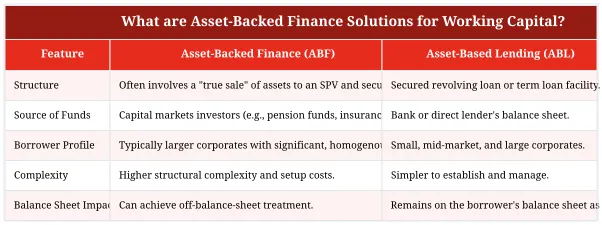
Asset-Backed Finance (ABF) and Asset-Based Lending (ABL) are often used interchangeably but represent different corporate finance structures. ABL is typically a secured commercial loan, while ABF can involve complex capital markets transactions.
Differentiating ABF and ABL Structures and Scope
The primary difference between ABF and ABL is the transaction structure and capital source. ABL is direct lending where a company obtains a revolving line of credit from a bank or specialist lender, secured by assets like receivables and inventory. The funding remains on the lender’s balance sheet.
In contrast, ABF often involves a “true sale” of the assets to a special purpose vehicle (SPV). This SPV then issues securities to capital markets investors, a process known as securitisation. This structure isolates the assets from the originator’s bankruptcy risk, often resulting in a higher credit rating and lower cost of funds. For more detail, explore the evolution of asset-based lending in European private credit.
View data as table
| Feature | Asset-Backed Finance (ABF) | Asset-Based Lending (ABL) |
|---|---|---|
| Structure | Often involves a “true sale” of assets to an SPV and securitisation. | Secured revolving loan or term loan facility. |
| Source of Funds | Capital markets investors (e.g., pension funds, insurance companies). | Bank or direct lender’s balance sheet. |
| Borrower Profile | Typically larger corporates with significant, homogenous asset pools. | Small, mid-market, and large corporates. |
| Complexity | Higher structural complexity and setup costs. | Simpler to establish and manage. |
| Balance Sheet Impact | Can achieve off-balance-sheet treatment. | Remains on the borrower’s balance sheet as debt. |
Strategic Advantages of ABF for Corporate Borrowers and Investors
For corporate borrowers, ABF provides access to larger, more diverse capital pools than traditional ABL. Off-balance-sheet financing can improve key financial ratios. For institutional investors, asset-backed securities (ABS) offer a diversified yield source, with risk profiles tailored through tranching for different investment mandates. The ABF market is a focus for private credit funds and structured finance teams.
The Strategic Role of ABF in European Private Credit Markets
Non-bank lending is a key capital source in Europe. Asset-backed finance solutions provide liquidity to businesses and offer secured investment opportunities for the private credit community.
ABF as a Catalyst for European SME and Corporate Growth
Access to traditional bank financing for European SMEs and mid-market corporates can be constrained by rigid credit assessments and capital requirements. Asset-backed financing provides an alternative, allowing companies to use working capital assets to fund growth, manage seasonal peaks, or navigate economic uncertainty.
In markets with a strong SME backbone, this funding can fuel innovation and expansion. The growth of alternative credit supports these businesses, as seen in the development of Italian SME financing. By focusing on asset quality over historical performance, ABF providers can support viable companies that may not fit standard bank lending models.
Institutional Investor Perspectives on European ABF Opportunities
The European ABF market offers investors a secured asset class with predictable cash flows and attractive risk-adjusted returns. The dialogue between GPs, LPs, and corporate borrowers is a core topic at industry events like those hosted by DDTalks.
Private credit funds are active in this space, providing bespoke, scalable facilities that banks may be unable to offer. These funds have specialized underwriting expertise to assess complex asset pools, from trade receivables to esoteric assets. Our investor’s guide to asset-backed finance in Europe details these market nuances.
Optimizing Working Capital: Implementing ABF for European Businesses
Implementing asset-backed financing requires assessing business needs, asset quality, and potential financing partners. The goal is to structure a facility that aligns with the company’s operational rhythm and strategic goals.
Key Considerations for Selecting the Right ABF Solution
The choice between receivables, inventory, or other asset-backed structures depends on the asset type. Assets used for ABF include trade receivables, inventory, equipment leases, auto loans, and sometimes intellectual property rights, provided they generate predictable cash flows.
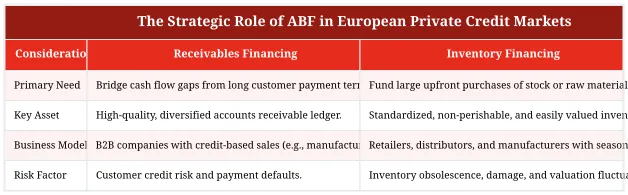
Businesses must evaluate their asset concentration, customer credit quality (for receivables), and inventory turnover rates. A company with a diverse base of high-quality debtors is an ideal candidate for receivables financing, while a manufacturer with significant raw material stock may be better suited for inventory financing.
View data as table
| Consideration | Receivables Financing | Inventory Financing |
|---|---|---|
| Primary Need | Bridge cash flow gaps from long customer payment terms. | Fund large upfront purchases of stock or raw materials. |
| Key Asset | High-quality, diversified accounts receivable ledger. | Standardized, non-perishable, and easily valued inventory. |
| Business Model | B2B companies with credit-based sales (e.g., manufacturing, wholesale, business services). | Retailers, distributors, and manufacturers with seasonal or long production cycles. |
| Risk Factor | Customer credit risk and payment defaults. | Inventory obsolescence, damage, and valuation fluctuations. |
Navigating the ABF Process and Partner Selection in Europe
Securing asset-backed finance involves a due diligence phase where the provider assesses asset quality and the company’s internal controls and reporting systems, followed by structuring and legal documentation. European providers include international banks, specialized non-bank lenders, and private credit and direct lending funds.
Selecting the right partner requires finding providers with expertise in the specific industry and asset class. A good partner offers capital, structural flexibility, and scalability. Experienced legal and financial advisors help navigate documentation and optimize the structure for the company’s needs.
Unlock Liquidity and Growth: Engage with European ABF Leaders at Our Conferences
Asset-backed finance helps companies increase liquidity, optimize balance sheets, and fuel growth. For institutional investors and private credit managers, it is an opportunity for secured, yield-generating capital deployment in Europe.
DDTalks conferences are a platform for deal-making and strategic discussions in European private credit, structured finance, and distressed debt. At our events, you can engage directly with the GPs, LPs, and advisors in asset-backed finance.
Discover the latest trends and connect with key decision-makers. Request Agenda for our upcoming events in London, Madrid, and across Europe.
Conclusion
A corporate borrower must decide how to structure asset-backed financing to align with strategic objectives. The choice between an ABL facility and an ABF securitisation depends on scale, cost-benefit analysis, and the need for capital markets access. Investors must perform due diligence on the underlying assets and servicer capabilities. The sophistication and application of these financial instruments will expand as the European private credit market matures.
To learn more and connect with leaders in this space, contact us about our conferences or Request Agenda for our next event.
Frequently Asked Questions
How does asset-backed finance differ from asset-based lending (ABL)?
The primary distinction lies in the legal structure and recourse. Asset-backed finance (ABF) often involves a “true sale” of assets to a Special Purpose Vehicle (SPV), legally separating them from the originator’s bankruptcy risk. Asset-based lending (ABL) is typically a secured revolving line of credit where the assets remain on the company’s balance sheet, and the lender has recourse to the company itself.
What is a typical advance rate for inventory financing in the European market?
Advance rates for inventory financing in Europe are not standardized and depend heavily on the asset quality. For highly liquid, easily valued inventory like standard commodities, rates may be higher, while specialized or perishable goods will command a lower rate. Lenders, including many private credit funds present at our forums, determine this “borrowing base” after rigorous due diligence on the inventory’s marketability and depreciation.
Can asset-backed financing be used for intangible assets like intellectual property?
Yes, though it is a more complex and specialized area of structured finance. Financing against intangible assets like patents, trademarks, and royalty streams is possible but requires sophisticated valuation and legal structuring. These transactions are often led by specialist private credit funds and investment banks that focus on IP-rich sectors like technology and pharmaceuticals.
How are cross-border receivables managed in European asset-backed finance solutions?
Cross-border asset-backed finance solutions require careful structuring to navigate varying legal and tax jurisdictions across Europe. Lenders often use a master trust or a multi-jurisdictional SPV and require legal opinions from counsel in each relevant country, such as those from firms attending DD Talks events. The process must account for differences in insolvency laws, like the UK’s PPSA framework versus civil law systems in Spain or Italy.
What role do private credit funds play in providing these financing structures?
Private credit funds are major providers of flexible and bespoke asset-backed finance, often stepping in where traditional banks face regulatory constraints. They can offer more tailored terms, handle complex or non-standard asset pools, and provide covenant-lite structures. This agility makes them a crucial source of capital for mid-market companies across the UK and continental Europe.
Is it possible to finance a single, large invoice or contract through ABF?
Yes, financing a single large asset, such as a major government contract or a substantial commercial invoice, is known as single-asset securitization or project finance. This structure isolates the credit risk to that specific contract or receivable, making it attractive for funding large-scale projects or one-off transactions. It allows a company to secure significant liquidity without leveraging its entire book of receivables.



0 Comments