

Call for Papers Mistakes: Elevate Your Conference Submission Strategy
Avoiding common call for papers mistakes is crucial for securing a speaking slot at premier financial conferences. This guide details how to prevent speaker proposal rejection by tailoring submissions to specific event themes, such as European private credit or distressed debt. It emphasizes crafting compelling abstracts with clear takeaways, avoiding generic pitches, and strictly adhering to submission guidelines and deadlines. Understanding these frequent errors significantly increases your chances of presenting valuable insights to an audience of institutional investors and industry leaders.
DD Talks specializes in organizing elite B2B financial conferences focused on European private credit, NPL, and structured finance markets. Our platform provides unparalleled networking and knowledge exchange opportunities for industry professionals.
To explore your options, contact us to schedule your consultation. You can also reach us via: Request Agenda
Understanding Call for Papers: Why Your Pitch Matters
A Call for Papers (CFP) is an invitation from conference organizers to experts to submit presentation proposals. For premium B2B financial conferences, such as those focused on European private credit or distressed debt, the CFP is a quality control mechanism. It ensures the agenda has relevant, timely, and high-value content for an audience of general partners (GPs), limited partners (LPs), and institutional investors.
A well-crafted CFP submission secures a speaking slot and positions you as a thought leader, enhancing your professional visibility and networking potential. Conversely, a poorly executed proposal is quickly discarded, wasting an opportunity.
What is the single most common reason a Call for Papers submission is rejected?
The most common reason for a speaker proposal rejection is a failure to tailor the submission to the conference theme and its audience. Organizers of niche financial events receive many generic pitches that ignore core topics like structured finance or non-performing loans (NPLs). This lack of customization signals to the review committee that the applicant has not invested time to understand the event’s purpose or the challenges faced by its senior-level attendees. Underestimating this alignment is a frequent call for papers mistake.
Why Speaker Proposals Get Rejected: Common Submission Errors
Beyond a lack of tailoring, several other conference submission errors consistently lead to rejection.
Abstract Writing Mistakes and Generic Pitches
A weak abstract is a primary cause of speaker proposal rejection. Vague summaries that lack a clear thesis, specific data points, or actionable takeaways fail to capture the committee’s interest. For a financial conference, a proposal on “The Future of Private Credit” is too broad. A successful pitch might focus on “Navigating AIFMD II: New Fund Structuring Strategies for European Direct Lending.”
Submitting a generic pitch you send to every event is another critical error. Organizers can easily spot these. Your proposal must demonstrate a clear understanding of the event’s unique focus. For more guidance, review our guide on pitching for a speaking slot at a premier European financial conference.
Overlooking Guidelines and Deadlines
Ignoring the rules is the fastest way to get your proposal disqualified. Organizers provide specific guidelines on word count, formatting, required biographical information, and submission deadlines. Failing to adhere to these demonstrates a lack of attention to detail, a trait that does not inspire confidence in a potential speaker.
Deadlines are not suggestions. Conference planning operates on a strict schedule that includes content review, agenda finalization, and marketing material production. A late submission disrupts this process and is almost always rejected without review.
Crafting a Winning Proposal: Best Practices for Financial Experts
Crafting a winning public speaking application requires a proactive, strategic approach. Focus on demonstrating clear value to both the organizers and the audience.
Tailoring Your Content to the Conference Theme and Audience
Thoroughly research the conference. Analyze past agendas, speaker lists, and sponsor profiles. If the event is DD Talks’ Private Credit Days Europe, your topic should directly address challenges and opportunities within the European private credit market. Understand the audience seniority; a presentation for LPs and GPs requires a different level of technical depth than one for a broader corporate audience.
Your proposal should explicitly state how your insights will benefit attendees. Will you provide a new framework for assessing NPL portfolios? Offer a data-driven forecast on asset-backed finance trends? Connect your topic to the business objectives of the delegates.
Developing Engaging Titles and Clear Takeaways
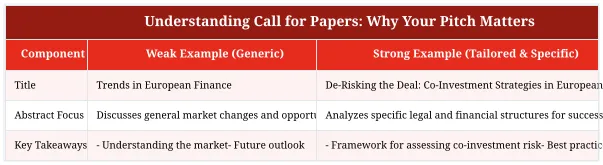
Your title is the first thing the review committee sees. It must be compelling and descriptive. Instead of a generic title, opt for one that promises a solution or a unique insight.
The abstract should be structured logically. Start with the core problem or question your presentation will address. Follow with your proposed solution, methodology, or perspective. Conclude with three to five bullet points summarizing the key takeaways the audience will gain. This clarity helps the committee quickly grasp the value of your session.
View data as table
| Component | Weak Example (Generic) | Strong Example (Tailored & Specific) |
|---|---|---|
| Title | Trends in European Finance | De-Risking the Deal: Co-Investment Strategies in European Mid-Market Private Credit |
| Abstract Focus | Discusses general market changes and opportunities. | Analyzes specific legal and financial structures for successful co-investments, addressing GP/LP alignment. |
| Key Takeaways | – Understanding the market – Future outlook |
– Framework for assessing co-investment risk – Best practices for negotiating term sheets – Outlook for co-investment activity in 2026 |
The DD Talks Perspective: What Organizers Seek in Speakers
As organizers of premium B2B financial conferences in London and Madrid, the DD Talks Event Committee evaluates hundreds of proposals annually. Our primary goal is to build an agenda that facilitates high-value deal-making and provides actionable market intelligence. This objective shapes our selection criteria.
The most significant red flag is a proposal that is a thinly veiled sales pitch. Our attendees, who include senior decision-makers from firms like Blackstone and PIMCO, pay to gain insights, not to listen to product demos. Presentations must be educational and offer thought leadership. Any promotional content should be reserved for sponsored sessions, which are clearly designated.
Beyond the Pitch: Demonstrating Industry Expertise
We identify experts by the depth and specificity of their proposals. A strong submission goes beyond reciting publicly available information. It presents a unique perspective backed by practical experience, proprietary (but non-promotional) data, or a forward-looking analysis. For example, a proposal on regulatory changes would not just summarize the Alternative Investment Fund Managers Directive (AIFMD); it would offer a strategic analysis of its impact on fund structuring and capital flows in the DACH region.
Expertise is also demonstrated by a willingness to engage with complex issues, offering a nuanced view rather than simplistic answers. This provides value to an audience of seasoned financial professionals.
Maximizing Your Impact: Beyond Just Getting Accepted
Securing a speaking slot at a premier financial conference is a strategic opportunity. The value lies in leveraging the platform to enhance your professional standing, generate business opportunities, and expand your network.
Building Your Brand and Expanding Your Network
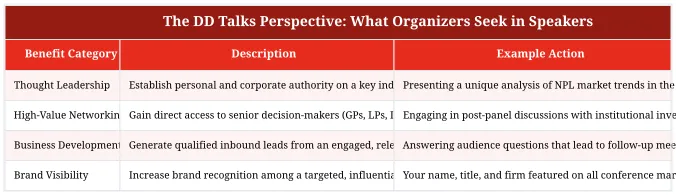
An insightful presentation positions you and your firm as authorities in your niche. This visibility can attract inquiries from potential clients, partners, and investors. The content of your presentation becomes an asset that can be repurposed for marketing and business development.
The networking value is immense. Speakers gain access to other panelists, keynote presenters, and senior delegates. These interactions, often in exclusive speaker lounges or private dinners, can lead to collaborations and high-value relationships that are difficult to forge elsewhere. You can learn more about the caliber of our speakers by reviewing our expert insights from industry leaders.
View data as table
| Benefit Category | Description | Example Action |
|---|---|---|
| Thought Leadership | Establish personal and corporate authority on a key industry topic. | Presenting a unique analysis of NPL market trends in the Iberian Peninsula. |
| High-Value Networking | Gain direct access to senior decision-makers (GPs, LPs, Investment Bankers). | Engaging in post-panel discussions with institutional investors. |
| Business Development | Generate qualified inbound leads from an engaged, relevant audience. | Answering audience questions that lead to follow-up meetings. |
| Brand Visibility | Increase brand recognition among a targeted, influential group. | Your name, title, and firm featured on all conference marketing materials. |
Ready to Share Your Expertise? Submit Your Proposal
If you have expertise in European private credit, NPLs, distressed debt, or structured finance, we invite you to contribute to industry conversations. Speaking at a DD Talks event offers a platform to connect with key players shaping the future of finance.
By avoiding common submission pitfalls and focusing on delivering value, you can secure your place on our agenda. Share your insights, elevate your professional profile, and engage in high-level deal-making and networking.
Conclusion
A successful CFP submission hinges on relevance. Invest time in understanding the conference and its audience before you write. By avoiding these common call for papers mistakes and aligning your expertise with the event’s goals, your proposal becomes a value proposition that organizers cannot ignore.
To learn more about our upcoming events and speaking opportunities, contact us or Request Agenda to see the topics we are currently exploring.
Frequently Asked Questions
Why was my speaker proposal for a private credit conference rejected despite my expertise?
The most common reason is a mismatch between your pitch and the event’s specific theme. A general proposal on “direct lending” is likely to be rejected if the conference, like our London forum, is focused on granular topics like the impact of AIFMD II on fund structuring. The DDTalks Event Committee prioritizes submissions that directly address the niche issues outlined in the official agenda.
How can I showcase my firm’s strategy in a CFP without being overly promotional?
Focus on methodology and market analysis rather than fund performance or assets under management (AUM). For example, explain the innovative covenant structures you developed in response to market volatility. This approach shares educational value, which an audience of institutional investors seeks, and avoids one of the most common call for papers mistakes.
What makes a presentation title compelling for a European distressed debt event?
Specificity and timeliness are critical for standing out to the review committee. A vague title like “NPL Market Update” is weak, whereas “Navigating CEE NPL Markets: A Framework for Valuing Secured vs. Unsecured Portfolios” is strong. It promises actionable, data-driven insights relevant to a sophisticated audience of GPs and LPs.
Are CFP deadlines and formatting rules like word count really that strict?
Yes, they are non-negotiable and often enforced by automated filters before a human review. Due to the high volume of submissions for events featuring institutions like Blackstone and Ares Management, organizers use strict criteria to create a manageable shortlist. Ignoring these rules signals a lack of attention to detail and almost always results in automatic disqualification.
Is it a major error to propose a topic I’ve already presented at another industry event?
It can be a significant misstep unless the content is substantially updated with new data and re-angled for the new audience. Premium B2B conferences promise exclusive insights to delegates paying upwards of €1499. Submitting recycled content devalues the event and can harm your reputation with organizers who prioritize fresh, cutting-edge analysis.
Should I include co-presenters from other firms in my initial CFP submission?
Including a co-presenter, especially one with a complementary perspective like a GP partnering with a legal advisor, can significantly strengthen a proposal. It demonstrates a commitment to a balanced, non-promotional discussion and shows the review committee you understand the value of diverse viewpoints. Be sure to clearly state each speaker’s proposed contribution in the abstract.

0 Comments