

NPL Market Southern Europe: Navigating Distressed Debt Opportunities
The npl market southern europe is undergoing significant transformation, driven by post-crisis deleveraging and evolving regulatory frameworks in Italy, Spain, and Greece. This article explores the unique national strategies, such as Italy’s GACS scheme and the Greek NPL market’s recovery, alongside key mechanisms like NPL securitisation and special servicers. Readers will gain insights into the drivers of non-performing loans, the role of distressed debt investors, and future investment strategies across these dynamic Southern European economies, enabling informed decision-making in this complex asset class.
DDTalks provides authoritative insights into European financial markets, facilitating high-value deal-making and industry networking through premier B2B conferences. Our content reflects deep expertise in private credit, distressed debt, and structured finance, supporting professionals in navigating complex market dynamics.
To explore your options, contact us to schedule your consultation. You can also reach us via: Request Agenda
Understanding the Evolving NPL Market in Southern Europe
The non-performing loan (NPL) market in Southern Europe is shaped by post-crisis bank deleveraging, regulatory oversight, and government initiatives. Banks offload distressed asset portfolios to specialist investors and funds. The market in Italy, Spain, and Greece evolved to strengthen bank balance sheets and create a resilient financial system, attracting international capital for distressed debt.
What Drives NPL Levels in Italy, Spain, and Greece?
High non-performing exposure volumes in these countries resulted from the 2008 financial crisis and subsequent European sovereign debt crisis. These crises led to prolonged recessions, increased unemployment, and corporate defaults, causing a surge in loans borrowers could not service.
Regulatory bodies like the European Central Bank (ECB) implemented stricter capital requirements and provisioning rules. This pressure compelled banks to reduce their NPL ratios by selling large distressed asset portfolios. This created the secondary npl market southern europe, where institutional investors, private equity firms, and credit funds acquire portfolios to generate returns through workout and recovery strategies.
Navigating National NPL Strategies: Italy, Spain & Greece
Despite common drivers, the Southern European distressed asset landscape varies. Each country developed unique mechanisms and regulatory frameworks to manage its NPL stock, creating distinct market characteristics. Government-backed guarantee schemes helped bridge the pricing gap between buyers and sellers, accelerating transaction volumes.
Understanding these national nuances is critical for investors. The table below compares key market features.

View data as table
| Country | Key Government Scheme | Primary Asset Focus | Market Maturity & Investor Focus |
|---|---|---|---|
| Italy | GACS (Garanzia sulla Cartolarizzazione delle Sofferenze) | Secured and unsecured corporate/SME loans; growing focus on Unlikely-to-Pay (UTP) loans. | Mature market with a sophisticated servicing ecosystem. Focus is shifting from legacy bad loans to more complex UTP restructuring. |
| Spain | SAREB (Asset management company, post-crisis) | Real Estate Owned (REO) assets and secured real estate developer loans. | Highly developed market with a strong link to the real estate cycle. Investors often require expertise in both credit and property management. |
| Greece | Project Hercules (Hellenic Asset Protection Scheme – HAPS) | Secured corporate and retail mortgage portfolios. | Rapidly matured post-Hercules. Significant transaction volumes have cleaned up bank balance sheets, with focus now on servicing efficiency. |
Italy’s GACS Scheme and UTP Loans
Italy has one of Europe’s largest NPL markets. The GACS scheme was pivotal, providing a state guarantee on senior tranches of NPL securitisations. This de-risking made portfolios more attractive, enabling Italian banks to offload billions in bad debt. As the stock of bad loans (sofferenze) diminished, market focus shifted to more complex Unlikely-to-Pay (UTP) loans. UTPs represent borrowers in financial difficulty but not yet insolvent, requiring restructuring and turnaround strategies rather than liquidation. This shift demands a different skill set from investors and servicers, focusing on corporate finance and operational turnarounds.
Spanish NPL Portfolios & Real Estate Owned (REO) Assets
The Spanish market is linked to its real estate sector. After its property bubble collapsed, Spanish banks held large portfolios of defaulted developer loans and foreclosed properties, known as Real Estate Owned (REO) assets. Many Spanish NPL portfolios are sold with a significant REO component. Investors need expertise in managing both distressed debt and real estate. Resolution strategies include completing developments, managing rental properties, or selling assets into the retail market. Spain’s servicing infrastructure is well-developed, with major players offering integrated loan and property management.
The Greek NPL Market: From Crisis to Recovery & Opportunity
The Greek NPL market’s transformation has been rapid. Greece reduced one of Europe’s highest NPL ratios in a short period, facilitated by a government strategy of structural reforms and the Hellenic Asset Protection Scheme (HAPS), known as Project Hercules.
This program, modeled on Italy’s GACS, was designed to accelerate NPL securitisation. By providing a public guarantee on the senior notes of NPL securitisations, Project Hercules attracted international investment funds, enabling Greek banks to dispose of large portfolios and clean their balance sheets. The initiative revitalized Greece’s banking sector and created a secondary market for distressed assets.
Project Hercules and the Securitisation Landscape
Under Project Hercules, Greek systemic banks bundled large NPL portfolios and transferred them to special purpose vehicles (SPVs), which issued securities to investors. The government guarantee on the senior tranche was the catalyst, making transactions viable for a broader investor base. This process reduced bank NPL stock and consolidated the Greek NPL market‘s servicing landscape. Independent servicers, often backed by the international funds purchasing the portfolios, now manage most of these assets, focusing on maximizing recoveries through workout strategies.
Key Players & Mechanisms: Securitisation and Special Servicing
Distressed asset portfolio transfers and management rely on NPL securitisation for transactions and special servicers for value recovery. Understanding their interplay is key to how the market functions.
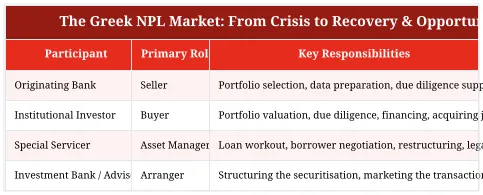
View data as table
| Participant | Primary Role | Key Responsibilities |
|---|---|---|
| Originating Bank | Seller | Portfolio selection, data preparation, due diligence support, transaction execution. |
| Institutional Investor | Buyer | Portfolio valuation, due diligence, financing, acquiring junior/mezzanine notes of securitisations. |
| Special Servicer | Asset Manager | Loan workout, borrower negotiation, restructuring, legal enforcement, asset disposal, reporting. |
| Investment Bank / Advisor | Arranger | Structuring the securitisation, marketing the transaction, connecting buyers and sellers. |
How NPL Securitisation Works and Attracts Investors
NPL securitisation is a structured finance technique where a bank pools a portfolio of non-performing loans and sells it to an SPV. The SPV finances the purchase by issuing different classes, or tranches, of notes to investors. These tranches have varying levels of risk and return. Senior tranches are the safest and offer the lowest yield, while junior and mezzanine tranches carry higher risk but offer the potential for higher returns.
This structure allows investors to participate based on their risk appetite. Conservative investors might purchase government-guaranteed senior notes, while distressed debt funds and private equity firms acquire junior tranches, betting the servicer can recover more than the discounted purchase price. This process transfers credit risk from the bank to capital markets. For more on the broader market, see our overview of the European NPL Market: Challenges and Opportunities.
The Indispensable Role of Special Servicers
Once a portfolio is sold, the special servicer manages the underlying loans. Their objective is to maximize investor recovery value. They achieve this by contacting borrowers to negotiate repayment plans, restructuring loan terms, managing legal proceedings like foreclosure, and overseeing the sale of collateral. Servicer performance is tied to investment profitability, making partner selection critical for buyers.
Expert Outlook: Future Trends & Investment Strategies
The npl market southern europe is maturing. As legacy NPL disposals subside, focus is shifting to new challenges and opportunities. Discussions among industry partners and advisors highlight key trends shaping investment strategies for 2026 and beyond.
New NPL formation is possible from macroeconomic headwinds like inflation and higher interest rates. This could impact economically sensitive sectors, creating a new vintage of distressed assets. The market for “Stage 2” loans—assets with increased credit risk but not yet non-performing—is a leading indicator of future NPL flows.
Navigating New Regulatory Horizons and Market Evolution
The regulatory landscape is evolving. Phasing out government guarantee schemes like GACS and Hercules will test the market’s resilience. Investors and servicers must adapt to a market driven by asset quality and servicing performance, not state-backed de-risking. Focus is growing on specialized asset classes like shipping loans, SME debt, and consumer unsecured credit, which require niche expertise. The convergence of private credit and distressed debt strategies is another theme, as funds seek opportunities across the capital structure. These dynamics are crucial for navigating the asset-backed finance and distressed debt landscape in Europe.
Connect with Industry Leaders at Our Premier NPL Events
Navigating Southern European distressed debt and private credit markets requires timely insights and connections. DD Talks hosts B2B financial conferences in Europe, connecting institutional investors, GPs, LPs, and special servicers. Our events in London and Madrid facilitate deal-making and provide intelligence on market trends, regulatory shifts, and investment strategies. Gain the knowledge and network to capitalize on opportunities. To learn more, contact us or Request Agenda for our next event.
Conclusion
The npl market southern europe has matured from a post-crisis necessity into a sophisticated investment class due to regulatory resolve and market innovation. While large legacy portfolio sales may be concluding, the sector remains dynamic. Investors must now adapt to new asset classes like UTPs, navigate a less government-supported environment, and leverage advanced servicing technologies. Industry professionals should deepen their expertise and strengthen their networks to stay ahead of opportunities. Engage with market leaders at our conferences. Request Agenda or contact us to secure your place.
Frequently Asked Questions
How did ECB regulations specifically accelerate NPL portfolio sales in Southern Europe?
The European Central Bank (ECB), through its Single Supervisory Mechanism (SSM), introduced stringent guidelines on NPL provisioning and classification. These rules increased the capital pressure on banks holding non-performing assets, creating a powerful regulatory incentive to deleverage and sell these portfolios to specialist investors, thus accelerating market activity in Italy, Spain, and Greece.
How did Italy’s GACS scheme de-risk NPL securitisations for investors?
The GACS (Garanzia sulla Cartolarizzazione delle Sofferenze) scheme provided a government guarantee specifically on the senior tranches of NPL securitisation vehicles. By mitigating the credit risk of the safest portion of the investment structure, GACS made these complex financial products significantly more attractive to institutional investors and lowered the cost of funding for the transactions.
What is the difference between UTPs and bad loans in the Italian NPL market?
In Italy, “bad loans” (sofferenze) refer to debt from borrowers deemed permanently insolvent. In contrast, “unlikely-to-pay” (UTP) loans are from borrowers in temporary difficulty who could potentially return to performing status with proper restructuring. This distinction is critical, as UTPs often require a ‘turnaround’ investment strategy rather than a pure liquidation approach.
What asset classes are most common in Spanish NPL and REO portfolios?
The Spanish non-performing loan market is heavily weighted towards assets connected to the 2008 real estate crisis. Portfolios predominantly consist of defaulted residential and commercial mortgages, loans to property developers, and a large volume of Real Estate Owned (REO) assets, which are physical properties that banks have acquired through foreclosure proceedings.
How is the rise of secondary NPL trading impacting the market?
The development of a secondary market, where initial portfolio buyers sell seasoned or re-grouped assets to other investors, is a sign of maturation for the npl market southern europe. This increases liquidity, allows for more specialized strategies, and enables original investors to exit positions and recycle capital. It creates a more dynamic and efficient ecosystem for distressed assets.
What specific role do special servicers play in the Greek NPL market?
In Greece, special servicers are crucial for navigating the country’s historically complex legal and judicial system for debt recovery. Following reforms like the Hercules Asset Protection Scheme, these servicers manage the entire workout process, from borrower negotiations and restructuring to overseeing asset liquidations and foreclosures, thereby unlocking value from the underlying loan portfolios.




0 Comments