

Public Vs Private ABS: Navigating European Securitisation Markets
Understanding the distinctions between public vs private abs markets is crucial for European institutional investors and issuers navigating securitisation. This article details how public asset-backed securities offer broad distribution and higher liquidity, contrasting with private placements characterized by direct negotiation, tailored structures, and faster execution. Key differences in transparency requirements, regulatory oversight, and deal execution speed significantly impact strategic decisions. It explores why market participants choose private placements and current European ABS market trends, providing insights for optimizing securitisation strategies.
DDTalks provides expert insights into European private credit, NPL, and structured finance markets. Our content draws from extensive experience hosting premium B2B financial conferences, connecting industry leaders and facilitating high-value deal-making.
To explore your options, contact us to schedule your consultation. You can also reach us via: Request Agenda
What is the Main Distinction Between Public and Private ABS Markets?
The primary distinction between public and private asset-backed securities (ABS) markets is their distribution method and investor access. Public ABS are offered to a broad range of investors through a registered public offering and are typically listed on a stock exchange. Private ABS are placed directly with a limited number of institutional investors in a non-public, negotiated transaction.
This difference in distribution drives most other variations. The public vs private abs choice impacts regulatory oversight, disclosure requirements, liquidity, and execution speed. A public offering requires extensive documentation and compliance with securities laws to protect a wide range of investors. A private placement, accessible only to qualified buyers, allows for more tailored structures and a streamlined process because it operates under different regulatory exemptions.
Key Differences: Navigating Liquidity, Transparency, and Regulation in ABS
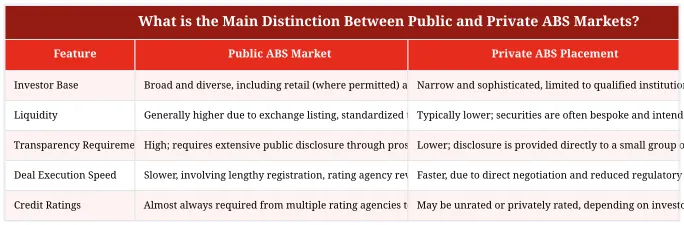
The public and private ABS markets differ in liquidity profiles, transparency requirements, and regulatory frameworks, which influences issuer and investor decisions.
View data as table
| Feature | Public ABS Market | Private ABS Placement |
|---|---|---|
| Investor Base | Broad and diverse, including retail (where permitted) and institutional investors. | Narrow and sophisticated, limited to qualified institutional buyers (QIBs). |
| Liquidity | Generally higher due to exchange listing, standardized terms, and a larger number of potential buyers. | Typically lower; securities are often bespoke and intended to be held to maturity by the initial investors. |
| Transparency Requirements | High; requires extensive public disclosure through prospectuses and ongoing reporting. | Lower; disclosure is provided directly to a small group of investors under confidentiality agreements. |
| Deal Execution Speed | Slower, involving lengthy registration, rating agency review, and marketing processes. | Faster, due to direct negotiation and reduced regulatory filing requirements. |
| Credit Ratings | Almost always required from multiple rating agencies to achieve broad distribution. | May be unrated or privately rated, depending on investor requirements. |
Understanding STS and Securitisation Regulation
The EU Securitisation Regulation introduced Simple, Transparent and Standardised (STS) securitisations. This framework creates a quality label for asset-backed securities that meet specific criteria, granting them more favorable regulatory capital treatment for bank and insurance investors. While the STS label is more common for public deals due to its emphasis on transparency, private transactions can also be structured to meet STS criteria.
Issuers and investors must navigate the European securitisation framework. Ongoing discussions about how to ease securitisation rules aim to revitalize the market, potentially impacting the appeal of public versus private issuance by adjusting compliance burdens and capital requirements.
Why Choose Private? Issuer and Investor Perspectives on ABS Placements
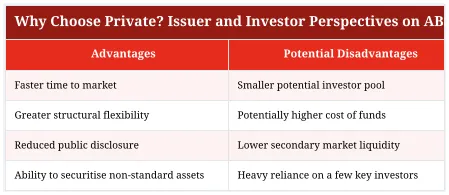
A private ABS placement offers strategic advantages. For issuers, the motivators are efficiency and control; for investors, customization and direct engagement.
Advantages for Issuers: Flexibility and Efficiency
Private transactions are faster than public ones, which require regulatory review and a public marketing period. Flexibility allows issuers to work directly with investors to create bespoke structures, which is useful for esoteric or complex asset classes. Confidentiality is another benefit, as a private placement avoids public disclosure of sensitive portfolio information.
View data as table
| Advantages | Potential Disadvantages |
|---|---|
| Faster time to market | Smaller potential investor pool |
| Greater structural flexibility | Potentially higher cost of funds |
| Reduced public disclosure | Lower secondary market liquidity |
| Ability to securitise non-standard assets | Heavy reliance on a few key investors |
Investor Appeal: Customization and Direct Access
Institutional investors can negotiate terms directly with the issuer to create securities that match specific risk, return, and duration targets. This customization is rarely available in the public market. Investors also gain direct access to the issuer and the underlying asset pool, facilitating deeper due diligence. This direct relationship can lead to future transactions and a collaborative partnership.
European ABS Market Trends: Growth in Private Placements and Regulatory Impact
The European structured finance market has seen growth in private securitisation, fueled by non-bank lenders and private credit funds using securitisation as a financing tool. As these entities grow, their demand for flexible funding solutions makes the private placement route attractive. These transactions often involve asset classes like direct lending, SME loans, and other receivables that benefit from tailored structuring.
Industry events show European credit managers using tailored private securitisation structures to optimize their balance sheets and generate liquidity. This growth contrasts with trends in other regions, like the Australian securitisation market, which has its own drivers and regulatory environment.
The Role of Institutional Investors in European Private ABS
The growth in private ABS is linked to the increasing sophistication of institutional investors. Pension funds, insurance companies, and private credit funds seek yield and have developed the capabilities to analyze and invest in less liquid, more complex securities. These investors value the direct sourcing and due diligence opportunities that private placements provide, allowing them to deploy capital into assets that align with their long-term investment horizons.
Navigating AIFMD II and Other European Regulations
Directives like the Alternative Investment Fund Managers Directive (AIFMD) and its successor, AIFMD II, impact key players in the private ABS space. These regulations govern how fund managers operate, including rules on delegation, liquidity management, and reporting. For managers using securitisation, understanding how these rules interact with the Securitisation Regulation is necessary for compliance and planning. The European Banking Authority (EBA), which oversees these frameworks, aims to ensure financial stability while fostering a robust and transparent market for securitised products.
Optimizing Your ABS Strategy: Deal Execution and Investor Engagement
The choice between a public offering and a private placement dictates the deal execution process. A public deal relies on broad marketing and standardized documentation; a private transaction hinges on targeted investor relationships and bespoke negotiation.
For a private deal, issuers and their advisors cultivate relationships with institutional investors who have an appetite for their specific asset class and risk profile. Understanding these investors’ return hurdles, structural preferences, and due diligence processes is key to a successful placement.
The Arranger’s Role in Private ABS Placements
In a private ABS placement, the arranger or investment bank acts as a strategic advisor and matchmaker, unlike in a public deal where they are underwriters. The arranger’s responsibilities include identifying suitable investors, facilitating direct negotiations between the issuer and investors, and providing guidance on structure and pricing. Their expertise in a negotiated transaction is key to ensuring the final terms meet the objectives of all parties.
Connect with European Structured Finance Leaders at Our Next Event
Connect with general partners, limited partners, and advisors at our next premium B2B conference. Our events provide a platform for networking and deal-making in the European private credit and structured finance sectors. Explore the latest strategies and build relationships.
To learn more about our upcoming agenda and secure your place, Request Agenda.
Conclusion
The choice between a public offering and a private placement for asset-backed securities depends on an issuer’s objectives. The decision is a trade-off: the public market’s broad access and liquidity versus a private transaction’s speed, structural flexibility, and confidentiality. As European markets evolve, the growth of private credit and non-bank lending suggests private securitisation will remain a vital component of the structured finance ecosystem. Market participants should monitor regulatory refinements that could shape the advantages of each path.
For more information on market trends, contact us or Request Agenda for our next event.
Frequently Asked Questions
How do EU regulations affect the choice between public vs private ABS issuance?
Public ABS in Europe must adhere to the strict disclosure and transparency requirements of the EU Securitisation Regulation, including reporting via ESMA templates. Private placements, often defined as those offered to fewer than 150 qualified institutional investors, can be exempt from these public prospectus rules, allowing for a more streamlined execution which is a key factor in the public vs private abs decision.
Which specific asset classes are better suited for private ABS placements?
Non-standard or esoteric asset classes like music royalties, litigation finance, and bespoke SME loan portfolios are often better suited for the private ABS market. The complexity and unique risk profiles of these assets are more easily assessed by sophisticated institutional investors through direct due diligence, rather than through the standardized disclosures required for a public offering.
How does the typical holding period differ for investors in public versus private ABS?
Investors in public ABS benefit from secondary market liquidity, often facilitated by listings on exchanges like Euronext Dublin, allowing for more flexible holding periods. In contrast, private ABS are typically structured as buy-and-hold investments for institutions like pension funds or insurers, who are compensated with an illiquidity premium for holding the security to maturity.
What are the key cost differences when structuring a public versus a private ABS deal?
A public issuance incurs significant upfront costs related to legal counsel, mandatory credit ratings from agencies like Moody’s or Fitch, and exchange listing fees. While private placements avoid many of these initial expenses, the yield offered to investors may be higher to compensate for the deal’s lower liquidity and reduced transparency.
Has the balance between public and private securitisation shifted in Europe recently?
Yes, the European market has seen a significant trend towards private securitisation, especially for asset-backed finance (ABF) solutions. This shift is driven by issuers seeking faster execution and by the growing appetite of private credit funds, which actively seek these tailored, often higher-yielding assets that are not available in the public domain.
How does investor due diligence differ between public and private ABS transactions?
In the public market, investors heavily rely on third-party credit ratings and standardized disclosure documents. For a private ABS transaction, investors conduct their own intensive, bottom-up due diligence, which often includes direct access to the originator’s management and a granular analysis of the underlying asset pool’s data tape.




0 Comments