

Speaking at Finance Conferences: Elevate Your Debt Market Influence
Speaking at finance conferences, particularly European debt summits, offers a strategic pathway to establish thought leadership and drive business development. This article details how to leverage these opportunities for enhanced brand visibility and high-value deal origination within the European debt market. It outlines strategies for securing a speaking slot, crafting compelling proposals on topics like distressed debt and private credit, and mastering your presentation as a panelist or keynote speaker. Effective speaking at finance conferences maximizes impact beyond the podium, fostering crucial networking and positioning your firm as an authority in the sector.
DDTalks specializes in organizing premium B2B financial conferences focused on European private credit, NPL, distressed debt, and structured finance. Our events facilitate high-value deal-making and industry networking among senior decision-makers and institutional investors.
To explore your options, contact us to schedule your consultation. You can also reach us via: Request Agenda
Why Speaking at European Debt Summits Boosts Your Brand & Business?
Speaking at European debt summits establishes authority, enhances brand visibility, and drives business development. It positions you and your firm as experts before a concentrated audience of senior decision-makers, institutional investors, and potential partners in the European debt market.
This engagement creates a platform for substantive dialogue, fostering trust and opening deal origination opportunities inaccessible through other channels. Speaking at finance conferences is a strategic investment in intellectual capital and relationship building.
Establishing Authority & Thought Leadership in Finance
Taking the stage at a specialized financial forum demonstrates command of your subject matter. This public validation builds credibility. Sharing data-driven insights on complex topics like distressed debt restructuring or private credit trends builds a reputation for expertise.
The audience at European debt summits consists of peers, competitors, and potential clients—General Partners (GPs), Limited Partners (LPs), and advisors—seeking credible information. A well-delivered presentation solidifies your firm’s position as an authority, building long-term trust and influence.
Unlocking High-Value Networking & Deal Origination
A speaker badge provides privileged access. It acts as a conversation starter, drawing interested parties to you during networking breaks, lunches, and receptions. This shifts networking from seeking connections to being sought out.
Engaging with attendees who have heard your market perspective creates a warm lead for discussions about potential mandates, co-investment opportunities, or strategic partnerships. The focused environment of a B2B summit ensures these interactions are with relevant professionals, accelerating the deal-making cycle.
How to Secure a Speaking Slot at Top European Debt Forums
Securing a role on the conference agenda requires a strategic approach. Organizers of events like the NPL and Distressed Debt Forums seek speakers who provide actionable insights. The process begins before the call for speakers is announced and hinges on a well-researched proposal.
Crafting a Proposal: Topics in Demand (NPL, Private Credit, Securitisation)
A successful proposal addresses market challenges and opportunities. Research the event’s past agendas and target audience. For 2026, topics include the operational complexities of AIFMD II, workout strategies for distressed commercial real estate, and the revival of private securitisation structures in Spain and Italy.
Your proposal should be specific. Instead of “Private Credit,” propose “Navigating Covenant-Lite Structures in Pan-European Mid-Market Direct Lending.” This demonstrates understanding and value to attendees. Frame your topic as a solution or an insight into a new trend, supported by your experience and data.
Navigating the ‘Call for Speakers’ Process
When the call for speakers opens, a prepared proposal lets you respond quickly. Most organizers use an online submission portal. Your submission should be concise, outlining the presentation’s key takeaways, target audience, and what makes your perspective unique. Highlight your public speaking experience and credentials in the financial sector.
Platforms like DDTalks curate their agendas for quality and relevance. When submitting, emphasize how your contribution provides delegates with expert insights. A well-structured proposal is your primary tool for impressing the event committee.
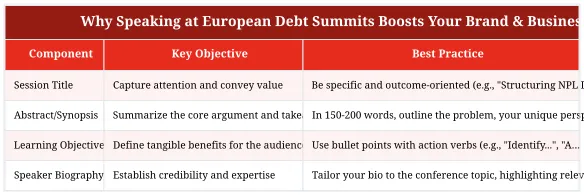
View data as table
| Component | Key Objective | Best Practice |
|---|---|---|
| Session Title | Capture attention and convey value | Be specific and outcome-oriented (e.g., “Structuring NPL Deals in the Iberian Market”). |
| Abstract/Synopsis | Summarize the core argument and takeaways | In 150-200 words, outline the problem, your unique perspective, and what the audience will learn. |
| Learning Objectives | Define tangible benefits for the audience | Use bullet points with action verbs (e.g., “Identify…”, “Analyze…”, “Implement…”). |
| Speaker Biography | Establish credibility and expertise | Tailor your bio to the conference topic, highlighting relevant experience and accomplishments. |
Mastering Your Presentation: From Panel Discussion to Keynote Speaker
Once you secure a slot, the focus shifts to preparation and delivery. Whether you are a keynote speaker or a panelist, the goal is to deliver a clear presentation. Public speaking in a financial context is about clarity, credibility, and substance.
Strategies for Financial Talks
A financial audience values data and actionable insights. Structure your presentation logically, starting with a clear thesis or problem statement. Use clean, easy-to-interpret charts and data visualizations to illustrate complex points. Slides should support your spoken words, not replace them.
Incorporate case studies or real-world examples to make abstract concepts concrete. Conclude with a summary of key takeaways and a forward-looking statement. Rehearsing your timing ensures you deliver your core message within the allotted slot.
Panel Discussions
A panel discussion is a moderated conversation, not a series of mini-presentations. Preparation involves knowing your key points and anticipating fellow panelists’ perspectives. Research their backgrounds and publications. Coordinate with the moderator beforehand to understand the flow and key questions.
During the discussion, be an active listener. Build on points made by others, and respectfully disagree while providing your reasoning. Your contributions should be concise and targeted. Aim to make two or three key points rather than dominate the conversation. This collaborative approach demonstrates confidence and respect.
Maximizing Your Impact: Beyond the Podium at DDTalks Events
The value of speaking at a DDTalks summit extends beyond the time on stage. A strategic approach to pre-event promotion, on-site networking, and post-event follow-up converts visibility from your presentation into business outcomes. The opportunity begins when your name is added to the agenda.
Strategic Networking & Follow-Up for Deal-Making
Before the event, use your firm’s marketing channels and your LinkedIn profile to announce your speaking engagement. This alerts your network and can help schedule meetings in advance. During the conference, make yourself available during breaks. Referencing your talk can initiate conversations.
Post-event follow-up is critical. Connect on LinkedIn with people you met, referencing your conversation. For high-priority contacts, a personalized email can continue the dialogue. Strategic networking transforms a speaking opportunity into a business development engine.
Comparing Speaking Roles: Keynote vs. Panelist at European Debt Summits
Choosing the right format depends on your goals, experience, and message. Both keynote and panelist roles offer distinct advantages. Understanding these differences helps you target the best opportunities for your objectives.
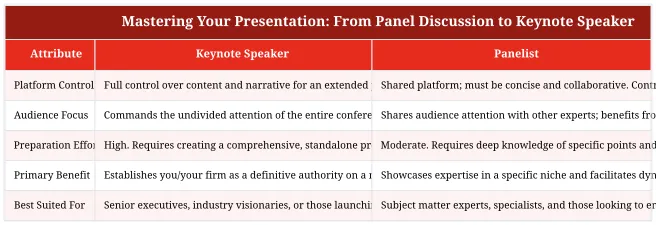
View data as table
| Attribute | Keynote Speaker | Panelist |
|---|---|---|
| Platform Control | Full control over content and narrative for an extended period (e.g., 30-45 minutes). | Shared platform; must be concise and collaborative. Contributions are part of a larger conversation. |
| Audience Focus | Commands the undivided attention of the entire conference delegation. | Shares audience attention with other experts; benefits from diverse perspectives. |
| Preparation Effort | High. Requires creating a comprehensive, standalone presentation from scratch. | Moderate. Requires deep knowledge of specific points and coordination with a moderator. |
| Primary Benefit | Establishes you/your firm as a definitive authority on a major topic. Maximum brand visibility. | Showcases expertise in a specific niche and facilitates dynamic exchange with industry peers. |
| Best Suited For | Senior executives, industry visionaries, or those launching a major report or initiative. | Subject matter experts, specialists, and those looking to engage in nuanced industry debate. |
What Topics Are Driving Discussion at European Debt Summits in 2026?
To secure a speaking slot, your proposed topic must be timely, relevant, and forward-looking. Conference organizers prioritize content that addresses the concerns and strategic planning of their delegates. For 2026, discussions in the European debt market focus on regulatory adaptation, sector-specific distress, and financing structures.
Key Trends in Private Credit, NPL, and Structured Finance
The private credit landscape is focused on specialization. Topics include the growth of asset-backed finance (ABF), direct lending strategies in Central and Eastern Europe (CEE), and private debt performance in a shifting interest rate environment. For Non-Performing Loans (NPLs), the focus is on secondary markets, servicing technology, and opportunities in distressed real estate, particularly in the Iberian Peninsula. The resurgence of private securitisation for capital relief and funding is also a theme, as detailed in our in-depth panels on NPL and distressed debt.
Regulatory Shifts & Market Dynamics Shaping the European Debt Landscape
Regulatory evolution remains a dominant theme. The impact of the Alternative Investment Fund Managers Directive II (AIFMD II) is a critical topic, as delegates want to understand its implications for loan origination, delegation, and liquidity management. According to the European Securities and Markets Authority (ESMA), these updates aim to enhance the AIFM framework. Proposals that demystify these regulations and offer practical compliance strategies are valued.
Macroeconomic factors such as inflation, geopolitical risk, and their impact on credit quality and deal flow across Europe are central to the conversation. Speakers who connect these macro trends to investment strategies in regions like the DACH or Nordics will interest organizers and attendees.
Elevate Your Profile: Speak at a DDTalks European Debt Summit
Presenting at a DDTalks event places you at the center of the European private credit, NPL, and structured finance communities. Our summits in London, Madrid, and other financial capitals are curated to facilitate deal-making and knowledge exchange among industry leaders. We provide a platform for experts to share insights with an audience of decision-makers.
If you have a perspective on European debt challenges and opportunities, explore our speaking opportunities. Share your expertise, build your profile, and connect with market leaders. You can book your ticket to attend our next event or contact our team to discuss potential speaking roles.
Conclusion
Speaking at finance conferences is a strategic decision. It requires developing unique insights and preparing to deliver them. The key criterion is whether the event’s audience aligns with your firm’s business development goals. For professionals in the European debt market, the benefits—from establishing thought leadership to accelerating deal origination—are clear. Identify a shortlist of summits and craft a proposal that showcases your expertise. To learn more about our upcoming agendas and speaker opportunities, contact us or Request Agenda.
Frequently Asked Questions
What specific NPL or distressed debt topics are European summit organizers prioritizing right now?
Organizers are currently focused on data-driven case studies from Southern European markets like Spain and Portugal, particularly regarding workout strategies for commercial real estate. Additionally, sessions analyzing the impact of new regulatory frameworks, such as the final implementation of the EU’s NPL Directive (Directive (EU) 2021/2167), are in high demand as firms navigate compliance.
How far in advance should I pitch a speaking idea for a major European debt summit?
For premier annual summits in financial hubs like London or Madrid, the call for speakers typically opens 6 to 9 months prior to the event date. Agendas are often curated by a dedicated research committee or advisory board, so submitting a well-defined, relevant proposal early in this window significantly increases your chances of selection.
Is it better to be a keynote speaker or a panelist at a debt investment conference?
A keynote offers maximum brand exposure and message control, ideal for a major firm announcement or market outlook. However, a panel discussion often provides more value for demonstrating deep, collaborative expertise on complex topics like private securitisation, as the format allows you to engage directly with peers from firms like PIMCO or Oaktree.
How can I make my panel contribution stand out at a crowded European debt summit?
To differentiate yourself, prepare one unique, non-public data point or a compelling chart that anchors your argument and provides genuine information gain for the audience. Also, coordinate with the moderator beforehand to introduce a well-reasoned, contrarian viewpoint, which can spark a more memorable and engaging discussion than simply agreeing with fellow panelists.
What are the most common mistakes to avoid when presenting at a European debt forum for the first time?
A frequent error when speaking at finance conferences is delivering a generic sales pitch instead of providing educational value, which alienates a sophisticated audience of institutional investors. Another pitfall is failing to research fellow panelists, leading to repetitive points. Finally, many new speakers underestimate the importance of networking during coffee breaks and lunches, which is where many valuable connections are actually solidified.

0 Comments