

Sponsorship ROI B2B: Maximizing Value at Financial Summits
Evaluating sponsorship roi b2b at B2B financial summits requires a strategic approach focused on high-quality interactions, not just lead volume. This article details how to measure value beyond direct deal flow, encompassing strategic partnership development and enhanced brand authority among institutional investors and General Partners (GPs). It outlines key metrics like pipeline value generated, qualified meetings scheduled, and thought leadership impact, crucial for assessing event sponsorship value in specialized sectors like private credit events and structured finance. Understanding these elements ensures sponsors achieve tangible returns and long-term strategic gains.
DD Talks specializes in organizing elite B2B financial conferences across Europe, facilitating high-value deal-making and industry networking for private credit, NPL, and structured finance markets. Our events connect top-tier GPs and LPs, ensuring a focused and influential audience for sponsors.
To explore your options, contact us to schedule your consultation. You can also reach us via: Request Agenda
What is Sponsorship ROI for B2B Financial Summits?
For B2B financial summits, sponsorship return on investment is a measure of the value generated from a sponsorship investment, extending beyond lead counts. It encompasses direct deal flow, strategic partnership development, and enhanced brand authority among a targeted audience of institutional investors, General Partners (GPs), and senior advisors. Unlike general trade shows, value is measured in the quality of interactions, not the quantity.
Evaluating sponsorship roi b2b in this context requires a nuanced approach that balances tangible financial outcomes with long-term strategic gains. Success is defined by access to decision-makers, influence on industry dialogue, and the acceleration of complex, high-value sales cycles.
Key Metrics for Evaluating B2B Sponsorship Value
An evaluation framework combines quantitative and qualitative data points:
- Pipeline Value Generated: The total value of new business opportunities added to your sales pipeline that originated from event interactions.
- Cost Per Lead (CPL): The total sponsorship cost divided by the number of qualified leads captured. For financial summits, a “lead” should be defined as a senior professional from a target institution.
- Client Acquisition Cost (CAC) Contribution: An analysis of how the sponsorship lowered the overall cost to acquire new clients sourced from the event compared to other marketing channels.
- Qualified Meetings Scheduled: The number of one-on-one meetings secured with target LPs, GPs, or strategic partners during or immediately after the summit.
- Brand Exposure & Share of Voice: Measured through media mentions, social media engagement analysis, and post-event surveys assessing brand recall among attendees.
- Thought Leadership Impact: Qualitative feedback on speaking sessions, panel participation, and the perceived expertise of your firm’s representatives.
How to Accurately Measure Event Sponsorship Value
Accurate measurement of event sponsorship value begins before the conference opens. It requires a clear framework for defining success and tools to capture data throughout the engagement lifecycle. Without a structured approach, attributing revenue to an event is challenging, especially with the long sales cycles in private credit and structured finance.
Setting Clear Goals and Tracking Mechanisms
Before committing to a sponsorship, define SMART (Specific, Measurable, Achievable, Relevant, Time-bound) goals. Are you aiming to schedule 20 meetings with LPs, generate €10 million in new pipeline value, or establish your firm as a leading voice on AIFMD II regulations? Once goals are set, implement tracking mechanisms.
Integrate the event into your Customer Relationship Management (CRM) system with a dedicated campaign. Use unique landing pages or QR codes for event-specific content downloads to track digital engagement. Post-event surveys sent to attendees who interacted with your brand can provide direct feedback on brand perception and purchase intent.
Calculating ROI: Formulas and Attribution Models
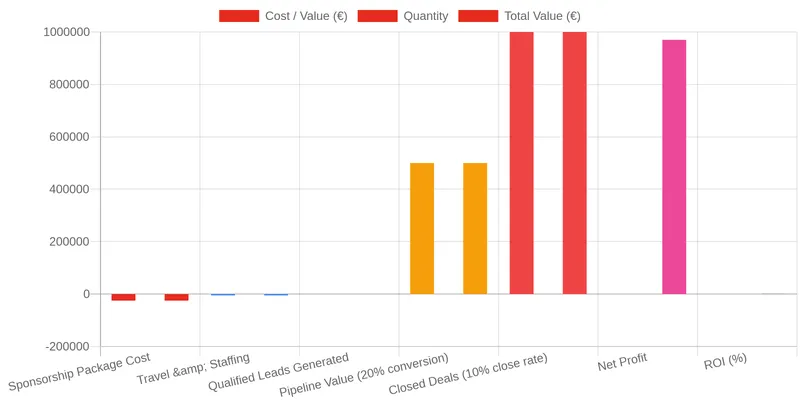
The basic formula for sponsorship ROI is: `[(Financial Gain – Sponsorship Cost) / Sponsorship Cost] x 100`. The challenge is accurately determining the “Financial Gain,” which requires marketing attribution models. Because deals in the private credit space can take over a year to close, a multi-touch attribution model is often more accurate than a first-touch or last-touch model. According to research published in the Harvard Business Review, sophisticated attribution helps marketers justify spending and optimize their channel mix.
View data as table
| Metric | Cost / Value (€) | Quantity | Total Value (€) |
|---|---|---|---|
| Sponsorship Package Cost | -25,000 | 1 | -25,000 |
| Travel & Staffing | -5,000 | 1 | -5,000 |
| Qualified Leads Generated | N/A | 50 | N/A |
| Pipeline Value (20% conversion) | 500,000 | 10 | 500,000 |
| Closed Deals (10% close rate) | 1,000,000 | 1 | 1,000,000 |
| Net Profit | 970,000 | ||
| ROI (%) | 3233% |
| Model | Description | Best For | Limitations |
|---|---|---|---|
| First-Touch | Gives 100% of the credit to the first marketing touchpoint (the event). | Understanding top-of-funnel channel effectiveness. | Ignores all subsequent interactions that nurture the lead. |
| Last-Touch | Gives 100% of the credit to the final touchpoint before conversion. | Identifying closing channels. | Devalues the initial engagement and nurturing stages. |
| Linear | Distributes credit evenly across all touchpoints in the journey. | Valuing the entire customer journey equally. | May overvalue minor touchpoints and undervalue key events. |
| Time-Decay | Gives more credit to touchpoints closer to the time of conversion. | Long sales cycles where recent interactions are more influential. | Can undervalue critical early-stage awareness building. |
Maximizing Your Brand Exposure at Private Credit Events
At elite financial summits, brand exposure is about demonstrating intellectual capital and building trust, not having the largest booth. The goal is to become part of the industry conversation. Success requires a targeted approach that leverages the format of high-level financial conferences.
Leveraging Thought Leadership and Speaking Opportunities
Securing a speaking role on a panel or hosting a workshop is an effective way to establish authority. This platform lets you share insights on topics like direct lending strategies, NPL workout solutions, or the nuances of asset-backed finance. It positions your firm’s experts as leaders, not just participants. Preparing well-researched, non-promotional content that addresses the key concerns of LPs and GPs builds credibility that traditional advertising cannot. For more on this, explore our GP’s playbook for European private credit conferences.
Strategic Networking for High-Value Deal-Making
Networking sessions at premier financial events create significant value. To maximize this, your team must be proactive: use the event app and delegate list to request meetings with key individuals weeks in advance. During the event, focus on quality conversations to understand the other party’s challenges and objectives, not just collect business cards. These interactions lead to partnerships and direct deal flow, a core component of positive sponsorship roi b2b.
Why DD Talks Events Deliver Strong Sponsorship ROI
Sponsorship return depends on the event’s quality and audience. General B2B conferences often attract a wide but shallow pool of attendees. DD Talks events, such as Private Credit Days Europe in London and Private Credit Day Iberia in Madrid, deliver a concentrated audience of senior decision-makers for efficient, high-stakes deal-making and partnership building.
Access to Top-Tier Institutional Investors and GPs
Our conferences are attended by senior representatives from leading global financial institutions, including institutional investors, LPs, and GPs from firms like Blackstone, Ares Management, and PIMCO. Sponsoring provides a direct and efficient channel to engage these stakeholders who are seeking opportunities in European private credit, NPLs, and structured finance. This curated attendance improves sponsorship roi b2b by eliminating less relevant contacts.
Curated Content and Deal-Focused Environments
The agenda for each summit is researched and developed by the DDTalks Research and Event Committee to address current market trends and regulatory shifts. Panels and workshops focus on practical strategies and real market flows. You can review our in-depth panels on NPL and distressed debt. This environment, with dedicated networking zones and pre-scheduled meeting systems, ensures meaningful interactions. This structure accelerates relationship-building and lowers client acquisition cost by focusing on a pre-qualified, engaged audience. For further context on market dynamics, see our analysis of European debt and equity markets.
What Results Can You Expect from Financial Conference Marketing?
Financial conference sponsorship yields immediate, measurable results and long-term strategic advantages.
Quantifiable Gains: Leads, Pipeline, and Client Acquisition
A successful sponsorship delivers a substantial increase in qualified leads from target institutions. A realistic goal is to add 3-5x the sponsorship cost in new, qualified pipeline value within six months post-event. The event should also reduce the average client acquisition cost for clients sourced from the conference.
Long-Term Value: Thought Leadership and Market Positioning
Intangible benefits are also critical. Consistent participation solidifies your firm’s position as a thought leader in the European private credit landscape. This reputation builds trust and preference among LPs and potential partners, making future business development efforts more effective. Relationships from these summits can evolve into long-term alliances, co-investment opportunities, and a professional network providing long-term value.
Secure Your Firm’s Visibility at Europe’s Elite Financial Summits
Positioning your firm in the European private credit and distressed debt conversation is essential for growth and influence. Sponsoring a DD Talks summit provides a platform to engage with influential industry leaders, from top-tier GPs to major institutional LPs. Our events facilitate meaningful connections and tangible deal flow, ensuring your investment yields measurable outcomes.
Explore how our tailored sponsorship opportunities can help you achieve your business objectives in 2026. To learn more about our upcoming events in London, Madrid, and across Europe, contact us or Request Agenda for a detailed overview of our delegate profile and sponsorship packages.
Conclusion
Sponsoring a B2B financial summit depends on providing access to a relevant, influential audience in an engaging context. While metrics like CPL and pipeline value are crucial, success also depends on the strategic value of relationships built and authority established. Choose events where the attendee list mirrors your ideal client profile. Request Agenda for our upcoming summits or contact us to discuss a sponsorship strategy aligned with your firm’s goals.
Frequently Asked Questions
How do you calculate the pipeline-to-spend ratio for a B2B financial summit sponsorship?
A common industry benchmark is to target a pipeline-to-spend ratio of at least 5:1 within six months of the event. To calculate this, sum the total potential deal value of all qualified leads generated from the summit and divide it by your total sponsorship cost. For high-value private credit deals, successful sponsors often see this ratio exceed 10:1 over the full 12-18 month sales cycle.
What is a realistic cost-per-meeting to expect from sponsoring a European private credit conference?
While variable, a successful sponsorship at a premium event should aim for a Cost-Per-Meeting with a qualified GP or LP in the range of €500 to €1,500. This figure is justified by the high seniority of attendees from firms like PIMCO or Oaktree and the significant potential value of each initiated relationship. The key is to track meetings with actual decision-makers, not just casual booth conversations.
What is a realistic timeframe to see ROI from a financial summit sponsorship?
While initial leads are generated at the event, the true financial return often materializes over a 6 to 18-month sales cycle. This extended period is typical for the private credit and distressed debt markets, reflecting lengthy due diligence and complex deal structuring processes. Effective post-conference lead nurturing is critical for converting these high-value connections into closed deals.
How does a speaking slot specifically improve sponsorship roi b2b?
A speaking slot directly enhances ROI by positioning your firm as an authority, which generates higher-quality inbound inquiries. According to research from event marketing platform Bizzabo, sponsors with speaking roles can see up to a 70% increase in on-site engagement and lead quality. This visibility allows you to frame key industry debates, such as the impact of AIFMD II, and attract partners aligned with your perspective.
How can we justify sponsorship costs to stakeholders if direct deal attribution is difficult?
Justification beyond direct attribution relies on strategic metrics that demonstrate long-term value. Track the number of meetings secured with C-suite executives from target firms like Blackstone or Goldman Sachs, which are otherwise difficult to obtain. Additionally, measure competitive intelligence gathered and the strengthening of relationships with key legal and advisory partners, which de-risks future transactions.


0 Comments