

Tech Due Diligence Checklist: Underwriting Private Credit Deals
A tech due diligence checklist is crucial for private credit lenders evaluating tech sector investments. This article details essential components for assessing a technology company’s financial health, operational stability, and growth potential. It emphasizes scrutinizing SaaS metrics like ARR and churn, intellectual property, and cybersecurity risks to ensure predictable cash flows for debt service. Understanding these elements is vital for mitigating risks in private credit underwriting and structuring robust deals.
DDTalks provides expert insights into European private credit markets, offering platforms for high-value deal-making and industry networking. Our content reflects deep expertise in direct lending, NPLs, and structured finance, trusted by leading financial institutions.
To explore your options, contact us to schedule your consultation. You can also reach us via: Request Agenda
Private credit deals in the tech sector require a tech due diligence checklist to mitigate risks and ensure returns. Lenders must verify a technology company’s operational and financial health can support stable cash flows for debt service. This article outlines essential components for assessing SaaS metrics, intellectual property, and cybersecurity risks.
What is a Tech Due Diligence Checklist for Private Credit Deals?
A technology due diligence checklist for private credit is a framework lenders use to evaluate a tech company’s viability before extending debt financing. It assesses the target’s financial health, operational stability, product defensibility, and growth potential to confirm its ability to service debt. The process includes analyzing the company’s technology, market position, and operational risks.
The most critical item is validating the company’s recurring revenue streams. For SaaS companies, this involves scrutinizing metrics like Annual Recurring Revenue (ARR), customer churn, and net revenue retention. These figures indicate predictable cash flow, the foundation of private credit underwriting. Analysis determines if revenue is stable enough to meet debt payments.
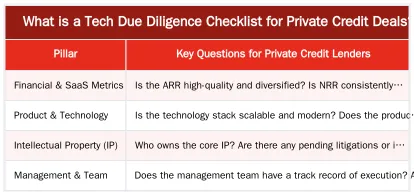
Key Pillars of Technology Due Diligence in Private Credit Underwriting
Technology due diligence rests on core pillars that uncover specific risks and opportunities. This framework connects technical realities to financial performance and is key to structuring sector-specific private credit investments in Europe.
Evaluating Financial & SaaS Metrics for Lenders
The financial pillar is the bedrock of private credit underwriting. Lenders must analyze the quality and predictability of cash flows, not just top-line revenue. Key SaaS metrics include:
- Annual Recurring Revenue (ARR): Assessing the quality, growth rate, and concentration of recurring revenue.
- Net Revenue Retention (NRR): Measuring the ability to retain and expand revenue from existing customers. An NRR above 100% indicates strong product stickiness and upsell potential.
- Customer Churn: Analyzing both logo churn (customer loss) and revenue churn to understand customer satisfaction and product dependency.
- Customer Acquisition Cost (CAC) & Lifetime Value (LTV): Evaluating the efficiency of sales and marketing spend and its long-term return. A healthy LTV:CAC ratio (typically 3:1 or higher) is a positive signal.
Assessing Intellectual Property, Product, and Cybersecurity Risk
A company’s technology and intellectual property (IP) are its core assets. Diligence here confirms its market position’s defensibility. Investigations include verifying IP ownership, reviewing the patent portfolio, and assessing freedom to operate. The product roadmap is scrutinized for viability and market alignment. A code quality audit can identify technical debt that hinders scalability. A cybersecurity risk assessment evaluates data protection and breach resilience, which have financial and reputational consequences.
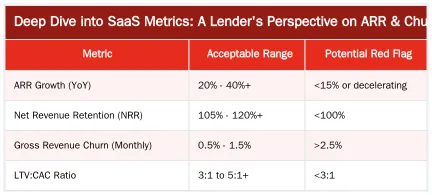
Deep Dive into SaaS Metrics: A Lender’s Perspective on ARR & Churn
For lenders, ARR and churn measure risk and predictability, not just growth. Debt providers focus on stable cash flow, unlike equity investors who may prioritize growth. High-quality ARR from multi-year contracts with a diverse customer base supports debt service coverage.
Lenders scrutinize churn to understand customer satisfaction and product indispensability. A low, stable gross revenue churn rate suggests a “sticky” product embedded in customer workflows. High or increasing churn is a red flag, indicating issues that could jeopardize revenue. Analyzing churn by cohort reveals long-term retention patterns.
Beyond the Numbers: Understanding Customer Stickiness and Expansion
Qualitative analysis contextualizes the numbers. Lenders should investigate drivers of low churn and high NRR, including customer success strategies, pricing models, and cross-selling potential. High switching costs, deep integrations, and a strong brand reputation contribute to customer stickiness, strengthening the credit case.
Mitigating Risk: Expert Insights from European Private Credit Leaders
Industry forums like our Private Credit Days Europe emphasize a localized, context-aware due diligence process. European tech markets have unique regulations and competitive dynamics. A checklist is a starting point, not a substitute for judgment. A common pitfall is relying on management metrics without verification via cohort analysis and customer interviews.
Another red flag is “growth at all costs.” Lenders must ensure rapid ARR growth is efficient and sustainable. A high CAC payback period, for instance, can strain cash flow. Understanding regulations like GDPR and AIFMD II is critical for mitigating compliance risks. The European Securities and Markets Authority (ESMA) provides guidance on regulatory frameworks. These factors are part of a European private credit risk management framework.
The Role of Management Team Assessment in Deal Success
A loan is an investment in a management team’s ability to execute. Assessing the leadership team is a critical part of due diligence. Lenders should evaluate the team’s industry experience, track record, and financial acumen. Assess the team’s depth beyond the C-suite, including key technical and sales leaders. The management team’s objectives and incentives must align with the lender’s goal of stable growth and capital preservation.
Implementing Your Due Diligence Checklist: Best Practices & Outcomes
Implementing a tech due diligence checklist requires a multi-disciplinary approach. The diligence team should combine financial analysts with technical experts who can evaluate code quality, system architecture, and cybersecurity. Many funds engage third-party specialists for code audits or penetration testing.
Efficient data room management is crucial. An organized virtual data room allows the team to work efficiently. The process requires collaboration and communication between the lender, target company, and advisors to ensure questions are addressed promptly and findings are incorporated into the analysis. The digital transformation in private credit has streamlined this process.
Structuring the Due Diligence Process for Efficiency
A phased approach optimizes resources and time. The process begins with screening high-level financials and market analysis. If it proceeds, detailed diligence begins, involving data room analysis, management interviews, and expert consultations. This process identifies key risks early. Thorough diligence informs the credit decision and provides a baseline for post-deal monitoring, helping lenders track performance against the underwriting case.
Unlock Exclusive Insights at Our Private Credit Conferences
These principles are discussed at our B2B financial conferences. Events like Private Credit Days Europe in London and Private Credit Day Iberia in Madrid bring together leading GPs, LPs, and advisors to share insights on deal-making, risk mitigation, and sector-specific underwriting. Network with peers, understand the tech lending landscape, and find investment opportunities. Request Agenda to connect with leaders in European private credit.
Conclusion
A systematic due diligence process is indispensable for private credit investing in tech. Focusing on recurring revenue quality, product and IP defensibility, and management capability helps lenders mitigate risk and structure deals for stable returns. This framework, combined with industry expertise, provides a foundation for analysis. To deepen your expertise and connect with market leaders, contact us to learn about our industry events. Request Agenda for our upcoming conferences.
Frequently Asked Questions
What is the most critical item for due diligence in a tech private credit deal?
The most critical item is the rigorous validation of the company’s recurring revenue stream. This involves scrutinizing key SaaS metrics like Annual Recurring Revenue (ARR), customer churn, and net revenue retention to confirm the stability of cash flows available for debt service.
Why is intellectual property (IP) analysis so important in this process?
In the technology sector, IP is often the company’s most valuable asset and a key part of the collateral. A thorough review of IP ownership, patents, and potential infringement risks is essential to ensure the company’s competitive advantage is secure and the lender’s security is protected.
How does a private credit technology review differ from a private equity one?
A private credit tech due diligence checklist is primarily focused on downside protection and cash flow stability for debt repayment. In contrast, a private equity review is more focused on upside potential, market size, and long-term growth prospects to generate an equity return.
What are three key red flags to look for during technology due diligence?
Three major red flags are high customer concentration, declining net revenue retention, and unclear ownership of critical intellectual property. Any of these issues, uncovered by a detailed tech due diligence checklist, can significantly increase the risk profile of a loan.
Does the diligence checklist for a tech loan include cybersecurity?
Yes, a comprehensive technology review must include a thorough cybersecurity risk assessment. A significant data breach could lead to reputational damage, regulatory fines, and customer loss, directly impairing the company’s ability to service its debt obligations.
Where can I learn more about advanced due diligence strategies for European private credit?
To gain deeper insights from industry leaders, you can explore the topics covered at our specialized forums. We bring together top-tier GPs and LPs to discuss the latest trends and best practices in deal underwriting. You can request an agenda for our upcoming European private credit conferences to see the full program.




0 Comments