

Litigation Funding Models: Maximizing Asset Recovery & De-risking Claims
Litigation funding models offer crucial strategies for institutional investors and distressed debt professionals to maximize asset recovery. This article details how these models transform legal claims into monetizable assets, enabling creditors to pursue recovery on non-performing loans (NPLs) and distressed situations without deploying additional capital. It compares single-case and portfolio funding structures, highlighting their strategic application in European NPL and special situations markets. Understanding these litigation funding models helps mitigate risk, enhance portfolio returns, and unlock value from complex legal claims.
DDTalks provides expert insights into European private credit, NPL, and distressed debt markets. Our content draws on extensive experience hosting premium financial conferences, facilitating high-value deal-making and industry networking among top-tier institutions. We deliver authoritative perspectives on complex financial strategies.
To explore your options, contact us to schedule your consultation. You can also reach us via: Request Agenda
Litigation funding models help institutional investors and distressed debt professionals maximize asset recovery. This tool transforms legal claims into monetizable assets, allowing creditors to pursue recovery on non-performing loans (NPLs) and distressed situations without deploying additional capital. This article compares funding structures and their application in European NPL and special situations markets to enhance portfolio returns and mitigate risk.
What Are Litigation Funding Models for Asset Recovery?
Litigation funding for asset recovery is a non-recourse financial arrangement where a third-party funder provides capital to a claimant for legal costs. In return, the funder receives a portion of the proceeds if the case is successful. This is relevant for holders of NPLs and distressed debt, as it converts unresolved legal claims as assets on the balance sheet. If the claim fails, the claimant owes nothing to the funder.
The Core Principle: De-risking Legal Claims
Litigation finance transfers the financial risk of legal action from the claimant to the funder. For an institutional investor with a distressed asset portfolio, legal enforcement can drain capital and resources. Engaging a funder preserves capital for core activities while pursuing meritorious claims. This de-risking allows creditors to unlock value in their legal claims without downside exposure, aiding balance sheet management and value creation.
Comparing Single-Case vs. Portfolio Funding for Distressed Assets
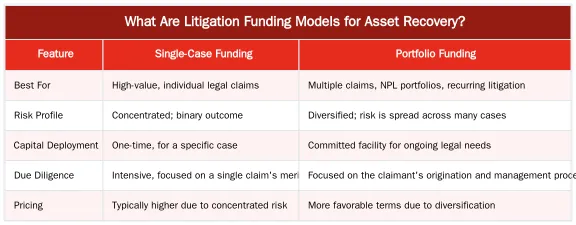
The primary litigation finance structures are single-case and portfolio funding. The choice depends on the claimant’s objectives, the nature of the legal claims, and the recovery scale. Single-case arrangements are for individual, high-value disputes, while portfolio facilities are for entities with multiple claims, such as servicers managing large books of distressed debt.
Single-Case Funding: Targeted Recovery
Single-case funding provides capital for one legal dispute. It is ideal for large, standalone claims where potential recovery justifies the funder’s due diligence, such as a significant corporate insolvency or a high-value defaulted commercial real estate loan. The underwriting process is intensive, and the cost of capital is higher than portfolio arrangements because of concentrated risk.
Portfolio Funding: Scaling NPL Workout Strategies
Portfolio funding provides capital across a pool of legal claims. This benefits NPL servicers and institutional investors managing diverse NPL workout strategies. By cross-collateralizing risk across cases, funders can offer more flexible and favorable terms. This model enables a programmatic approach to asset recovery, financing a range of cases—including smaller claims uneconomical to fund individually—and achieving economies of scale.
How Do Litigation Funding Agreements Work in Practice?
Litigation funding agreements are contracts outlining the relationship between the claimant, legal counsel, and the funder. They detail the funding scope, legal budget, capital deployment conditions, and distribution of proceeds. Structuring these agreements requires considering financial terms, litigation control, and termination rights to align all parties.
Key Terms and Fee Structures
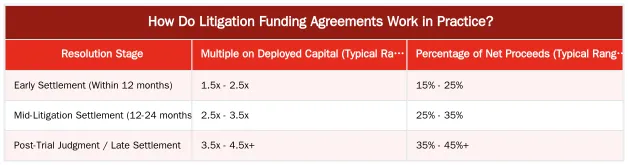
The funder’s return, the “success fee,” is the agreement’s central component. It is structured as a multiple of capital deployed, a percentage of total recovery, or a hybrid, depending on perceived risk and case duration. The “waterfall” provision dictates the payment order from proceeds, ensuring legal fees, the funder’s capital, and the funder’s return are paid before the claimant receives the balance.
The Due Diligence and Approval Process
Before committing capital, a funder conducts due diligence. This assesses the claim’s legal merits, potential damages, the defendant’s ability to pay, and the legal team’s expertise. For portfolio arrangements, the funder also evaluates the claimant’s internal processes for managing legal claims. Securing financing requires a strong, well-documented case with a clear recovery path.
Maximizing Value: Strategic Applications for European NPLs and Distressed Debt
In European NPL and distressed debt markets, litigation funding is a strategic component of portfolio management. Investors use third-party capital to pursue enforcement actions on defaulted loans, challenge insolvency proceedings, or litigate complex, cost-prohibitive fraud cases. This enhances recovery rates and unlocks value from assets previously written down or considered unrecoverable, enabling a comprehensive approach to asset recovery.
Integrating Funding into Distressed Investment Strategies
Investors integrate litigation funding into their distressed investment strategies. For example, a buyer acquiring an NPL portfolio can pre-arrange a funding facility for legal costs in the workout process. This improves financial modeling for the acquisition and provides capital certainty for recovery. By treating legal claims as a distinct asset class, investors can optimize capital allocation and focus on sourcing and managing distressed assets.
Navigating Regulatory Nuances and Ethical Considerations
The European regulatory landscape for litigation funding is fragmented. Historical doctrines like champerty and maintenance, which prohibited third-party funding, have been relaxed in markets like the UK, but restrictions remain elsewhere. Institutional players must work with legal advisors and funders who understand these local nuances. Adherence to ethical guidelines, particularly regarding the funder’s influence over litigation strategy and settlement, ensures compliance and maintains the legal process’s integrity.
Expert Insights: The Future of Litigation Finance in European Asset Recovery
Europe’s litigation finance market is maturing, driven by recognition of its benefits and demand for alternative capital in the NPL and special situations space. Industry trends, discussed at DDTalks events, include more sophisticated funding arrangements, such as facilities covering legal fees and claimant working capital. This reflects litigation funding’s integration into the private credit and distressed asset ecosystem.
Key Drivers and Market Evolution in Europe
Litigation finance growth is propelled by the complexity of cross-border insolvencies and restructurings, which require specialized legal expertise and capital. As banks deleverage and sell NPL portfolios, new owners need tools to manage the workout process. According to the International Bar Association, global acceptance and regulation of third-party funding are increasing, providing more certainty for investors and claimants. This trend should accelerate in Europe as more jurisdictions formalize regulatory frameworks, solidifying the role of distressed assets in portfolio management.
DDTalks’ Role in Shaping Industry Dialogue
DDTalks provides a forum for institutional investors, NPL servicers, legal advisors, and capital providers to connect and explore these strategies. Our conferences in London, Madrid, and across Europe facilitate discussions on structuring funding deals, navigating regulatory challenges, and integrating litigation finance into investment theses. We bring together industry leaders to shape dialogue and foster partnerships for complex asset recovery campaigns.
Unlock Strategic Opportunities at Our NPL & Distressed Debt Forums
Navigating European distressed debt requires specialized knowledge and connections. DDTalks’ NPL & Distressed Debt Forums are B2B events for deal-making and strategic insight. Join GPs, LPs, investment bankers, and workout professionals to explore trends in asset recovery, private credit, and structured finance. Our agendas address market challenges and opportunities, from capital restructuring to applying new funding solutions. Network with industry leaders and gain intelligence to optimize your investment strategies.
Conclusion
Understanding litigation funding models is critical for institutional investors and NPL servicers in European asset recovery. By deploying single-case or portfolio funding, stakeholders can de-risk legal processes, preserve capital, and unlock value from distressed assets. To explore these strategies and connect with capital providers and advisors, contact us or Request Agenda for our upcoming NPL and Distressed Debt forums.
Frequently Asked Questions
What is the primary benefit of using litigation funding for asset recovery?
The primary benefit is converting a legal claim into a financial asset without deploying additional capital. This financial arrangement allows creditors to pursue recovery on distressed debt by transferring the cost and risk of legal action to a third-party funder in exchange for a share of the proceeds.
Which financing structure is better for a diverse NPL portfolio: single-case or portfolio funding?
For a diverse NPL portfolio, portfolio funding is generally preferred. This approach allows funders to spread risk across multiple cases, which often results in more favorable terms and a higher likelihood of securing capital compared to funding individual, higher-risk claims.
What key terms should be scrutinized in a litigation funding agreement?
Key terms include the funder’s percentage of the proceeds, the precise definition of a successful outcome, and clauses governing control over settlement decisions. Asset managers should also scrutinize any “waterfall” provisions that dictate the priority of payments upon a successful recovery.
How does counterparty risk affect the selection of a litigation funder?
Assessing the financial stability and track record of the litigation funder is crucial. A funder’s inability to meet capital calls throughout a prolonged legal battle can jeopardize the entire asset recovery process, making counterparty due diligence an essential step for investors.
How are different litigation funding models applied in the European NPL market?
In the European NPL market, various litigation funding models are used to unlock value from complex, often cross-border, legal claims. Portfolio funding is common for large books of distressed assets, while specialized single-case funding is used for high-value insolvency or enforcement actions in jurisdictions like Spain and Italy.
Where can investors learn more about comparing litigation funding models for European distressed debt?
Our NPL & Distressed Debt Forums feature expert panels dedicated to comparing different litigation funding models. These sessions provide institutional investors and servicers with actionable insights for structuring agreements to maximize recovery. You can request the latest agenda to see upcoming discussions on this topic.




0 Comments