

NPL Securitisation Ratings: Understanding Agency Assessment Methods
NPL securitisation ratings provide independent assessments of credit risk for asset-backed securities collateralized by non-performing loans. This article details how credit rating agencies like Moody’s, S&P, and Fitch evaluate these complex transactions. It covers the critical methodologies, including thorough portfolio analysis, robust cash flow modeling, and waterfall analysis within the special purpose vehicle (SPV) structure. Understanding these assessments is crucial for investors and market participants to gauge risk, ensure transparency, and facilitate capital relief in structured finance. The quality of loan servicing and effective credit enhancement also significantly influence final ratings.
DDTalks specializes in facilitating high-value deal-making and industry networking across European private credit, NPL, and structured finance markets. Our platforms offer deep insights into complex financial instruments and regulatory landscapes, connecting institutional investors with leading market participants.
To explore your options, contact us to schedule your consultation. You can also reach us via: Request Agenda
What are NPL Securitisation Ratings and Why Do They Matter?
NPL securitisation ratings are independent assessments of the credit risk associated with asset-backed securities (ABS) collateralized by a pool of non-performing loans. Provided by credit rating agencies, these evaluations offer investors a standardized measure of the likelihood of receiving promised principal and interest payments.
Securitisation involves a bank or financial institution selling an NPL portfolio to a special purpose vehicle (SPV). The SPV issues tradable ABS to investors, with payments funded by cash flows recovered from the NPL portfolio. This provides capital relief for originating banks and creates a distinct asset class for investors. NPL securitisation ratings provide the transparency and risk assessment needed for the market to function.
The Core Function of Credit Rating Agencies in Structured Finance
Agencies like Moody’s, S&P Global Ratings, and Fitch Ratings analyze the interplay between distressed asset quality, the transaction’s legal structure, and the loan servicer’s capabilities. Their rating opinion influences an ABS tranche’s marketability, pricing, and liquidity, allowing institutional investors to compare investments using a consistent risk framework.
How Do Rating Agencies Assess NPL Securitisation Transactions?
Assessing an NPL securitisation combines quantitative modeling with qualitative judgment. It begins with a review of the underlying loan portfolio, where analysts scrutinize data on the non-performing assets. This includes loan type (e.g., secured vs. unsecured), borrower characteristics, collateral valuations, and the history of collection efforts.
The transaction’s structure is then examined. This involves ensuring the special purpose vehicle (SPV) is bankruptcy-remote from the seller, isolating the assets. A core component of this analysis is the waterfall analysis, which models the priority of payments. It dictates how cash recovered from the NPLs flows through the SPV to cover servicer fees, other transaction costs, and then interest and principal payments to investors in different tranches, from the most senior to the most junior (or equity) tranche.
Key Methodologies: Portfolio Analysis and Cash Flow Modeling
Rating agencies use cash flow models to project the timing and amount of future recoveries from the NPL pool. They create multiple scenarios—base case, optimistic, and pessimistic (stress case)—based on historical recovery data, collateral type, and macroeconomic forecasts. For example, recoveries on secured real estate loans will be modeled differently from unsecured consumer debt. These models estimate metrics like gross recovery rate and time to recovery to determine if projected cash flows can support payments on rated securities under various stress conditions.
Key Factors Influencing NPL Securitisation Ratings
Several interconnected factors determine the credit rating of an NPL-backed security. Agencies scrutinize these elements to build a view of the transaction’s risk profile. The underlying asset pool’s quality is paramount. Factors like the average loan-to-value (LTV) ratio for secured loans, geographic collateral diversification, and the legal status of foreclosure proceedings are critical inputs.
The legal and regulatory framework of the asset’s jurisdiction also has a significant impact. The efficiency and predictability of a country’s judicial system for debt recovery can drastically alter recovery timelines and costs. The macroeconomic outlook, including projected unemployment rates and property market trends, provides the context for testing recovery assumptions.
Credit Enhancement: Mitigating Risk in NPL ABS
Credit enhancement mechanisms are structural features that protect investors from potential losses and are a key driver of higher ratings. The most common form is subordination, where the transaction is structured into different classes or tranches of securities. Junior tranches absorb losses first, providing a protective cushion for the more senior tranches. Other methods include overcollateralization, where the principal balance of the NPLs exceeds the principal of the issued securities, and dedicated cash reserve funds to cover temporary shortfalls in collections.
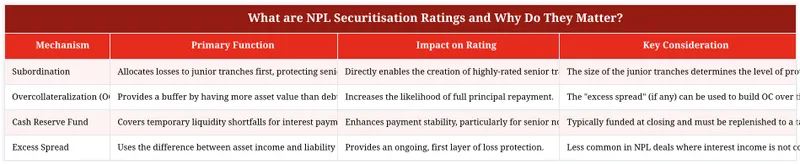
View data as table
| Mechanism | Primary Function | Impact on Rating | Key Consideration |
|---|---|---|---|
| Subordination | Allocates losses to junior tranches first, protecting senior tranches. | Directly enables the creation of highly-rated senior tranches. | The size of the junior tranches determines the level of protection. |
| Overcollateralization (OC) | Provides a buffer by having more asset value than debt issued. | Increases the likelihood of full principal repayment. | The “excess spread” (if any) can be used to build OC over time. |
| Cash Reserve Fund | Covers temporary liquidity shortfalls for interest payments or fees. | Enhances payment stability, particularly for senior notes. | Typically funded at closing and must be replenished to a target level. |
| Excess Spread | Uses the difference between asset income and liability costs to absorb losses. | Provides an ongoing, first layer of loss protection. | Less common in NPL deals where interest income is not contractual. |
The Critical Role of Servicer Quality and Due Diligence in NPL Ratings
The special servicer’s capabilities are the most dynamic factor in an NPL securitisation, alongside asset quality and structural protections. Unlike in performing loan securitisations, the servicer in an NPL transaction is not a passive collector but an active asset manager. Their effectiveness in loan workouts, litigation management, and asset disposal directly determines the amount and timing of cash recoveries. Rating agencies review the servicer’s operations, assessing their track record, staffing, IT systems, and collection strategies.
An agency analyzes a servicer’s historical recovery curves for similar assets, comparing performance against market benchmarks. They also evaluate the servicer’s business plan for the portfolio, ensuring workout strategies are realistic and supported by their operational capacity. An experienced servicer can improve recovery expectations, leading to a more favorable assessment.
Why Due Diligence is Non-Negotiable for NPL Securitisation
Due diligence on the NPL portfolio is the foundation of the rating analysis. Seller-provided data must be validated before a rating is assigned. This often involves a third-party firm reviewing a statistically significant sample of the loan files. This process verifies the existence of key legal documents, confirms collateral details, and assesses the accuracy of the data tape. Discrepancies, missing information, or systemic issues found during due diligence can lead to conservative adjustments in the rating agency’s recovery assumptions.
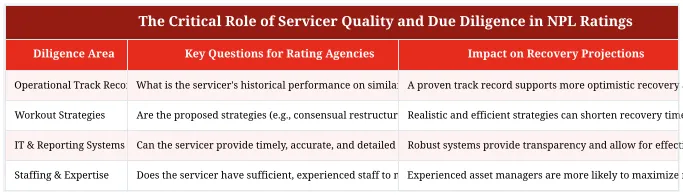
View data as table
| Diligence Area | Key Questions for Rating Agencies | Impact on Recovery Projections |
|---|---|---|
| Operational Track Record | What is the servicer’s historical performance on similar NPL portfolios? Do they have experience in the relevant jurisdiction? | A proven track record supports more optimistic recovery assumptions. |
| Workout Strategies | Are the proposed strategies (e.g., consensual restructuring, litigation, asset sale) appropriate for the portfolio? | Realistic and efficient strategies can shorten recovery times and increase net proceeds. |
| IT & Reporting Systems | Can the servicer provide timely, accurate, and detailed reporting on collections and workout progress? | Robust systems provide transparency and allow for effective performance monitoring. |
| Staffing & Expertise | Does the servicer have sufficient, experienced staff to manage the portfolio’s complexity and volume? | Experienced asset managers are more likely to maximize recovery values. |
Elevate Your NPL Strategy: Join Europe’s Leading Securitisation Forums
Understanding how credit rating agencies evaluate NPL transactions is fundamental for any investor, servicer, or originator in the distressed debt market. The process blends quantitative analysis and qualitative judgment, influenced by servicer quality, legal frameworks, and macroeconomic conditions.
To navigate this environment, direct engagement with market leaders is invaluable. DDTalks provides a platform for senior professionals in European private credit and structured finance to connect, share insights, and originate deals. Participating in our forums provides direct access to experts shaping the NPL market.
Conclusion
The key criterion for investors in NPL-backed securities is the credibility of the recovery assumptions underpinning the transaction’s rating. Understanding the rating agency’s methodology, particularly its assessment of the servicer and structural protections, is essential for informed investment decisions. As the European market evolves, staying current on regulatory changes and workout strategies is paramount. Professionals should engage with peers and experts to refine their approach to this asset class. For more information on upcoming events and industry insights, please contact us or Request Agenda for our next NPL and Structured Finance forum.
Frequently Asked Questions
How do agencies like Moody’s and S&P evaluate a servicer’s track record for an NPL transaction?
Rating agencies conduct deep operational due diligence on the servicer, scrutinizing their historical static pool data to assess recovery rates, liquidation timelines, and workout costs. They analyze the servicer’s specific experience with the relevant asset class and jurisdiction, as a strong track record provides confidence in the cash flow projections underpinning the rating.
How does a jurisdiction’s legal framework, such as Italy’s GACS scheme, influence npl securitisation ratings?
A country’s legal and insolvency framework is a critical rating factor, as it dictates the speed and efficiency of asset recovery. Government guarantee schemes, like Italy’s GACS (Garanzia sulla Cartolarizzazione delle Sofferenze), directly mitigate credit risk for senior tranches, allowing agencies to assign a much higher rating to these specific notes than would otherwise be possible based solely on the NPL pool’s performance.
Can an NPL securitisation with mostly unsecured loans achieve an investment-grade rating?
Achieving an investment-grade rating for a portfolio of primarily unsecured non-performing loans is challenging but possible. It requires substantial credit enhancement, such as a very large subordinated tranche to absorb initial losses, and a highly specialized servicer with a verifiable, top-tier track record in unsecured debt collection. The rating agency’s stress scenarios for unsecured recovery rates are typically much more severe than for secured debt.
What is the difference between a rating agency’s ‘base case’ and ‘stress case’ for NPL recoveries?
The ‘base case’ represents the rating agency’s realistic expectation of cash flow recoveries from the NPL portfolio over time. The ‘stress case’ applies harsher assumptions, such as a severe economic downturn, lower property sale values, and longer recovery periods, to test the resilience of the transaction’s structure. The ability of the senior notes to withstand these stress scenarios is essential for achieving higher credit ratings for an NPL deal.
Why might two NPL portfolios with similar gross book values receive different credit ratings?
Two portfolios with identical gross book values (GBV) can receive vastly different npl securitisation ratings due to variations in collateral quality, loan seasoning, and geographic concentration. A portfolio of seasoned, first-lien residential mortgages in a stable housing market will be viewed more favourably than a geographically concentrated portfolio of unsecured loans to small businesses, even if their face values are the same.




0 Comments