

Understanding Waterfall Structures Tranche Risk in NPL ABS
Understanding waterfall structures tranche risk is crucial for investors in Non-Performing Loan (NPL) Asset-Backed Securities (ABS). These structures define the sequential distribution of cash flows from a securitised NPL portfolio, establishing a clear priority of payments for different bondholder tranches. Analyzing the payment waterfall reveals how senior, mezzanine, and junior tranches absorb losses and receive payments, directly impacting their creditworthiness and potential returns. Effective cash flow modeling is essential to accurately assess the inherent risks and opportunities within these complex structured finance instruments.
DD Talks specializes in fostering expertise within European private credit, NPL, and structured finance markets. Our conferences provide platforms for institutional investors and industry leaders to gain insights into complex financial instruments, facilitating high-value deal-making and strategic networking.
To explore your options, contact us to schedule your consultation. You can also reach us via: Request Agenda
What are Waterfall Structures and Tranche Risk in NPL ABS?
In Non-Performing Loan (NPL) Asset-Backed Securities (ABS), a waterfall structure dictates the sequential distribution of cash flows from the loan portfolio. It establishes a priority of payments for fees, interest, and principal to different bondholder classes, known as tranches, in a predefined order. Understanding waterfall structures tranche risk is fundamental to assessing each security’s creditworthiness and potential returns.
Defining NPL ABS and Securitisation Fundamentals
NPL ABS are structured finance instruments created by securitisation. This process involves pooling non-performing loans from a bank’s balance sheet and transferring them to a Special Purpose Vehicle (SPV). The SPV issues tradable debt securities (ABS) backed by expected cash flows from the recovery of these assets. This transforms illiquid, high-risk loans into marketable securities with varying risk profiles, a key topic in decoding NPL securitisation.
The Core Concept of Payment Waterfalls
The payment waterfall is the operational core of an NPL ABS transaction, a contractual cash distribution cascade outlined in the deal’s legal documents. Collections from the NPL portfolio flow into the SPV and are paid out according to this waterfall. Senior expenses like servicer fees and trustee costs are paid first. Cash flows then pay interest and principal to security tranches, from most senior to most junior. This hierarchy allocates payments and losses.
How Do Waterfall Structures Dictate Payment Priority and Risk?
A payment waterfall’s design creates a risk and return hierarchy among the securities in an NPL ABS deal. Its payment priority ensures some investors are paid before others, insulating them from initial losses. This mechanism, subordination, creates securities with distinct credit ratings and investment characteristics from a single asset pool.
Senior, Mezzanine, and Junior Tranches: A Hierarchy of Risk
An NPL ABS transaction is sliced into tranches, each with a different claim on cash flows:
- Senior Tranche: Has the first claim on cash flows for interest and principal. Its priority position and protection from lower tranches give it the lowest risk and typically the lowest coupon. It is often designed for an investment-grade credit rating.
- Mezzanine Tranche: Positioned between senior and junior tranches, it offers a moderate risk-return profile. It absorbs losses after the junior tranche is eroded but before the senior tranche.
- Junior Tranche (or Equity Tranche): Last to receive principal and first to absorb losses from NPL portfolio underperformance. For this high risk, it offers the highest potential return, often as residual cash flows after all other obligations are met.
The Mechanics of Subordination and Credit Enhancement
Subordination is the primary internal credit enhancement. It ensures cash shortfalls from the NPL portfolio are first absorbed by the junior tranche. Losses affect the mezzanine tranche only after the junior tranche’s value is zero. This sequential loss absorption protects the senior tranche. Other credit enhancements include overcollateralization (where the NPL portfolio’s value exceeds the securities’ value) and a cash reserve fund for temporary liquidity shortfalls.
Modeling Cash Flow and Assessing Tranche Risk in NPL Deals
Assessing payment waterfalls and tranche risk requires cash flow modeling. Investors and rating agencies model NPL portfolio performance under various economic scenarios to project payments to each tranche. This analysis is critical for pricing securities and making investment decisions.
Key Variables in NPL ABS Cash Flow Modeling
NPL ABS cash flow modeling depends on several inputs. Key variables include projected recovery rate, recovery timing, and workout costs. Key inputs include:
- Gross Recovery Rate: Total cash expected to be recovered from the NPL portfolio.
- Recovery Timing: The schedule of expected recoveries; faster recoveries enhance returns.
- Servicer Fees and Workout Costs: Operational expenses to manage and collect on NPLs.
- Interest Rate Assumptions: Projections for floating-rate liabilities and reinvestment income on collected cash.
- Prepayment Rates: Assumptions on early loan repayments, which alter cash flow timing.
Analyzing Attachment and Detachment Points for Tranches
Attachment and detachment points define a tranche’s loss exposure. The attachment point is the cumulative loss level the asset pool must experience before a tranche incurs losses. The detachment point is the loss level at which the tranche is wiped out. For example, a tranche with a 5% attachment point and a 10% detachment point takes losses after 5% of the portfolio defaults and is fully written off if losses reach 10%.
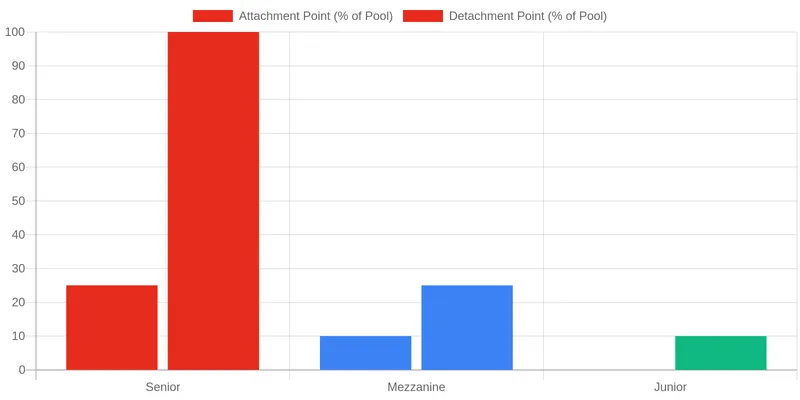
View data as table
| Tranche Type | Attachment Point (% of Pool) | Detachment Point (% of Pool) | Typical Credit Rating | Primary Risk Factor |
|---|---|---|---|---|
| Senior | 25.0% | 100.0% | A to AAA | Systemic economic shock |
| Mezzanine | 10.0% | 25.0% | BB to BBB | Moderate recovery underperformance |
| Junior | 0.0% | 10.0% | Not Rated | Any deviation from expected recoveries |
Optimizing Investment Strategies Through Waterfall Analysis
Waterfall analysis allows investors to tailor strategies to their risk appetite and return objectives. Dissecting cash flow mechanics helps identify the most suitable tranche profile, from stable, lower-yield senior notes to high-risk, high-reward junior securities.
Mitigating Risk and Maximizing Returns
Investors can stress test cash flow models to see how tranches perform under adverse economic conditions. For example, modeling lower NPL recovery rates can quantify a mezzanine tranche’s potential losses and determine if its yield adequately compensates for that risk. This analysis enables investors to make decisions based on a deal’s structural protections, not just credit ratings.
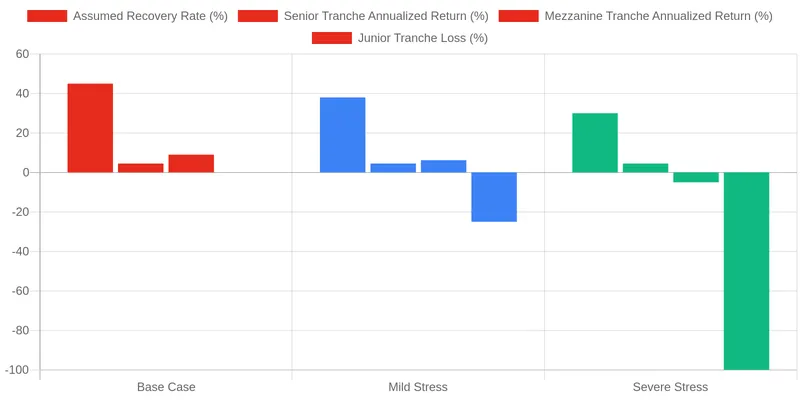
View data as table
| Recovery Scenario | Assumed Recovery Rate (%) | Senior Tranche Annualized Return (%) | Mezzanine Tranche Annualized Return (%) | Junior Tranche Loss (%) |
|---|---|---|---|---|
| Base Case | 45.0 | 4.5 | 9.0 | 0.0 |
| Mild Stress | 38.0 | 4.5 | 6.2 | -25.0 |
| Severe Stress | 30.0 | 4.5 | -5.0 | -100.0 |
The Role of Due Diligence in Tranche Selection
Tranche selection requires due diligence beyond the numbers. This includes a legal review of transaction documents to confirm waterfall mechanics and a qualitative assessment of the NPL servicer, whose effectiveness is key to the portfolio’s success. Understanding these elements is central to valuing and trading NPL-backed securities and building a resilient portfolio.
Join Europe’s Elite at Our Next NPL & Structured Finance Forum
Analyzing waterfall structures and tranche risk is a critical skill for deal-making in European distressed debt markets. At DDTalks events, these topics are debated by practitioners from firms like Blackstone, Ares Management, and PIMCO. Join investors, bankers, and servicers shaping NPL securitisation. Enhance your network, originate deals, and deepen your expertise. For our upcoming conferences in London, Madrid, and other European capitals, contact us or Request Agenda for our next forum.
Conclusion
An NPL ABS investment’s integrity hinges on its payment waterfall. For investors, a key criterion is the structural resilience of their chosen tranche under stress, not just projected return. Market participants must perform due diligence on servicer capabilities and the legal soundness of payment priority. Mastery of these structural mechanics will define success in European markets through 2026. To engage with market experts, Request Agenda for our next event or contact us to explore speaking and sponsorship opportunities.
Frequently Asked Questions
What are common performance triggers that alter an NPL ABS waterfall’s payment priority?
Common performance triggers include Cumulative Default Rate (CDR) and Delinquency Rate thresholds. For instance, if the portfolio’s CDR exceeds a predefined level, such as 15%, the waterfall can switch from a ‘pro-rata’ paydown to a ‘sequential’ paydown. This change prioritizes the rapid amortization of senior tranches to de-risk the structure for senior noteholders.
How do overcollateralization (OC) tests interact with the payment waterfall to protect investors?
Overcollateralization tests act as a crucial safety mechanism within the waterfall. If the ratio of the underlying asset pool’s value to the outstanding notes falls below a specified trigger level (e.g., 110%), the waterfall diverts all available principal and excess spread to pay down the most senior notes. This continues until the OC test is “cured,” thereby rebuilding credit enhancement for the senior tranches.
How are servicer fees typically prioritized within the NPL ABS payment waterfall?
Servicer fees are split into senior and subordinate payments to align incentives. The senior or primary servicing fee is typically paid at the very top of the waterfall, even before senior note interest, to ensure the active management and collection on the NPL portfolio. Conversely, performance-based “special servicer” fees are often paid much lower down, subordinate to note interest, rewarding the servicer only after investors have received their expected payments.
What key assumptions are most sensitive when modeling waterfall structures tranche risk for Iberian NPL portfolios?
When modeling NPLs from Spain or Portugal, the most sensitive assumptions are recovery timing and recovery rates. Analysts must accurately forecast the average time to liquidation, which can range from 36 to over 60 months for secured assets, and apply differentiated recovery rate assumptions for different collateral types (e.g., residential mortgages vs. unsecured SME loans). Small changes in these timing assumptions can significantly impact the net present value (NPV) of cash flows to junior and mezzanine tranches.
How do rating agencies like Fitch or Moody’s assess the robustness of a waterfall structure?
Rating agencies run extensive stress tests on the waterfall using proprietary models, such as Moody’s CDOEdge. They analyze the structure’s ability to withstand severe economic scenarios by stressing default rates, recovery amounts, and recovery timing. The final rating for a tranche depends on the level of subordination, the strength of performance triggers, and whether the tranche can absorb these stressed losses without defaulting on its payment obligations.
Beyond absorbing first losses, what other function does the junior tranche serve in an NPL ABS deal?
The junior tranche, or equity piece, serves a critical regulatory function by often being used to satisfy risk retention rules, such as the 5% requirement under the EU Securitisation Regulation. Furthermore, the holder of the junior tranche frequently retains the right to appoint or replace the special servicer. This gives them significant influence over the workout strategy for the underlying non-performing loans, directly impacting the portfolio’s recovery performance.




0 Comments