

Private Securitisation Structures: Optimizing European Credit Fund Strategies
Private securitisation structures offer European credit managers a flexible mechanism to finance illiquid assets and transfer credit risk. This article details how these bespoke arrangements enable direct lending funds to pool assets like corporate loans, issuing debt securities to select institutional investors. Readers will learn about the role of the Special Purpose Vehicle (SPV), the critical waterfall structure for cash flow distribution, and key distinctions from public securitisations. Understanding these private securitisation structures is essential for optimizing capital management and navigating European securitisation regulation effectively.
DDTalks specializes in organizing premium annual B2B financial conferences across Europe, focusing on private credit, NPL, and structured finance. Our platforms facilitate high-value deal-making and provide critical insights into complex financial instruments and market trends for institutional investors and credit managers.
To explore your options, contact us to schedule your consultation. You can also reach us via: Request Agenda
What are Private Securitisation Structures for Credit Managers?
Private securitisation is a financial technique where a credit manager pools a portfolio of illiquid assets, such as corporate loans or receivables, and issues debt securities backed by these assets to a select group of qualified institutional investors. The purpose is to transform future cash flows from these assets into tradable notes, transferring credit risk from the originator to the investors who purchase the securities.
Defining Private Securitisation in the European Context
In the European market, private securitisation structures are a tool for alternative asset managers, particularly in direct lending and private credit. Unlike public securitisations, which are broadly offered and listed on stock exchanges, these private transactions are bespoke arrangements negotiated directly with a limited number of sophisticated investors, such as pension funds, insurance companies, and other asset managers.
This approach allows for greater flexibility in structuring terms, collateral pools, and repayment profiles to match the assets and the risk appetite of the investors. The process is governed by a distinct set of regulatory considerations, offering a more streamlined execution path compared to the extensive disclosure and rating requirements of public market offerings.
How Do Private Securitisations Work for European Credit Funds?
The mechanics of a private securitisation involve several key components and participants. The process begins when a credit manager (the originator) identifies a pool of income-generating assets on its balance sheet to finance or transfer risk from. These assets are sold to a newly created, bankruptcy-remote legal entity known as a Special Purpose Vehicle (SPV).
The Role of the SPV and Waterfall Structure
The Special Purpose Vehicle (SPV) purchases the assets from the originator and issues debt securities—or notes—to investors. By isolating the assets in the SPV, they are shielded from any potential credit events or bankruptcy affecting the originator. This legal separation is fundamental to the credit risk transfer process.
The SPV issues different classes, or tranches, of notes, each with a different level of risk and return. Cash flows from the underlying assets (e.g., loan repayments) are collected and distributed to noteholders according to a predefined hierarchy known as the waterfall structure. Senior noteholders are paid first and bear the least risk, while junior and equity tranche holders are paid last but have the potential for higher returns, absorbing initial losses.
Private vs. Public Securitisation: Key Distinctions
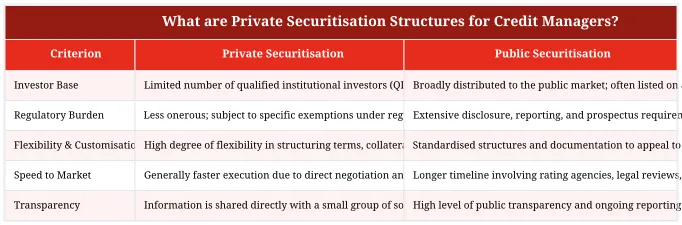
While both private and public securitisation achieve similar goals of risk transfer and funding, their execution and target audience differ.
View data as table
| Criterion | Private Securitisation | Public Securitisation |
|---|---|---|
| Investor Base | Limited number of qualified institutional investors (QIIs) | Broadly distributed to the public market; often listed on an exchange |
| Regulatory Burden | Less onerous; subject to specific exemptions under regulations like the EU Securitisation Regulation | Extensive disclosure, reporting, and prospectus requirements |
| Flexibility & Customisation | High degree of flexibility in structuring terms, collateral, and covenants | Standardised structures and documentation to appeal to a wide market |
| Speed to Market | Generally faster execution due to direct negotiation and fewer regulatory hurdles | Longer timeline involving rating agencies, legal reviews, and regulatory filings |
| Transparency | Information is shared directly with a small group of sophisticated investors | High level of public transparency and ongoing reporting is mandatory |
Why European Credit Managers Leverage Private Securitisation
For European private credit funds and direct lenders, bespoke securitisation provides strategic advantages beyond financing. These structures are integral to portfolio management, capital optimisation, and growth strategies.
Optimizing Capital and Risk Management
A primary driver for private securitisation is capital efficiency. By selling assets to an SPV, a credit manager can remove them from its balance sheet. This can provide regulatory capital relief, freeing up capacity to originate new loans and expand business activities without raising additional equity. This is a key component of asset-backed finance in Europe.
The technique allows for precise management of credit risk. A fund can sell the riskiest portion of its portfolio (the equity or junior tranches) while retaining the senior, lower-risk tranches. This targeted credit risk transfer allows managers to fine-tune their portfolio’s risk profile to align with their fund’s mandate and investor expectations.
Accessing Bespoke Institutional Funding
Private securitisation provides access to institutional capital that may otherwise be inaccessible. Many institutional investors, such as insurance companies, have specific risk, duration, and yield requirements met by the customised tranches of a private deal. This allows credit managers to create tailored funding solutions that match their underlying assets, whether they are middle-market corporate loans, infrastructure debt, or real estate credit.
This bespoke nature enables managers to build long-term relationships with institutional partners, creating a reliable and repeatable source of funding for their origination platforms. The ability to structure deals that align with both the asset portfolio and investor appetite is an advantage over more rigid financing options.
Structuring Private ABS and CLOs for Optimal Outcomes
A private securitisation’s success depends on its structure, which requires consideration of the underlying collateral, liability tranching, and investor protection mechanisms. These elements are tailored to create securities that meet the risk-return objectives of the credit manager and investors.
Eligible Assets and Collateral Management
Many assets originated by private credit funds can be securitised. The most common are middle-market corporate loans, pooled into Collateralized Loan Obligations (CLOs). The technology also applies to other asset classes, creating Asset-Backed Securities (ABS) from pools of:
- Commercial real estate loans
- Infrastructure and project finance debt
- Trade receivables and supply chain finance
- Equipment leases
- NAV and other fund financing facilities
Collateral management involves establishing clear eligibility criteria for the assets in the pool, along with rules for managing asset concentrations and reinvesting principal proceeds during a defined reinvestment period.
Credit Enhancement and Tranching Strategies
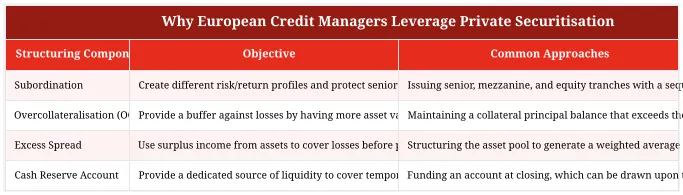
Credit enhancement techniques improve the credit quality of the issued notes. The primary method is subordination, achieved through the waterfall structure where junior tranches absorb losses before senior tranches. Other common techniques are detailed below.
View data as table
| Structuring Component | Objective | Common Approaches |
|---|---|---|
| Subordination | Create different risk/return profiles and protect senior noteholders. | Issuing senior, mezzanine, and equity tranches with a sequential payment priority. |
| Overcollateralisation (OC) | Provide a buffer against losses by having more asset value than debt issued. | Maintaining a collateral principal balance that exceeds the note principal balance. |
| Excess Spread | Use surplus income from assets to cover losses before principal is affected. | Structuring the asset pool to generate a weighted average interest rate higher than the note coupons. |
| Cash Reserve Account | Provide a dedicated source of liquidity to cover temporary shortfalls. | Funding an account at closing, which can be drawn upon to make timely payments to noteholders. |
Connect with European Private Credit Leaders at DDTalks
Implementing private securitisation requires market intelligence and industry connections. DDTalks provides a platform for European private credit, structured finance, and distressed debt professionals to discuss trends and facilitate deals.
Our conferences in London and Madrid bring together leading GPs, LPs, investment bankers, and legal advisors. To learn about upcoming events, Request Agenda or contact us.
Conclusion
Private securitisation structures are a tool for European credit managers to optimize capital, manage risk, and access diverse funding sources. Their flexibility and bespoke nature suit the portfolios in direct lending and private credit. Managers must balance the structural complexity and execution costs against the benefits of capital efficiency and tailored risk transfer. The next step for a fund manager is to engage with expert legal and financial advisors to model a structure that aligns with their portfolio and strategic goals.
Frequently Asked Questions
How does a private securitisation differ from a syndicated loan for funding a credit portfolio?
A private securitisation transfers credit risk from the originator to capital markets investors by creating tradable securities backed by a specific asset pool. In contrast, a syndicated loan involves multiple banks sharing the credit risk on their own balance sheets without creating new, separately traded instruments. Securitisation provides term-matched, non-recourse funding, whereas syndicated loans are typically recourse to the borrower.
What specific risk retention requirements apply under the EU Securitisation Regulation?
Under Regulation (EU) 2017/2402, the originator, sponsor, or original lender must retain a material net economic interest of not less than 5% in the securitisation. This “skin-in-the-game” rule ensures an alignment of interests between the entity managing the assets and the end investors. This requirement applies to all European securitisations, including private placements.
Which jurisdictions are most commonly used for SPVs in European private credit deals?
European credit managers typically establish Special Purpose Vehicles (SPVs) in jurisdictions known for their robust legal frameworks and tax neutrality for such structures. Ireland and Luxembourg are the dominant choices due to their established financial infrastructure, expertise in servicing securitisation vehicles, and recognition by international investors.
How do these structures handle defaults within the underlying asset pool?
Defaults are managed through a predefined payment “waterfall” where cash flows from the asset pool are distributed based on seniority. Losses are first absorbed by the most junior tranche (often called the equity tranche), protecting the mezzanine and senior tranches. This subordination mechanism is a core feature that allows a single pool of assets to create securities with vastly different risk-return profiles.
What is the typical role of a rating agency in a private placement securitisation?
Unlike public deals, private securitisation structures are often unrated by agencies like Moody’s or S&P. The due diligence is instead performed directly by the small number of sophisticated institutional investors purchasing the notes. These investors rely on their own internal credit analysis and the detailed reporting provided by the asset manager, making the transaction more bespoke and faster to execute.
Can ESG criteria be integrated into the asset selection for these transactions?
Yes, integrating Environmental, Social, and Governance (ESG) criteria is a growing trend in the European market. Managers can structure deals where the underlying collateral pool must meet specific ESG scores or adhere to exclusion lists, creating a “green” or “social” securitisation. This approach helps managers meet specific investor mandates and align their funding strategies with broader sustainability goals.




0 Comments