

Italian NPL Portfolio Pricing: Understanding GACS Impact
The GACS scheme significantly influences italian npl portfolio pricing by de-risking senior tranches within NPL securitisations. This government guarantee elevates senior notes to investment-grade status, broadening their appeal to institutional investors seeking lower credit risk. Consequently, originating banks can achieve higher valuations for their non-performing loan portfolios. The mechanism clarifies risk across all tranches, impacting the valuation of mezzanine and junior tranches by providing a clearer risk-reward profile for distressed debt investors. This structured approach facilitates efficient NPL disposals and enhances market liquidity.
DD Talks provides authoritative insights into European distressed debt and NPL markets through its premium B2B financial conferences. Our events connect institutional investors, GPs, and servicers, fostering high-value deal-making and industry networking in structured finance.
To explore your options, contact us to schedule your consultation. You can also reach us via: Request Agenda
Understanding Italian NPLs and the GACS Scheme
The Italian government’s guarantee scheme impacts italian npl portfolio pricing by de-risking a securitisation’s senior tranche. This state guarantee allows senior notes to achieve an investment-grade credit rating, making them accessible to more institutional investors and enabling originating banks to secure a higher price for the non-performing loan portfolio.
The Landscape of Italian Non-Performing Loans
The Italian banking sector held significant non-performing loans (NPLs) from prolonged economic stagnation. These distressed assets, including sofferenze (bad loans) and Unlikely to Pay (UTP) exposures, pressured bank balance sheets, restricting new lending and impacting financial stability. The wide bid-ask spread created a market bottleneck, requiring a mechanism for large-scale disposals.
What is the GACS Scheme and How Does it Work?
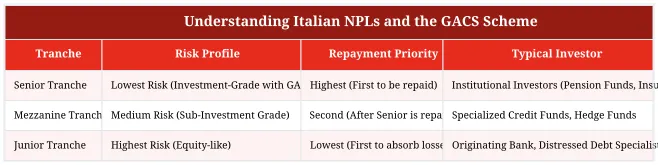
The “Garanzia sulla Cartolarizzazione delle Sofferenze” (GACS) is a state guarantee from the Italian government to accelerate reducing NPLs on bank balance sheets. The scheme targets the least risky portion of a securitisation, not the entire NPL portfolio. In an NPL securitisation, a bad loan portfolio is sold to a Special Purpose Vehicle (SPV), which issues asset-backed securities (notes) in different risk tranches.
The GACS guarantee applies only to the senior tranche, the first to receive payments from loan recoveries. To qualify, this tranche must get an investment-grade rating (BBB- or higher) from an independent credit rating agency. By guaranteeing payments on senior notes, the government removes substantial credit risk, making them a safer asset for investors like pension funds and insurance companies.
How GACS Transforms NPL Securitisation & Tranche Valuation
The GACS scheme alters the risk profile and valuation of an NPL securitisation. By isolating and guaranteeing senior notes, it distinguishes risk and reward across the capital structure, influencing investor appetite for each tranche.
De-risking the Senior Tranche: From Sub-Investment Grade to Investment Grade
Without a guarantee, an NPL securitisation’s senior tranche would typically have a sub-investment-grade rating because of uncertain recovery cash flows from distressed debt. This limits the investor base to specialized credit funds. The GACS guarantee is a credit enhancement that elevates senior notes to investment-grade status, unlocking demand from risk-averse institutional capital often mandated to hold only investment-grade assets. The increased demand and reduced credit risk lead to a lower yield (funding cost) and a higher price for the senior notes.
Impact on Mezzanine and Junior Tranches
While GACS does not cover mezzanine and junior tranches, its effect on senior notes has indirect consequences. A successful senior tranche makes the securitisation more viable. Investors in the mezzanine and junior tranches benefit from a more stable structure. The senior notes’ sale provides the originating bank with liquidity, making the NPL disposal more favorable. This can lead to more competitive pricing and investor interest in the higher-risk, higher-return junior notes, often retained by the originator or sold to specialist distressed debt investors.
View data as table
| Tranche | Risk Profile | Repayment Priority | Typical Investor |
|---|---|---|---|
| Senior Tranche | Lowest Risk (Investment-Grade with GACS) | Highest (First to be repaid) | Institutional Investors (Pension Funds, Insurers) |
| Mezzanine Tranche | Medium Risk (Sub-Investment Grade) | Second (After Senior is repaid) | Specialized Credit Funds, Hedge Funds |
| Junior Tranche | Highest Risk (Equity-like) | Lowest (First to absorb losses) | Originating Bank, Distressed Debt Specialists |
Quantifying the Impact: GACS and NPL Portfolio Pricing Dynamics
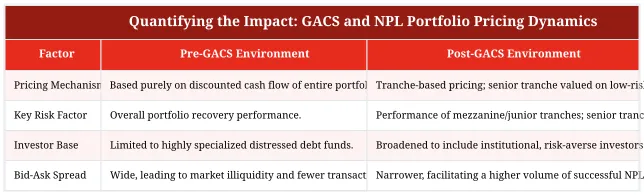
The GACS scheme narrowed the valuation gap in the Italian NPL market. It influenced loan portfolio valuation by changing risk assumptions and improving market liquidity, a key component of the italian npl portfolio pricing process.
Valuation Methodologies for GACS-Backed NPLs
NPL portfolio valuation begins with Gross Book Value (GBV), the total outstanding loan amount. The purchase price is a fraction of GBV, determined by estimating future cash flows from loan recoveries, discounted to present value. Key variables include recovery rate, recovery time, and legal and servicing costs. GACS alters this calculation by adding certainty to a large part of the capital structure. The guaranteed senior tranche can be valued with a lower discount rate, reflecting its low credit risk. This higher valuation for senior notes increases the total proceeds the originating bank receives for the portfolio.
Pre-GACS vs. Post-GACS Pricing: A Comparative Analysis
The market dynamics for valuing Italian NPLs shifted after GACS. The scheme provided a pricing uplift and standardized the securitisation process, creating a more liquid secondary market. This affects how buyers and sellers approach distressed asset transactions, including the recent finalization of major NPL securitizations.
View data as table
| Factor | Pre-GACS Environment | Post-GACS Environment |
|---|---|---|
| Pricing Mechanism | Based purely on discounted cash flow of entire portfolio; high uncertainty. | Tranche-based pricing; senior tranche valued on low-risk yield, improving overall price. |
| Key Risk Factor | Overall portfolio recovery performance. | Performance of mezzanine/junior tranches; senior tranche risk is mitigated. |
| Investor Base | Limited to highly specialized distressed debt funds. | Broadened to include institutional, risk-averse investors for senior notes. |
| Bid-Ask Spread | Wide, leading to market illiquidity and fewer transactions. | Narrower, facilitating a higher volume of successful NPL disposals. |
Strategic Implications for Investors and Financial Institutions
The GACS framework reshaped strategies for participants in the Italian distressed debt market. For institutional investors, it created a new, safe asset class. For banks and servicers, it provided a way to clean up balance sheets. These shifts affect italian npl portfolio pricing.
Navigating Investment Opportunities in the Italian NPL Market
For institutional investors and LPs, GACS-backed senior notes offer a stable, investment-grade entry point to the Italian credit market. Analysis focuses on the securitisation’s structural integrity and the government guarantee’s reliability. Opportunistic investors focus on the mezzanine and junior tranches for higher returns. This requires due diligence on the loan portfolio and the servicer’s capabilities. The NPL market in Southern Europe presents complex opportunities for specialists.
The Evolving Role of Servicers and Originators
For originating banks, GACS is an effective deleveraging tool. Selling NPL portfolios at favorable prices has accelerated reducing non-performing exposures, as noted by the Bank of Italy. This improved capital ratios and allowed banks to refocus on core lending. For NPL servicers, the scheme increased the volume of securitised portfolios under management. Their performance in maximizing recoveries is critical, as it impacts returns for mezzanine and junior noteholders and determines if the GACS guarantee is called upon.
Beyond GACS: Future Trends in Italian Distressed Debt
As the GACS scheme ends and legacy bad loans diminish, the Italian distressed debt market’s focus is shifting. New asset classes and evolving regulations will define the next chapter for investors and financial institutions.
The Rise of UTPs and New Market Challenges
With many sofferenze resolved, the market is turning to Unlikely to Pay (UTP) loans. Unlike bad loans tied to insolvent borrowers, UTPs are exposures to borrowers in financial difficulty but still operating. Managing UTPs requires a different skill set than NPLs; the goal is to return the borrower to performing status through restructuring and new financing, not liquidation. This “turnaround” approach has unique valuation challenges and requires servicers with corporate restructuring expertise, not just collections capabilities. While Italian banks have reduced legacy NPLs, new challenges are emerging.
Regulatory Shifts and Their Influence on Portfolio Management
The European regulatory environment is evolving. Directives like AIFMD II and new ECB guidelines shape how funds are structured and how banks manage credit risk. Increased capital requirements and stricter provisioning rules for non-performing exposures push banks to address credit deterioration earlier. This will likely generate a flow of UTP and Stage 2 loans into the market, creating opportunities for specialized credit investors. These regulatory pressures will remain a primary driver of transaction activity in Italy.
Connect with Industry Leaders at DD Talks Events
European distressed debt and private credit dynamics are evolving. Gain insights from the dealmakers, regulators, and institutional investors shaping these markets at our B2B conferences. Our events provide a platform for networking and analysis of market trends, from NPL securitisation to direct lending strategies.
Engage with GPs, LPs, and advisors to form partnerships and find opportunities. For our upcoming events in London, Madrid, and Europe, Request Agenda or explore our conference lineup.
Conclusion
The GACS scheme reshaped Italian NPL portfolio pricing and enabled a cleanup of bank balance sheets. By de-risking senior tranches, it created a more liquid market. Now, investors must adapt to a market shifting from legacy bad loans to complex UTPs. Market participants need specialized skills to value and manage these turnaround situations. To stay ahead, contact us about our industry events or Request Agenda for our next NPL and Private Credit forum.
Frequently Asked Questions
How does the GACS guarantee specifically affect the valuation of senior versus junior tranches?
The GACS guarantee is designed to elevate a securitisation’s senior tranche to an investment-grade credit rating, which significantly increases its market value and liquidity. Conversely, the junior and mezzanine tranches remain un-guaranteed and absorb first losses, meaning their valuation depends entirely on the underwritten recovery forecasts of the underlying NPL assets.
Are Unlikely-to-Pay (UTP) loans typically included in GACS-backed securitisations?
No, the GACS scheme was specifically designed for non-performing loans classified as sofferenze (bad loans). Unlikely-to-Pay (UTP) exposures are generally ineligible because they often require active corporate restructuring, a workout strategy incompatible with the GACS framework which is focused on liquidation recoveries.
What role do credit rating agencies play in the GACS process?
Credit rating agencies, such as Moody’s or S&P Global Ratings, are integral to the GACS structure. They must assign an investment-grade rating to the senior notes for the state guarantee to become effective. Their independent analysis of the portfolio’s expected cash flows and structural protections is a prerequisite for the transaction, directly influencing the final italian npl portfolio pricing.
For investors, what is the primary risk associated with the non-guaranteed mezzanine and junior tranches?
The primary risk for investors in junior and mezzanine tranches is the actual performance of the underlying loan portfolio versus the original business plan. Since these tranches are first in line to absorb any shortfalls in collections, their financial return is highly sensitive to the special servicer’s effectiveness in managing judicial processes and out-of-court settlements in Italy.
How did the evolution of the GACS scheme impact servicer performance requirements?
Later renewals of the GACS scheme introduced stricter rules, including performance-based triggers tied to the servicer’s actual recovery rates versus projections. If collections fall below predefined thresholds, control rights within the securitisation can shift, which has forced market participants to adopt more conservative assumptions in their initial pricing models.
Besides GACS securitisations, what other transaction structures are common for Italian distressed debt?
Beyond GACS, direct portfolio sales to specialist credit funds and institutional investors remain a prominent transaction method, especially for smaller or more complex portfolios. Additionally, the secondary market for both NPLs and UTPs offers an alternative route for banks and funds to manage distressed asset exposures without undertaking a full public securitisation.




0 Comments