

Significant Risk Transfer: Deleveraging Banks and Optimizing Capital
Significant risk transfer (SRT) transactions enable banks to offload credit risk from loan portfolios, optimizing regulatory capital and facilitating deleveraging. These mechanisms, including synthetic securitisation and true sale structures, reduce Risk-Weighted Assets (RWAs) without selling underlying assets. By achieving significant risk transfer, banks gain crucial regulatory capital relief under frameworks like Basel III, enhancing balance sheet management. This process frees up capital for new lending and strengthens financial positions, making SRT a vital tool for European financial institutions navigating capital requirements.
DDTalks provides authoritative insights into complex financial instruments like SRT, drawing on expertise from leading European private credit and structured finance conferences. Our content supports institutional investors and financial professionals in navigating regulatory landscapes and market opportunities.
To explore your options, contact us to schedule your consultation. You can also reach us via: Request Agenda
What is Significant Risk Transfer (SRT) and Why Does it Matter?
Significant risk transfer (SRT) is a financial transaction enabling a bank to transfer a substantial portion of the credit risk from a loan portfolio to third-party investors. Its primary purpose is to reduce the bank’s Risk-Weighted Assets (RWAs), providing regulatory capital relief and improving balance sheet efficiency.
Banking regulations require banks to hold capital against their assets, with the amount determined by asset riskiness. A large loan portfolio can tie up substantial capital. By transferring the credit risk—the risk of borrower default—banks lower their RWA calculation for that portfolio. This process allows institutions to free up capacity for new lending or strengthen their financial position without selling the underlying assets.
How Do SRT Transactions Work: True Sale vs. Synthetic Structures?
SRT transactions use two main structures: true sale securitisation and synthetic securitisation. The choice depends on the bank’s objectives, the underlying assets, and market conditions.
In a true sale securitisation, the bank legally sells a loan portfolio to a separate Special Purpose Vehicle (SPV). The SPV issues securities to investors, backed by the portfolio’s cash flows. This achieves risk transfer by removing the assets from the bank’s balance sheet.
Synthetic securitisation achieves risk transfer without the legal sale of assets. The loans remain on the bank’s balance sheet. The bank uses credit derivatives, such as a Credit-Linked Note (CLN), to pass credit risk to investors. The bank issues CLNs, and the proceeds are held as collateral. If losses on the reference loan portfolio exceed a threshold, the collateral compensates the bank. For taking this risk, investors receive regular coupon payments.
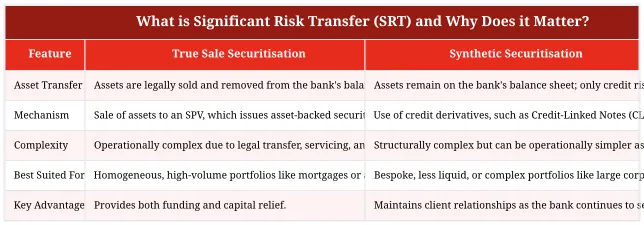
True Sale vs. Synthetic Securitisation: A Comparison
View data as table
| Feature | True Sale Securitisation | Synthetic Securitisation |
|---|---|---|
| Asset Transfer | Assets are legally sold and removed from the bank’s balance sheet. | Assets remain on the bank’s balance sheet; only credit risk is transferred. |
| Mechanism | Sale of assets to an SPV, which issues asset-backed securities (ABS). | Use of credit derivatives, such as Credit-Linked Notes (CLNs) or credit default swaps. |
| Complexity | Operationally complex due to legal transfer, servicing, and SPV management. | Structurally complex but can be operationally simpler as assets are not moved. |
| Best Suited For | Homogeneous, high-volume portfolios like mortgages or auto loans. | Bespoke, less liquid, or complex portfolios like large corporate loans. |
| Key Advantage | Provides both funding and capital relief. | Maintains client relationships as the bank continues to service the loans. |
SRT in the European Market: Opportunities for Institutional Investors
The European SRT market offers significant opportunities for institutional investors like pension funds, insurance companies, private credit funds, and specialized asset managers. As conveners of structured finance and private credit events, we see growing appetite from both General Partners (GPs) and Limited Partners (LPs) for this asset class.
For investors, these deals provide exposure to diversified portfolios of performing bank loans that are otherwise inaccessible. Returns can be attractive, reflecting the complexity and illiquidity premium of these instruments. Investors can choose their risk level by investing in different tranches, from safer senior tranches to higher-yielding junior and mezzanine tranches.
Connecting SRT to Private Securitisation Structures
Many SRT transactions are private placements, aligning with private credit dynamics. These deals are often customized for the bank’s needs and the risk appetite of select institutional investors. They demonstrate how private securitisation structures for European credit managers are used to create value and manage risk.
Beyond Deleveraging: The Broader Impact of SRT on Bank Balance Sheets
While capital relief is a primary driver, SRT’s strategic impact extends beyond deleveraging. These transactions are a tool for bank balance sheet management and credit risk mitigation. By transferring risk on a specific portfolio, a bank can reduce its concentration in an industry, geography, or asset class, creating a more resilient and diversified loan book.
Freeing up capital from legacy portfolios enables banks to redeploy it into new, higher-yielding lending opportunities, supporting economic activity. This makes banks more agile in responding to market demands without being constrained by capital tied up in existing assets. SRT transforms capital management from a defensive, regulatory-driven exercise into a strategic function that enhances profitability.
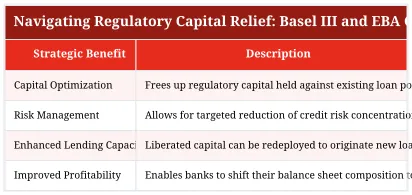
View data as table
| Strategic Benefit | Description |
|---|---|
| Capital Optimization | Frees up regulatory capital held against existing loan portfolios, improving the bank’s capital ratios (e.g., CET1). |
| Risk Management | Allows for targeted reduction of credit risk concentration in specific sectors, industries, or geographic regions. |
| Enhanced Lending Capacity | Liberated capital can be redeployed to originate new loans, supporting business growth and strategic objectives. |
| Improved Profitability | Enables banks to shift their balance sheet composition towards higher-return assets, improving metrics like Return on Equity (ROE). |
The Future of SRT: Trends and Market Evolution in European Finance
The SRT market is evolving. Several trends are shaping its future in Europe. Regulators continue to refine rules, and the EBA’s work on the securitisation framework remains a critical factor influencing transaction structures.
One trend is the expansion of asset classes in SRT transactions. While large corporate loans were a mainstay, portfolios of SME loans, private credit assets, and ESG-linked loans are now being securitised. This broadening creates new opportunities for banks and investors. The investor base is also becoming more sophisticated, better understanding the risks and rewards, which leads to more innovative transaction structures.
SRT’s Role in Managing Non-Performing Loans and Distressed Debt
While SRT deals typically involve performing loans, they indirectly support a bank’s overall credit health. By freeing up capital and management resources, these transactions enhance a bank’s capacity to manage credit quality across its portfolio. This flexibility is crucial for mastering non-performing loans and addressing distressed debt, contributing to a more stable financial system.
Unlock Exclusive Insights at Europe’s Premier Financial Conferences
Significant Risk Transfer is an intersection of banking, structured finance, and private credit. Navigating this market requires engaging with industry leaders. DD Talks hosts premier B2B conferences across Europe, connecting the dealmakers, investors, and advisors shaping the future of SRT and structured credit.
Join us to gain insights, build relationships, and explore opportunities in the market. To learn more about our events in London, Madrid, and other European financial hubs, contact us or Request Agenda for our next conference.
Conclusion
SRT transactions have evolved from a niche mechanism into a mainstream strategic instrument for European banks. The key decision for banks and investors is not *if* they should engage, but *how* to engage effectively. Banks must identify the right portfolios and structures to meet strategic goals. Investors must develop the expertise to analyze and price complex credit risk. As the market matures, staying informed is crucial. To explore these topics, Request Agenda for our next event or contact us to discuss partnership opportunities.
Frequently Asked Questions
How does a significant risk transfer transaction impact a bank’s CET1 ratio?
By reducing Risk-Weighted Assets (RWAs), a significant risk transfer deal directly improves the Common Equity Tier 1 (CET1) ratio, as the ratio is calculated by dividing CET1 capital by total RWAs. This capital relief allows the bank to support new lending or absorb potential losses more effectively, a key objective under the Basel III framework.
What makes the mezzanine tranche of an SRT deal attractive to private credit funds?
The mezzanine tranche offers a compelling risk-return profile, providing investors with equity-like returns for taking on a specific, defined layer of credit risk. These tranches are often structured to meet the yield targets of specialized credit funds, which have the expertise to analyze the underlying loan portfolio’s performance and model potential loss scenarios.
Why do banks often prefer synthetic SRT structures over true sales for their core loan portfolios?
Synthetic structures allow banks to transfer credit risk without selling the actual loans, which is crucial for maintaining client relationships, especially in corporate and SME lending. This approach also avoids the operational complexity and potential accounting implications of a true sale, where assets are fully removed from the balance sheet.
What specific loan portfolios are most commonly used in European risk-sharing transactions?
While large corporate loan portfolios are traditional mainstays, the market has expanded significantly to include SME loans, auto loans, residential mortgages, and more specialized assets like capital call facilities. Regulators like the European Banking Authority (EBA) provide specific frameworks for assessing risk transfer across these diverse asset classes to ensure compliance.
How do regulators test for ‘commensurate risk transfer’ beyond just the thickness of the first-loss tranche?
Regulators apply both quantitative and qualitative tests under the Capital Requirements Regulation (CRR). Beyond the size of the first-loss piece retained by the bank, they scrutinize the structure for features that could undermine the transfer, such as certain call options or credit enhancement clauses that effectively return risk to the originating bank.



0 Comments