

Counterparty Risk Litigation Funding: Mitigating Funder Default and Ensuring Asset Recovery
Assessing counterparty risk litigation funding is crucial for institutional investors and legal professionals navigating third-party funding agreements. This article provides a framework for evaluating a third-party funder’s financial stability and operational reliability, critical for managing counterparty risk litigation funding. It details how to conduct thorough due diligence, identify risks beyond funder default, and assess capital adequacy. Understanding these elements is vital for mitigating potential disruptions in litigation finance. Effective risk management ensures the continuity of legal proceedings and safeguards asset recovery strategies, especially for NPL portfolios.
DD Talks specializes in facilitating high-value deal-making and industry networking at premium B2B financial conferences. Our events focus on European private credit, NPL, and distressed debt markets, providing platforms for institutional investors and industry leaders to discuss critical risk management strategies.
To explore your options, contact us to schedule your consultation. You can also reach us via: Request Agenda
Third-party litigation funding offers opportunities for asset recovery and NPL strategies but carries significant counterparty risk litigation funding. This risk, centered on a funder’s ability to meet financial obligations, can jeopardize the legal process if not managed. This article provides a framework for institutional investors, general partners, and legal professionals to assess and mitigate risks in third-party funding agreements, ensuring partners are financially sound and operationally reliable.
What is Counterparty Risk in Third-Party Litigation Funding?
In litigation finance, counterparty risk is the probability that the third-party funder will fail its contractual obligations, primarily the commitment to provide capital throughout a legal case. This “funding risk” or “default risk” is a primary concern for claimants and investors, as a shortfall can halt legal proceedings, force an unfavorable settlement, or lead to the complete loss of the claim.
For institutional investors in asset recovery, such as non-performing loan (NPL) portfolios, this risk is magnified. Litigation is often a multi-year process requiring staged capital infusions for legal fees, expert witnesses, and other disbursements. A funder’s default mid-stream withdraws financial support and can trigger adverse cost orders and damage the claimant’s strategic position. Assessing a funding partner’s financial health and commitment is foundational to any litigation-backed investment strategy.
Identifying Key Counterparty Risks: Beyond Funder Default
Beyond the failure to provide capital, a comprehensive assessment must evaluate other risks with a third-party funder. These risks fall into financial, operational, and reputational domains, each able to impact a funded case’s outcome.
Understanding Funder Default and Capital Adequacy
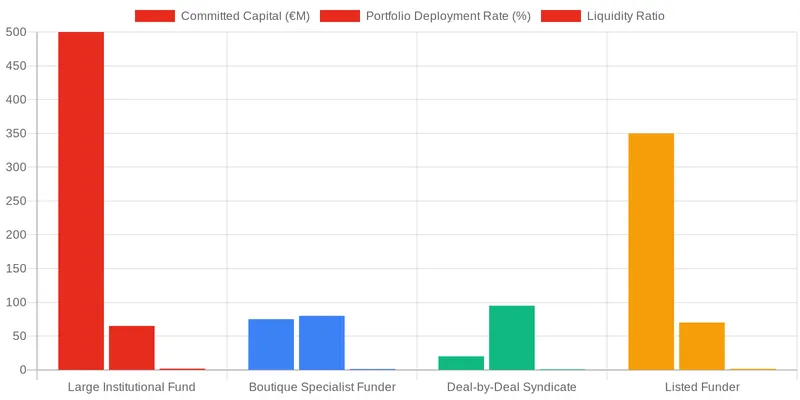
Funder default stems from insufficient capital adequacy—a funder’s ability to meet financial obligations across its entire portfolio. A funder may appear solvent but become overextended by committing to too many cases without sufficient committed capital. Investors must analyze the funder’s balance sheet, liquidity, and source of funds. A funder using a “deal-by-deal” fundraising model has a different risk profile than one with a fully committed, long-term institutional fund. Assessing these European private credit risk management frameworks is essential.
Operational and Reputational Risks of a Third-Party Funder
Operational risk is the potential for loss from inadequate or failed internal processes, people, and systems. In litigation funding, this can manifest as poor case management, inexperienced personnel making strategic decisions, or weak internal controls. A funder’s involvement often extends beyond capital to strategic input, making operational competence a critical factor.
Reputational risk is also important. Association with a funder facing ethical scandals, regulatory sanctions, or public disputes can negatively influence perceptions of the claimant’s case in court and settlement negotiations. A funder’s track record, industry standing, and adherence to ethical guidelines are key indicators of reliability and professionalism.
How Can Investors Mitigate Counterparty Risk with a Litigation Funder?
Mitigating funder risk requires rigorous due diligence. The investigation must extend beyond the legal case’s merits to the funder’s financial and operational integrity. Investors need a systematic approach to verify a funder’s claims and assess its long-term viability.
Comprehensive Due Diligence Framework for Litigation Finance
A due diligence framework should be a standard part of the selection process. It involves reviewing the funder’s audited financial statements, analyzing their investment portfolio (including success rates and case durations), and assessing the management team’s experience. Requesting references from law firms and corporate clients who have worked with the funder is also prudent. Understanding the various litigation funding models for asset recovery provides a baseline for this evaluation.
Scrutinizing Funding Structures: SPVs and Capital Commitments
Many funders use a special purpose vehicle (SPV) to house capital for a case or portfolio. While an SPV can ring-fence assets, investors must understand its capitalization. Is the capital fully committed and held within the SPV, or does the funder rely on future capital calls from limited partners? A structure dependent on future calls adds risk. Verifying committed versus deployed capital and assessing the funder’s overall liquidity are critical to understanding their ability to fulfill long-term obligations. This scrutiny is a core principle in managing risk in European capital markets.
Contractual Safeguards & Regulatory Protections Against Funder Default
The litigation funding agreement (LFA) is the primary tool for mitigating funder default. A well-drafted contract provides clear remedies and protections for the claimant. Europe’s evolving regulatory landscape offers additional oversight and investor protection.
Key Clauses in Litigation Funding Agreements
Essential contractual provisions safeguard against funder non-performance. These include defined default clauses specifying what constitutes a breach and the resulting remedies. Step-in rights can allow the claimant or a replacement funder to take over the funding arrangement. Security interests, such as a charge over the funder’s assets or the capital allocated to the case, can provide direct recourse in an insolvency. Warranties and representations from the funder regarding their financial standing and capital adequacy are also standard protective measures in asset recovery and litigation funding strategies.
Navigating European Regulatory Landscapes for Litigation Finance
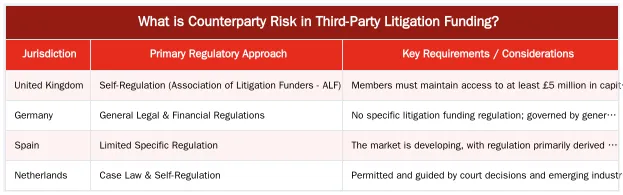
The regulatory environment for litigation funding varies significantly across Europe. The UK relies on self-regulation through bodies like the Association of Litigation Funders (ALF), which imposes capital adequacy requirements on its members. Other jurisdictions may have less specific regulation, treating litigation funding under broader financial services laws like the Alternative Investment Fund Managers Directive (AIFMD), as detailed by authorities like the European Securities and Markets Authority (ESMA). Understanding these nuances is critical for investors operating across multiple European markets.
DD Talks’ Perspective: Mitigating Risk in NPL & Distressed Debt Recovery
Sophisticated investors treat the assessment of counterparty risk litigation funding as a core pillar of their asset recovery strategy. For institutional players acquiring large portfolios of non-performing loans, litigation is a primary driver of returns. The choice of a funding partner is as critical as the valuation of the underlying assets.
Discussions at our events in London and Madrid highlight the need for a funder with deep pockets and a nuanced understanding of legal and commercial challenges within European jurisdictions. The ability to navigate complex cross-border enforcement or intricate insolvency proceedings is a key operational capability that distinguishes top-tier funders.
Integrating Risk Assessment into Institutional Investment Strategy
Leading General Partners and Limited Partners integrate funder due diligence into their investment thesis. They leverage expert networks and market intelligence, often from industry gatherings, to vet potential partners. This process goes beyond a checklist; it involves building relationships and confidence in the funder’s team, strategy, and long-term financial stability. The goal is to secure a strategic partner for the lifecycle of distressed asset recovery.
Ensuring Successful Asset Recovery: The Long-Term View
Successful asset recovery through litigation finance requires long-term risk management. Initial due diligence and contractual negotiation are only the beginning. The relationship with a litigation funder is a multi-year partnership that demands ongoing monitoring and open communication.
Claimants and investors should establish mechanisms for regular updates on the funder’s financial health and portfolio performance. This proactive approach allows for early identification and resolution of potential issues. An adaptable strategy, including contingency planning for a funder default, is a hallmark of a mature investment approach.
By treating funder selection with the rigor of a major investment decision, institutional investors can use litigation finance to unlock value while shielding their strategies from avoidable counterparty risks. This diligence ensures the focus remains on the legal claim’s merits, not the financial partner’s solvency.
Connect with Industry Leaders at DD Talks Events
Navigating litigation finance and counterparty risk requires current market intelligence and expert networks. DD Talks’ B2B financial conferences in London, Madrid, and across Europe provide a platform for institutional investors, NPL servicers, and legal advisors to connect and share insights on these topics.
Gain direct access to leaders shaping the private credit and distressed debt markets. Join discussions on risk management, deal structuring, and asset recovery strategies. To learn about our upcoming NPL & Distressed Debt forums, Request Agenda and explore opportunities to secure your delegate pass.
Conclusion
Assessing and mitigating counterparty risk is a strategic imperative in third-party litigation funding. By conducting rigorous due diligence, negotiating strong contractual safeguards, and maintaining ongoing oversight, investors can protect their interests and ensure the viability of asset recovery initiatives. This disciplined approach transforms litigation finance from a potential liability into a tool for value creation. To engage further on these topics, contact us or Request Agenda for our next European financial conference.
Frequently Asked Questions
What is the primary concern regarding counterparty risk litigation funding?
The primary concern is the funder’s potential inability to meet its financial commitments throughout the case’s lifecycle, known as funding or default risk. This failure can halt legal proceedings and jeopardize the entire asset recovery strategy. A thorough assessment of counterparty risk litigation funding is therefore essential before entering any agreement.
How can investors mitigate counterparty risk litigation funding?
Mitigation requires rigorous due diligence on the funder’s financial stability, capitalisation, and track record. Investors should also negotiate clear contractual terms for capital calls, default cures, and step-in rights. This proactive approach is fundamental to managing the inherent counterparty risk litigation funding.
How does a funder’s legal structure affect counterparty risk litigation funding?
The legal structure is critical; contracting with a single-purpose vehicle (SPV) versus the main fund presents different risk profiles. An SPV may have limited recourse, making it vital to assess the parent fund’s financial stability and any guarantees provided. This analysis is a key component of evaluating the overall counterparty risk litigation funding.
What are the red flags for high financial risk in a litigation funder?
Key warning signs include a lack of transparency about capital sources, an inexperienced management team, or an over-leveraged balance sheet. A portfolio that is heavily concentrated in a few high-risk cases, rather than being well-diversified, also indicates elevated funder instability.
Why is assessing a funder’s stability so crucial for NPL investors?
For investors in non-performing loans (NPLs), litigation is often the final, critical stage of a lengthy asset recovery process. A funder default at this point can lead to a total loss on the underlying asset, making a robust assessment of the funding partner’s reliability a non-negotiable part of the investment thesis.
Where can I learn more about managing risk in NPL and distressed debt investments?
Gaining insights from industry leaders is key to navigating complex financial risks, including those in litigation finance. To connect with top-tier GPs, LPs, and legal advisors discussing these topics, you can explore the agenda for our upcoming European debt summits. Request an agenda to see the full programme and speaker lineup.




0 Comments