

Distressed Real Estate Assets: Commercial & Residential Analysis
Distressed real estate assets present distinct challenges and opportunities across commercial and residential sectors. This article details the fundamental differences in their characteristics, valuation methodologies, and effective workout strategies. Readers will gain insights into assessing commercial real estate NPLs, which rely on income-based approaches, versus residential mortgage-backed securities and REO portfolios, valued by market comparisons. Understanding the role of a special servicer and tailored workout strategies is crucial for navigating these complex markets, particularly within the European economic landscape. This analysis equips investors with essential knowledge for informed decision-making.
DD Talks specializes in premium B2B financial conferences, providing platforms for institutional investors and distressed debt professionals. Our events facilitate high-value deal-making and offer deep insights into European private credit, NPL, and structured finance markets, connecting industry leaders with critical market intelligence.
To explore your options, contact us to schedule your consultation. You can also reach us via: Request Agenda
Defining Distressed Real Estate: Commercial vs. Residential
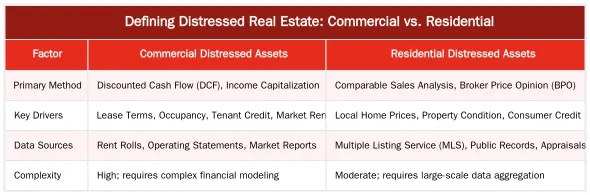
Distressed real estate is property under financial strain from loan defaults, foreclosure, or bankruptcy. The distinction between commercial and residential distressed properties is their economic drivers. Commercial assets are valued on their ability to produce cash flow, while residential assets are tied to borrower credit and local housing market dynamics.
What Distinguishes Commercial from Residential Assets?
Commercial properties, like office buildings, retail centers, or logistics real estate, are income-producing investments. Their value is linked to lease agreements, tenant creditworthiness, occupancy rates, and the business cycle. Investors analyze rent rolls, operating expenses, and market rental rates to determine viability.
Residential properties, including single-family homes and apartment units tied to individual mortgages, are valued by comparable sales analysis. Their distress often results from a homeowner’s inability to meet mortgage obligations because of job loss, interest rate changes, or personal financial hardships. The health of the consumer credit market and local employment rates are key indicators for this asset class.
Key Valuation Methodologies for Distressed Properties
Accurate property valuation is essential for investing in distressed debt. Methods differ between commercial and residential sectors. Commercial valuation focuses on projected income, while residential assessment relies on market comparisons.
Valuing Distressed Commercial Real Estate NPLs
For a commercial real estate NPL, valuation extends beyond the physical asset to the loan. Investors use income-based approaches like Discounted Cash Flow (DCF) analysis, which projects future income streams from the property, considering current vacancies, lease-up periods, capital expenditures, and workout costs. The valuation is adjusted for the risk of stabilizing the asset. A special servicer‘s involvement also influences valuation, as their expertise impacts the resolution timeline and cost.
Assessing Residential Mortgage-Backed Securities & REO Portfolios
Valuing large portfolios of non-performing residential mortgages or Real Estate Owned (REO) properties uses the Broker Price Opinion (BPO) or an appraisal based on comparable sales (“comps”). For large portfolios, this data is aggregated and analyzed statistically. Valuations account for each property’s physical condition, repair costs, and holding costs. Regional housing market health and consumer credit trends are critical inputs.
| Adjustment Factor | Estimated Impact on Value (%) | Typical Cost Range (€) |
|---|---|---|
| High Vacancy (vs. Market) | -15% | N/A (Income Loss) |
| Deferred Maintenance | -10% | €50,000 – €500,000+ |
| Legal & Workout Costs | -5% | €25,000 – €100,000 |
| Market Illiquidity Premium | -8% | N/A (Discount) |
Workout Strategies and the Role of Special Servicers
After acquiring a distressed real estate asset, the focus is resolution. A “workout” is the process of maximizing recovery from non-performing mortgages. This requires specialized skills, particularly in the commercial sector, where the special servicer’s role is paramount.
Effective Strategies for Non-Performing Mortgages
Workout strategies are an alternative to foreclosure. Common approaches include loan modification (adjusting terms for the borrower) or a forbearance agreement (temporarily pausing payments). Other options are a short sale, where the lender accepts less than the total amount owed, or a deed-in-lieu of foreclosure, where the borrower transfers the property title to the lender. Each strategy requires negotiation and understanding the asset’s value and the borrower’s financial situation. Learn more about capitalizing on NPL opportunities through effective strategies.
The Indispensable Role of the Special Servicer
With commercial mortgage-backed securities (CMBS), loans are transferred from a master servicer to a special servicer upon default or imminent default. The special servicer executes the workout strategy for bondholders. Their duties include analyzing the loan, communicating with the borrower, and determining the resolution path that maximizes net present value. This can involve loan restructuring, initiating foreclosure, managing the property post-foreclosure (as REO), and selling the asset. Their expertise in legal frameworks and property management is crucial to protect investor capital.
DD Talks’ Perspective: European Market Insights & Trends
DD Talks convenes Europe’s institutional investors, servicers, and advisors, providing a vantage point on market dynamics. Discussions at our forums highlight the evolving nature of European distressed debt markets, with distinct trends emerging across regions and property sectors.
Current Dynamics in European NPL and Distressed Real Estate
The European market for distressed real estate assets is fragmented, with varying legal and regulatory frameworks across jurisdictions. In 2026, Southern European markets, particularly the Iberian Peninsula, offer opportunities from legacy NPL portfolios, while regions like the DACH countries are seeing new distress in specific commercial sectors. Regulatory pressures on banks to clean up balance sheets drive portfolio sales. For a deeper analysis, explore our definitive guide to Europe’s NPL and distressed debt markets.
Forecasting Distressed Asset Performance: Office, Hospitality, Logistics
Expert panels at DD Talks events forecast divergent performance across commercial property types. The office market faces headwinds from remote work, leading to rising vacancies and distress, particularly for older buildings. Logistics real estate is resilient due to e-commerce growth. Hospitality assets are recovering after significant stress, but performance depends on location and business model. According to firms like PwC, these sector-specific trends are critical for underwriting new investments. Get more expert analysis on key insights on commercial property market trends.
Connect with Industry Leaders at DD Talks Events
DD Talks’ B2B conferences in European financial hubs like London and Madrid facilitate deal-making and strategic discussions. Our events bring together institutional investors, general partners, NPL servicers, and legal advisors to discuss workout strategies, property valuation, and market trends. Engage with decision-makers in the European private credit and distressed asset landscape.
Gain insights to capitalize on market dislocations. Request Agenda for our upcoming NPL & Distressed Debt Forum.
Conclusion
Investing in distressed real estate requires understanding the differences between commercial and residential properties. Valuation methodologies, workout strategies, and management approaches differ for each asset class. As the European market evolves in 2026, staying informed on sector-specific trends and regional dynamics is paramount. Connecting with industry leaders helps investors navigate risks and opportunities. To learn about our industry events, contact us or Request Agenda for our next forum.
Frequently Asked Questions
What is the main difference when evaluating commercial vs. residential distressed real estate assets?
The fundamental difference is their valuation basis. Commercial properties are valued on their ability to generate cash flow from leases, while residential properties are valued based on comparable sales and are more influenced by local housing market dynamics and consumer credit.
Which type of distressed real estate assets typically involves more complex workouts?
Commercial distressed real estate assets usually require more complex workout strategies. This is due to intricate lease structures, diverse tenant profiles, and the need for active asset management, such as capital improvements or re-tenanting, to restore value.
How does due diligence differ for commercial versus residential distressed property portfolios?
For commercial NPLs, due diligence focuses on tenant quality, lease agreements, and market analysis. In contrast, diligence for residential NPL portfolios centers on individual borrower credit data, property valuations (BPOs), and the specific legal status of each mortgage.
What are the primary risks when investing in European distressed real estate assets?
Key risks include navigating jurisdiction-specific insolvency laws, lengthy foreclosure processes, and macroeconomic volatility affecting property values. Successful investment in distressed real estate assets requires deep local market knowledge to mitigate these factors and accurately underwrite recovery values.
How can institutional investors connect with experts on European distressed real estate assets?
Attending specialized industry forums is a prime way to connect with leading GPs, LPs, and servicers in the sector. Events like those hosted by DD Talks provide a dedicated platform for deal-making and gaining insights into the latest trends for distressed real estate assets. You can request an agenda to learn more about our next European summit.




0 Comments