

Post-conference Lead Nurturing: Maximizing Financial Sponsorship ROI
Post-conference lead nurturing is a systematic process for converting event connections into business opportunities. This article outlines strategies for B2B financial sponsors to transform high-value interactions from conferences into a qualified deal pipeline. Learn to implement critical first steps like rapid, personalized event follow-up and build multi-touch sales cadences tailored for institutional investment leads. The content details optimizing nurturing workflows with CRM and marketing automation, ensuring consistent engagement. Ultimately, effective post-conference lead nurturing quantifies sponsorship ROI, justifying future marketing investments in private credit and structured finance sectors.
DD Talks specializes in premium B2B financial conferences, facilitating high-value deal-making and industry networking in European private credit and structured finance markets. Our content draws on extensive experience in event management and deep market expertise, providing actionable insights for sponsors.
To explore your options, contact us to schedule your consultation. You can also reach us via: Request Agenda
What is Post-Conference Lead Nurturing and Why it Matters for Financial Sponsors?
Post-conference lead nurturing is the systematic process of building relationships with potential clients met at an event, guiding them from awareness to business opportunities. For B2B financial sponsors in sectors like private credit and structured finance, this process is a core component for converting sponsorship costs into measurable returns.
Interactions at financial summits are high-value but brief. Without a structured nurturing strategy, the potential of these connections diminishes rapidly. In institutional investment, where sales cycles can span months or years and trust is paramount, a single follow-up email is insufficient. Nurturing ensures your firm remains top-of-mind by providing consistent, relevant value long after the event.
This engagement transforms a contact list into a qualified deal pipeline, linking event presence to revenue generation. It is the basis for evaluating sponsorship ROI at B2B financial summits and justifying future marketing investments.
The Critical First Steps: Speed, Personalization, and Context for B2B Leads
The 24-hour window following a conference is the most critical period for event follow-up. Conversations are fresh, and promptness demonstrates professionalism and interest. Delaying contact lets the interaction’s value fade and gives competitors an opening.
B2B lead nurturing requires personalization beyond using a contact’s name. Initial outreach must re-establish context by referencing a specific topic discussed, a question they asked during a panel, or a shared interest discovered at your booth. This detail shows you listened and valued the conversation, differentiating your message from generic, automated follow-ups.
Crafting the Initial Follow-Up Email
The first email sets the tone for the relationship. It should be concise, valuable, and focused on the lead. Avoid a hard sales pitch; aim to continue the conversation. Key elements include:
- A Specific Subject Line: Mention the event name and a conversation point. For example, “Following up from Private Credit Days Europe | AIFMD II Discussion.”
- A Contextual Opening: Reference your specific interaction. “It was a pleasure discussing the outlook for European NPLs with you at your booth on Tuesday.”
- Provide Value: Offer a relevant resource based on your conversation, such as a market report, a case study on a similar deal, or an article about the regulatory topic you discussed.
- A Clear, Low-Friction Call to Action (CTA): Suggest a brief, defined next step. Instead of “Let’s connect,” propose, “Would you be open to a brief 15-minute call next week to explore this further?”
Building a Multi-Touch Sales Cadence for Institutional Investment Leads
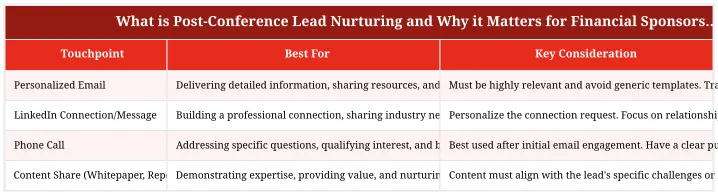
A single contact rarely converts a high-value institutional finance lead. A structured sales cadence—a sequence of multi-channel touchpoints—is essential for long decision-making processes. This sequence maintains momentum without overwhelming the prospect. For complex products like private credit funds or distressed debt portfolios, a cadence might involve 7-13 touches over several months.
Be persistent yet respectful, using mixed channels based on lead preference and seniority. A cadence should alternate between passive and active touchpoints, blending direct outreach with value-added content. This approach builds strategic partnerships, not just transactions.
View data as table
| Touchpoint | Best For | Key Consideration |
|---|---|---|
| Personalized Email | Delivering detailed information, sharing resources, and confirming next steps. | Must be highly relevant and avoid generic templates. Track open and click rates. |
| LinkedIn Connection/Message | Building a professional connection, sharing industry news, and engaging with their content. | Personalize the connection request. Focus on relationship-building, not immediate selling. |
| Phone Call | Addressing specific questions, qualifying interest, and building personal rapport. | Best used after initial email engagement. Have a clear purpose and respect their time. |
| Content Share (Whitepaper, Report) | Demonstrating expertise, providing value, and nurturing long-term interest. | Content must align with the lead’s specific challenges or market interests (e.g., European direct lending trends). |
Leveraging Content Marketing for Sustained Engagement
Content marketing fuels a long-term nurturing sequence. Provide valuable insights to position your firm as a thought leader, rather than repeatedly asking for a meeting. For institutional investors and fund managers, content should include market trend analysis, regulatory updates (like the impact of AIFMD II), and anonymized case studies of successful deals. Inviting leads to a webinar or sharing a proprietary market report maintains engagement and demonstrates industry expertise.
Optimizing Your Nurturing Workflow with CRM and Marketing Automation
Manually tracking conference leads is inefficient and error-prone. A Customer Relationship Management (CRM) is fundamental for organizing contacts, logging interactions, and managing the sales pipeline. Integrated with marketing automation platforms, a CRM can execute nurturing sequences, saving time and ensuring consistency.
This foundation allows lead segmentation based on event data. For example, you can create separate nurturing tracks for Limited Partners (LPs) interested in direct lending versus General Partners (GPs) seeking co-investment opportunities. Automation can deliver scheduled emails and content, while a CRM workflow can task sales reps with personal calls at impactful moments. This systematic approach is key to scaling your post-conference lead nurturing efforts.
Integrating Conference Data for Smarter Lead Scoring
A powerful use of a CRM is lead scoring—assigning points to leads based on their attributes and behaviors to prioritize follow-up. Conference interactions provide data for this model. Incorporate event-specific details beyond basic firmographics:
- Attendee Type: Assign a higher score to a decision-maker (e.g., a Managing Partner at a pension fund) than an analyst.
- Interaction Quality: A lead who engaged in a 15-minute conversation about a specific fund strategy scores higher than one who only dropped off a business card.
- Expressed Interest: Note the specific topics they showed interest in (e.g., asset-backed finance, NPL portfolios). Engagement with follow-up content on these topics should add to their score.
Refining your lead scoring model with this data lets your sales team focus high-touch efforts on the most promising opportunities, improving efficiency and conversion rates.
Measuring Success: Quantifying Sponsorship ROI Through Effective Nurturing
Event sponsorship success is measured by its return on investment. Post-conference lead nurturing provides the data to connect event spending to business outcomes. Tracking leads in your CRM from the conference allows you to monitor their progression through the sales funnel.
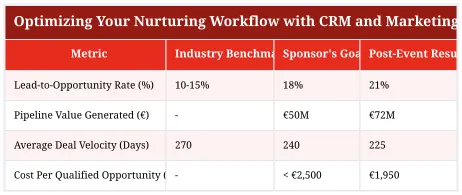
As organizers of European financial events, we at DDTalks know sponsors must demonstrate value. Move beyond vanity metrics like lead counts and focus on pipeline metrics. Track event lead conversions to qualified opportunities, the total pipeline value generated, and the number of closed deals. This data provides a defensible sponsorship ROI calculation and informs future event strategy. For further reading, the Salesforce blog offers guides on lead management principles.
View data as table
| Metric | Industry Benchmark | Sponsor’s Goal | Post-Event Result |
|---|---|---|---|
| Lead-to-Opportunity Rate (%) | 10-15% | 18% | 21% |
| Pipeline Value Generated (€) | – | €50M | €72M |
| Average Deal Velocity (Days) | 270 | 240 | 225 |
| Cost Per Qualified Opportunity (€) | – | < €2,500 | €1,950 |
From Lead to Deal: Tracking the Journey in High-Value Finance
In high-value financial services, the journey from a conference handshake to a closed deal is a marathon, not a sprint. A lead from a private credit summit might not result in a capital allocation for over a year. Nurturing bridges this gap, ensuring your firm is top-of-mind when a need arises. Tracking this long-term journey lets you attribute revenue to the initial event, proving the value of maintaining these industry relationships.
Conclusion
Post-conference lead nurturing is imperative for B2B financial sponsors to convert interactions into deal flow. Prioritizing speed, personalization, and a structured multi-touch approach enhances event sponsorship effectiveness. Event insights provide a foundation for these efforts, turning handshakes into potential collaborations.
To generate leads at European financial forums, contact us about sponsorship opportunities or request an agenda for our upcoming events.
Frequently Asked Questions
What is the ideal timeframe for the first follow-up after a financial conference?
The first personalized follow-up should be sent within 24 hours to maximize recall and capitalize on momentum. According to sales intelligence firm Brevet, 80% of sales require at least five follow-ups, making a prompt first contact critical. Reference a specific conversation point, such as a discussion on AIFMD II or a particular direct lending strategy, to immediately re-establish context.
How should we segment leads from a private credit conference for effective nurturing?
Move beyond simple ‘hot’ or ‘warm’ tags by segmenting based on both intent and professional profile. Create specific tiers in your CRM, such as ‘Tier 1: LP seeking immediate allocation,’ ‘Tier 2: GP exploring co-investment,’ and ‘Tier 3: Advisor gathering market intel.’ This allows you to tailor your content, from specific fund performance data for Tier 1 to broader market analysis for Tier 3.
What type of content is most effective for nurturing institutional investment leads post-event?
Value-added content that demonstrates deep market expertise is most effective for this audience. Instead of a generic sales deck, share a proprietary market report on European NPL trends, a case study on a recent distressed debt workout, or an invitation to a private webinar. This positions your firm as a thought leader and trusted advisor long after the conference ends.
What is a realistic multi-channel cadence for a post-conference lead nurturing campaign?
For high-value B2B finance leads, a 60-90 day multi-touch cadence is standard. This could involve an initial email (Day 1), a LinkedIn connection request (Day 3), sharing a relevant article (Day 14), a brief follow-up email (Day 30), and a call to schedule a meeting (Day 60). Using a CRM to automate reminders and track engagement across all touchpoints is essential for consistency.
How can we re-engage a high-value conference contact who has gone cold?
To re-engage a cold lead, use a new value proposition as a trigger for outreach. This could be a significant market development, an invitation to another exclusive event like our upcoming Madrid forum, or a newly published research piece relevant to their firm’s mandate. Avoid simply “checking in”; provide a compelling, timely reason for them to re-engage with your firm.
What specific CRM metrics track the ROI of post-event nurturing for sponsors?
To accurately measure sponsorship ROI, track metrics beyond lead volume. Focus on Lead-to-Opportunity Conversion Rate, Pipeline Velocity (how quickly leads move through sales stages), and the ultimate Cost Per Acquisition (CPA) calculated against the sponsorship fee. These KPIs provide a clear financial picture of how your follow-up activities are generating tangible business opportunities.

0 Comments