

Receivables Financing Vs Factoring: Optimizing Working Capital for European Smes
Understanding the core differences between receivables financing vs factoring is crucial for European small and medium-sized enterprises (SMEs) seeking efficient working capital solutions. Receivables financing, or invoice discounting, involves using invoices as collateral for a loan, allowing the SME to retain control over collections and customer relationships. Conversely, factoring entails selling invoices to a third party, which then assumes responsibility for credit control and collection, providing a more comprehensive outsourced service. This article clarifies these distinct approaches to invoice financing, enabling SMEs to make informed decisions for enhanced cash flow management.
DDTalks provides strategic insights into complex financial instruments within the European private credit and structured finance markets. Our content aims to equip institutional investors and corporate borrowers with the knowledge to navigate alternative lending solutions effectively.
To explore your options, contact us to schedule your consultation. You can also reach us via: Request Agenda
Receivables Financing vs. Factoring: Understanding the Core Differences for European SMEs
The primary distinction between receivables financing and factoring lies in control and ownership. Receivables financing is a loan secured by your invoices, where you retain ownership and manage customer collections. Factoring involves selling your invoices to a third party, who then takes over the collection process, effectively outsourcing your sales ledger management.
What is Receivables Financing (Invoice Discounting)?
Receivables financing, often called invoice discounting, is a form of asset-backed lending. A small or medium-sized enterprise (SME) uses its accounts receivable ledger as collateral to secure a line of credit or a loan. The business receives an advance of a high percentage of the invoice value, typically up to 90%. The SME remains responsible for its own credit control and for collecting payments from its customers. This solution is confidential, meaning customers are unaware that a third-party financier is involved.
What is Factoring?
Factoring is a financial transaction where a business sells its accounts receivable (invoices) to a third-party financial company, known as a factor. The factor pays the business a large portion of the invoice amount upfront. The factor then owns the invoices and assumes responsibility for collecting the full amount from the business’s customers. This service often includes credit control and sales ledger management, making it a more comprehensive financial service than simple financing.
How Do These Working Capital Solutions Operate in Practice?
The Mechanics of Invoice Discounting for Cash Flow Management
- Invoice Submission: The SME provides goods or services and issues an invoice to its customer as usual. A copy of the invoice is submitted to the financing provider.
- Capital Advance: The financier advances a pre-agreed percentage of the invoice’s value, often within 24-48 hours.
- Internal Collection: The SME’s finance team follows its standard credit control procedures to collect payment from the customer according to the invoice terms.
- Settlement: Once the customer pays the full invoice amount into a designated account, the SME repays the advanced amount to the financier, plus agreed-upon fees and interest. The remaining balance is retained by the SME.
The Factoring Process: Sales Ledger Management and Collections
- Invoice Sale: The SME raises an invoice and sells it to the factoring company.
- Upfront Payment: The factor advances a percentage of the invoice value to the SME.
- External Collection: The factor takes over the sales ledger for the factored invoices and communicates directly with the SME’s customer to collect payment.
- Final Payment: Upon receiving full payment from the customer, the factor pays the remaining balance to the SME, minus their service fee.
Choosing the Right Fit: Recourse, Non-Recourse, and Customer Impact
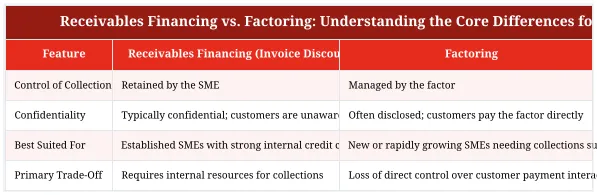
The decision between these two forms of trade finance hinges on an SME’s appetite for risk, the importance of confidentiality, and its internal capacity for credit control.
View data as table
| Feature | Receivables Financing (Invoice Discounting) | Factoring |
|---|---|---|
| Control of Collections | Retained by the SME | Managed by the factor |
| Confidentiality | Typically confidential; customers are unaware | Often disclosed; customers pay the factor directly |
| Best Suited For | Established SMEs with strong internal credit control | New or rapidly growing SMEs needing collections support |
| Primary Trade-Off | Requires internal resources for collections | Loss of direct control over customer payment interactions |
Recourse vs. Non-Recourse: Risk and Responsibility
In a recourse agreement, the SME is liable for any unpaid invoices. If a customer defaults, the business must buy back the debt from the factor or repay the advance. In a non-recourse agreement, the factor assumes the risk of customer non-payment (bad debt), offering the SME protection. This protection comes at a higher cost, and factors will still perform rigorous credit checks on the SME’s customers.
Confidentiality and Customer Relationships
Invoice discounting is almost always confidential. Since the SME handles all collections, the customer relationship is maintained without third-party intervention. This is often preferred by businesses with long-standing client relationships. In contrast, traditional factoring is disclosed. Customers are instructed to pay the factoring company directly, which can signal to the market that the business is using external financing. While this is a standard business practice, some SMEs prefer to keep their financing arrangements private.
Cost, Benefits, and Potential Pitfalls for European SMEs
Assessing the Financial Implications and Benefits for Working Capital
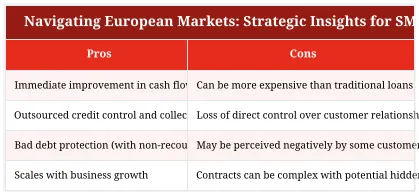
The primary benefit of both solutions is the conversion of outstanding invoices into immediate cash, which can be used to pay suppliers, meet payroll, or fund expansion. The costs, however, are structured differently. Invoice discounting typically involves a discount fee (similar to interest) on the advanced funds. Factoring fees can be more complex, often including a processing fee and a discount charge, with costs varying based on invoice volume, customer credit quality, and whether the arrangement is recourse or non-recourse.
View data as table
| Pros | Cons |
|---|---|
| Immediate improvement in cash flow | Can be more expensive than traditional loans |
| Outsourced credit control and collections | Loss of direct control over customer relationships |
| Bad debt protection (with non-recourse) | May be perceived negatively by some customers |
| Scales with business growth | Contracts can be complex with potential hidden fees |
Identifying and Mitigating Risks in European Factoring Markets
A key risk is becoming overly reliant on one source of funding. It is also vital to partner with a reputable provider. In strong European factoring markets like the UK or Germany, providers are plentiful, but diligence is required to understand contract terms fully, especially regarding fees, contract length, and termination clauses. Diluting control over customer relationships can also be a risk if the factor’s collection practices do not align with the SME’s brand values.
Unlock Strategic Funding Insights at Our Next Event
These topics are central to discussions among General Partners, Limited Partners, and corporate advisors at our exclusive European financial conferences. Our events bring together key players in private credit, distressed debt, and structured finance, facilitating dialogue that shapes deal-making across the continent. Gain direct access to experts defining the future of SME and corporate finance.
Explore our upcoming events to secure your place. For a detailed overview of our sessions, Request Agenda.
Conclusion
The choice between invoice financing and factoring depends on an SME’s specific circumstances. A business with an in-house finance team that prioritizes direct customer relationships may prefer the confidentiality of invoice discounting. Conversely, a scaling business that needs to outsource its credit control function and seeks protection from bad debt can use a full-service factoring arrangement to support growth. The financing solution must align with the company’s operational capabilities and strategic objectives. For more on these private credit strategies, contact us or Request Agenda for our next European forum.
Frequently Asked Questions
How does a lender assess an SME’s eligibility for invoice discounting versus factoring in Europe?
For invoice discounting, lenders in markets like Germany or the UK primarily assess the SME’s own financial health, credit control processes, and ledger management systems. In contrast, for factoring, the assessment shifts heavily to the creditworthiness of the SME’s customers (the debtors), as the factor is buying the debt and assuming collection risk. A strong debtor book can therefore make a less-established SME eligible for factoring.
Which financing option better protects an SME’s customer relationships?
Confidential invoice discounting is generally superior for protecting sensitive customer relationships, as the financing arrangement is not disclosed and you manage all collections communication. With factoring, the factor’s collection methods may not align with your company’s brand or service standards, creating potential friction. This is a critical consideration for businesses in the Iberian Peninsula and beyond that are built on long-term partnerships.
Does non-recourse factoring completely eliminate bad debt risk?
Non-recourse factoring provides significant protection against bad debt arising from a customer’s declared insolvency, acting much like credit insurance. However, it does not typically cover commercial disputes where a customer refuses to pay due to issues with goods or services. The SME remains responsible for resolving these disputes before the factor’s credit protection applies.
What are the typical cost components when comparing receivables financing vs factoring?
Factoring costs are multifaceted, often including a discount charge (interest on the advance), a service fee for ledger management, and a separate credit protection fee for non-recourse arrangements. Receivables financing is generally simpler, with costs primarily consisting of a discount charge and a service or arrangement fee, reflecting its nature as a more straightforward lending product.
How is cross-border factoring managed for trade between EU member states?
Cross-border EU trade is often managed via a “two-factor system” facilitated by global networks like Factors Chain International (FCI). An export factor in the seller’s country collaborates with an import factor in the buyer’s country, who handles local credit assessment and collections. This system effectively overcomes language barriers, differing legal frameworks, and local payment customs common in intra-EU commerce.
When might a fast-growing French tech SME prefer factoring over invoice discounting?
A fast-growing tech SME with a lean administrative team might prefer factoring to completely outsource its credit control and collections. This frees up internal resources to focus on core activities like product development and sales. The operational efficiency and immediate cash injection can be more valuable than maintaining control over a rapidly expanding sales ledger, a key strategic point in the receivables financing vs factoring decision for high-growth companies.




0 Comments