

Structuring an Inventory Financing Deal: ABL Insights
An inventory financing deal provides working capital by using a company’s inventory as collateral, typically structured within an asset-based lending framework. This article details the essential components for structuring such a deal, covering precise inventory valuation, robust borrowing base calculation, and the critical legal framework involving security agreements and UCC filings. Understanding these elements is crucial for both borrowers seeking flexible capital and European private credit investors evaluating an inventory financing deal. It provides insights into managing loan covenants and conducting field examinations, ensuring a secure and efficient financing arrangement.
DDTalks specializes in premium B2B financial conferences, facilitating high-value deal-making in European private credit, NPL, and structured finance markets. Our content reflects deep industry expertise, offering authoritative insights into complex financial structures like asset-backed finance solutions.
To explore your options, contact us to schedule your consultation. You can also reach us via: Request Agenda
What is an Inventory Financing Deal and How Does it Work?
An inventory financing deal is a form of asset-based lending where a company uses its stock—including raw materials, work-in-progress, and finished goods—as collateral to secure a revolving line of credit or a term loan. A thorough valuation of the inventory establishes a “borrowing base,” which is the maximum loan amount, determined by a lender’s assessment of the inventory’s quality, condition, and marketability.
This financing provides working capital for businesses with significant value tied up in their stock. Unlike cash flow-based loans that rely on historical profitability and credit scores, inventory lending is secured by the value of tangible assets. This makes it an option for growing companies, seasonal businesses, or firms with temporary cash flow constraints.
The Role of Asset-Based Lending in Inventory Finance
Asset-based lending (ABL) provides the structure for most inventory financing. In an ABL facility, available credit fluctuates with the value of the underlying collateral. As a company sells inventory and generates accounts receivable, its borrowing capacity adjusts, offering more flexibility than a fixed-term loan.
Inventory is often one component of a larger collateral pool that may also include accounts receivable. Lenders apply different advance rates to each asset class based on its liquidity and risk. Businesses in manufacturing, distribution, or retail can use asset-backed finance solutions to unlock capital for operations and growth.
Calculating the Borrowing Base: The Core of Inventory Lending
The borrowing base dictates the available credit. Its calculation involves inventory valuation, eligibility screening, and applying an advance rate. The borrower submits a periodic “borrowing base certificate” to the lender, detailing the current value of eligible collateral. This document determines credit availability under the facility.
Inventory Valuation Methods and Eligibility Criteria
A lender’s primary concern is the orderly liquidation value (OLV) of the inventory—what it could be sold for in a distressed scenario. Lenders assess the book value using standard accounting methods and then apply their own risk-adjusted criteria. Not all inventory qualifies as eligible collateral.
- Eligible Inventory: Typically includes marketable finished goods and, in some cases, readily usable raw materials.
- Ineligible Inventory: Often includes work-in-progress (WIP), obsolete or slow-moving stock, custom-made goods with limited resale value, and inventory held on consignment.
The lender applies an “advance rate,” a percentage of the eligible inventory’s value, to calculate the borrowing base. This rate varies based on inventory type, industry volatility, and seasonality, often falling between 25% to 65% of the appraised value.

View data as table
| Method | Description | Best Suited For | Lender Consideration |
|---|---|---|---|
| Lower of Cost or Market (LCM) | Values inventory at either its historical cost or its current market replacement cost, whichever is less. | Most industries, as it provides a conservative valuation. | This is the standard starting point for most ABL lenders before applying their own appraisals. |
| First-In, First-Out (FIFO) | Assumes the first units purchased are the first ones sold. In an inflationary environment, this can overstate inventory value. | Businesses with perishable goods or fast-moving stock (e.g., electronics, food). | Lenders may apply a higher discount if FIFO valuation is significantly above current market prices. |
| Last-In, First-Out (LIFO) | Assumes the last units purchased are the first ones sold. This can understate inventory value during inflation. | Industries with non-perishable, homogenous goods (e.g., oil, minerals). | Lenders may view this more conservatively but recognize it can provide a buffer against price declines. |
Field Examinations
A field examination is a due diligence step performed by the lender or a third-party firm before closing a loan and periodically thereafter. The examiner visits the borrower’s premises to verify the inventory’s existence and condition. The examination also includes a review of the company’s books, records, and internal controls for inventory management. The audit’s findings impact the borrowing base calculation and can confirm or adjust the lender’s valuation and advance rate.
Strategic Considerations for European Private Credit Investors
For institutional investors and General Partners (GPs) in European private credit, inventory financing is a segment within asset-backed finance strategies. These transactions offer secured, often floating-rate returns attractive in various interest rate environments. Demand for these working capital solutions is robust, particularly among the small and medium-sized enterprises (SMEs) that are a large part of the European economy.
Structuring these deals requires sector expertise and due diligence, aligning with the competencies of specialized direct lending funds. The complexities of cross-border European commerce, including different legal perfection regimes and supply chain logistics, create opportunities for knowledgeable lenders to generate alpha. According to market analysis by institutions like the European Central Bank, non-bank lending plays a role in funding the economy, and asset-based facilities are part of this ecosystem.
Inventory Financing within Broader ABF Strategies
Inventory loans are rarely standalone products. They are integrated into an asset-based lending structure that may also include financing against accounts receivable, machinery, and equipment. This approach allows private credit funds to provide larger, more flexible capital solutions while diversifying their collateral base. For Limited Partners (LPs), this strategy can offer a lower-risk profile compared to unsecured cash-flow lending, with recovery rates supported by tangible assets.
Risk Mitigation and Due Diligence for Lenders
Lenders must also manage collateral-specific risk. Focus areas include:
- Supply Chain Analysis: Understanding the resilience of the borrower’s supply chain to disruptions, geopolitical risks, and supplier concentration.
- Obsolescence Risk: Assessing the shelf-life and technological relevance of the inventory, particularly in fast-moving sectors like technology or fashion.
- Liquidity and Marketability: Evaluating the depth of the secondary market for the inventory and the costs associated with its liquidation.
- Fraud Prevention: Implementing strong controls and frequent audits to mitigate the risk of phantom inventory or misrepresentation of value.
Key Benefits and Potential Risks of Inventory Financing
Inventory-backed loans have advantages and disadvantages for borrowers and lenders. For businesses, it can enable growth; for lenders, it requires specialized oversight to manage collateral risks.
Advantages for Businesses and Lenders
The primary benefit for a business is access to working capital tied to its growth. As the company increases inventory to meet demand, its borrowing capacity can expand. This is an advantage over traditional loans with fixed limits. It is an alternative to equity financing, allowing owners to retain control of their company. For lenders, the secured loan provides a path to recovery in a default.
Mitigating Risks in Inventory-Backed Loans
The main risk is the inventory’s value and liquidity. Market downturns, shifts in consumer demand, or technological obsolescence can erode the collateral’s value. Other risks include damage, theft, or mismanagement. Lenders mitigate these risks through conservative advance rates, frequent field exams, strict covenants, and detailed reporting requirements. Specialized forms of inventory finance, like floor plan financing for auto dealerships, have specific risk management protocols.
View data as table
| Aspect | Benefit (Advantage) | Risk (Disadvantage) |
|---|---|---|
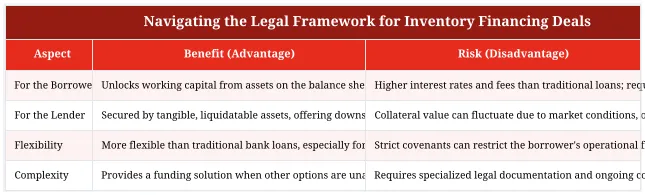
| For the Borrower | Unlocks working capital from assets on the balance sheet; borrowing capacity scales with growth. | Higher interest rates and fees than traditional loans; requires intensive reporting and monitoring. |
| For the Lender | Secured by tangible, liquidatable assets, offering downside protection. | Collateral value can fluctuate due to market conditions, obsolescence, or damage. |
| Flexibility | More flexible than traditional bank loans, especially for companies with seasonal or fluctuating revenue. | Strict covenants can restrict the borrower’s operational freedom. |
| Complexity | Provides a funding solution when other options are unavailable. | Requires specialized legal documentation and ongoing collateral management. |
Advanced Insights at Private Credit Conferences
Structuring an inventory financing deal requires understanding valuation, legal frameworks, and market dynamics. As the European private credit landscape evolves, staying current on asset-backed finance trends is critical for investors, lenders, and advisors.
To gain insights and connect with leaders in direct lending and structured finance, attend our upcoming events. Explore complex deal structures and network with GPs and LPs. Request Agenda for our next conference.
Conclusion
The success of an inventory financing deal depends on due diligence and a structure that aligns borrower and lender interests. The lender’s controls—the borrowing base, field exams, and covenants—must mitigate the inventory’s value volatility. For businesses, it is a growth tool that demands disciplined operational management. For private credit investors, it is a secured lending opportunity requiring specialized expertise to underwrite and manage.
To learn more about asset-backed finance and private credit, contact us or Request Agenda for our European conferences.
Frequently Asked Questions
How do lenders calculate the initial borrowing base for inventory?
Lenders establish the borrowing base through a detailed field examination and appraisal, often conducted by a third-party specialist. This assessment determines the Net Orderly Liquidation Value (NOLV) of the inventory, which is the estimated recovery value in a structured sale. The loan’s advance rate, which can vary significantly based on asset class, is then applied to this NOLV to set the maximum credit line.
What makes certain inventory “ineligible” on a borrowing base certificate?
Inventory is typically deemed ineligible if it is slow-moving (often unsold for over 90-120 days), obsolete, damaged, or consists of work-in-progress. Other common exclusions cited by asset-based lenders include goods held on consignment, items with third-party liens, or stock located at unapproved off-site locations. These exclusions protect the lender from collateral that cannot be easily liquidated at its appraised value.
What specific legal filing perfects a lender’s security interest in the UK?
In the United Kingdom, a lender perfects their security interest by registering a debenture at Companies House, typically within 21 days of its creation. This document usually creates a fixed charge over specific assets and a floating charge over the remaining inventory and other circulating assets. This public registration provides notice to all other creditors of the lender’s priority claim over the secured assets.
Why might a lender prefer financing fungible commodities over high-margin branded goods?
While high-margin goods seem attractive, lenders often prefer financing fungible commodities like standard industrial metals or chemicals due to their transparent and liquid public markets. This makes valuation and potential liquidation simpler and more predictable. Branded goods can be subject to brand-specific risks, obsolescence, and restrictive resale channels, which can complicate a lender’s recovery process in a default scenario.
What role does an inventory management system play in securing an inventory financing deal?
A sophisticated inventory management system, such as an Enterprise Resource Planning (ERP) platform, is critical for securing a favorable inventory financing deal. These systems provide lenders with real-time, auditable data on stock levels, turnover rates, and aging, which builds confidence in the collateral’s quality and value. Lenders frequently require direct reporting access or integration with these systems as a core condition of the financing agreement.
How are cross-border inventory assets handled in a European financing structure?
Handling cross-border inventory in Europe requires a multi-jurisdictional legal approach to ensure the lender’s security is perfected in each country where assets are located. This involves creating security agreements compliant with local laws, such as a UK debenture or a German *Sicherungsübereignung* (security transfer of title). As discussed at DD Talks’ private credit forums, this complexity necessitates specialized legal counsel to coordinate local filings and ensure enforceability across borders.



0 Comments