

NPL Investment Greece Portugal: Navigating Distressed Debt Opportunities
Evaluating npl investment greece portugal opportunities for 2025 requires understanding distinct market dynamics. Greece’s NPL market, significantly shaped by Project Hercules and the Hellenic Republic Asset Protection Scheme, has seen a dramatic reduction in NPL ratios, fostering a robust servicing ecosystem with players like doValue Greece. In contrast, Portugal’s distressed debt landscape reflects an earlier deleveraging cycle, characterized by a mature, private-sector-driven market with key entities such as Novo Banco and Arrow Global Portugal. This article provides a comparative analysis of asset classes, recovery dynamics, and regulatory environments to inform strategic capital deployment.
DDTalks delivers authoritative insights into European private credit and distressed debt markets, facilitating high-value deal-making and industry networking. Our events connect institutional investors with leading GPs and servicers, offering expert analysis on market trends and regulatory shifts.
To explore your options, contact us to schedule your consultation. You can also reach us via: Request Agenda
Evaluating npl investment greece portugal opportunities for 2025 requires understanding two distinct Southern European markets. This analysis compares the distressed debt landscapes in Greece and Portugal, highlighting primary drivers, regulatory nuances, and strategic considerations for capital deployment. The article covers differences in asset classes, recovery dynamics, and market maturity to identify prospects and navigate their complexities.
Understanding the Greek NPL Market: Project Hercules & Beyond
The Greek non-performing loan market has been reshaped by state-sponsored initiatives, primarily Project Hercules. This asset protection scheme enabled Greek banks to securitize and transfer large volumes of distressed debt off their balance sheets, creating a secondary market for institutional investors.
The Impact of Project Hercules and Hellenic Republic Asset Protection Scheme
Project Hercules, and the broader Hellenic Republic Asset Protection Scheme (HAPS), functions by providing a state guarantee for the senior tranches of NPL securitizations. This credit enhancement makes the senior notes more attractive to investors, allowing banks to deconsolidate the underlying non-performing exposures. This mechanism created a “greek bad bank” framework without a single physical entity, facilitating the transfer of over €50 billion in NPLs.
This program catalyzed the development of a servicing ecosystem and attracted international capital. For more details, investors can explore opportunities and challenges in the Greek NPL market.
Current NPL Ratios, Asset Types, and Key Players like doValue Greece
Following HAPS, Greece’s NPL ratio has fallen dramatically from its peak above 45% to single digits, aligning more closely with the European average. The remaining NPL stock and newly formed distressed assets are predominantly backed by real estate collateral, including residential mortgages and commercial real estate loans, alongside SME and corporate exposures.
The market is serviced by international and local players. Firms like doValue Greece, Intrum Hellas, and Cepal Hellas manage these portfolios, from loan restructuring to asset liquidation.
Portugal’s Distressed Debt Landscape: Key Players & Evolution
Portugal’s distressed debt market differs from Greece’s, with an earlier deleveraging cycle and a mature, private-sector-driven secondary market. By addressing its banking crisis earlier, Portugal has a steady flow of portfolio transactions without Greece’s level of state intervention.
Post-Crisis Recovery and Market Dynamics
The Portuguese NPL market began its recovery and deleveraging process earlier than the Greek market, leading to a more seasoned ecosystem of servicers, advisors, and investors. The dynamics are often compared to the broader Iberian NPL landscape, sharing characteristics with Spain’s market, such as a high concentration of real estate-backed loans and a competitive servicing environment. The market’s evolution is driven by banks optimizing their balance sheets and meeting regulatory capital requirements, resulting in a consistent pipeline of portfolio sales.
Major Servicers and Corporate Debt Opportunities
Portugal’s servicing landscape is established, with major international players like Arrow Global Portugal, Hipoges, and Altamira managing diverse asset classes for institutional investors. The market features corporate distressed debt opportunities, partly from the resolution of assets from institutions like Novo Banco, which released complex corporate and SME loans. This created a niche for investors with specialized workout capabilities for operational turnarounds and asset recovery.
Greece vs. Portugal: A Comparative Analysis for NPL Investors
For npl investment greece portugal, investors weigh distinct drivers, risk profiles, and regulatory environments. Greece offers scale through state-backed securitizations, while Portugal provides a mature market with diverse corporate debt opportunities.
Key Investment Drivers, Risks, and Asset Class Differences
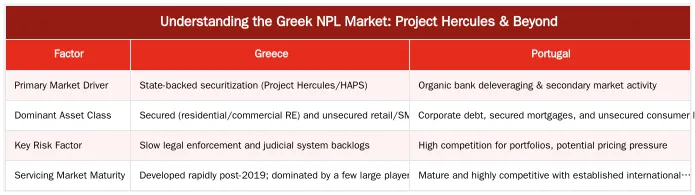
The primary driver in the greece npl market has been the HAPS program, creating large, relatively homogenous portfolios. In contrast, Portugal’s market is driven by organic bank deleveraging and secondary trades. Key risks in Greece include the lengthy judicial process for collateral enforcement, whereas in Portugal, competition among investors can compress pricing. The asset classes also differ, with Greece having a higher volume of retail and SME loans in recent transactions, while Portugal offers more complex single-name corporate exposures.
Regulatory Frameworks and NPL Recovery Rates
Both countries have implemented reforms to their insolvency and foreclosure laws to facilitate NPL resolution, but procedural timelines can vary significantly. According to data from the Bank of Greece, recovery rates depend on the efficiency of the legal system and the performance of the underlying real estate collateral. Portugal’s more established framework has historically provided more predictable recovery outcomes, though Greece’s recent reforms aim to close this gap.
| Country | NPL Ratio (%) | Estimated NPL Stock (€bn) | Average Recovery Rate (Secured) |
|---|---|---|---|
| Greece | 5.2% | €11.5 | 35-45% |
| Portugal | 2.9% | €8.0 | 40-50% |
What’s the Outlook for NPL Investment in Greece & Portugal in 2025?
For 2025, both Greece and Portugal are expected to remain active markets for distressed debt investors. The outlook is shaped by macroeconomic factors, European Central Bank interest rate policies, and the performance of sectors like tourism and real estate.
Emerging Trends and Future Opportunities in Distressed Debt
A key 2025 trend is the growth of the secondary market, particularly in Greece, as initial investors sell seasoned portfolios. This creates opportunities for buyers with different risk appetites. Another focus will be “unlikely-to-pay” (UTP) exposures, which require more operational restructuring than traditional NPLs. The Iberian private credit market outlook suggests a convergence between distressed debt and direct lending strategies to finance turnarounds.
The Influence of the Portuguese and Greek Real Estate Markets
NPL portfolio performance is linked to the health of the portuguese real estate market and its Greek counterpart. Both markets have shown resilience, supported by tourism and foreign investment. Rising construction costs and higher interest rates could impact affordability and asset valuations. Monitoring regional real estate trends is necessary for underwriting recovery values and timing asset disposals.
Unlock Exclusive NPL Investment Insights at DDTalks Events
Direct access to industry leaders, policymakers, and dealmakers is needed to capitalize on opportunities in the Greek and Portuguese distressed debt markets. DDTalks provides a platform for institutional investors, servicers, and advisors to connect, share intelligence, and originate transactions.
Our closed-door forums focus on European NPLs and private credit, with insights from executives at firms like doValue and Arrow Global. Request Agenda for our upcoming events.
Conclusion
The analysis of npl investment greece portugal shows two markets with distinct value propositions for 2025. Greece offers scale from its systemic cleanup, while Portugal presents a mature market with nuanced corporate debt situations. Success requires due diligence, local partnerships, and market intelligence. To learn more about our industry events, contact us or Request Agenda for our next NPL and Distressed Debt Forum.
Frequently Asked Questions
What is the primary driver of the Greek non-performing loan market?
The Greek NPL market has been primarily driven by Project Hercules, a state-backed asset protection scheme that enabled banks to securitize and sell large distressed debt portfolios. This government initiative created a significant secondary market, attracting substantial capital from international institutional investors and shaping the landscape for distressed asset investment in the country.
How does the Portuguese market differ in a direct npl investment greece portugal comparison?
The Portuguese market is more mature and less reliant on a single, large-scale government scheme like Greece’s Project Hercules. A direct comparison for npl investment greece portugal reveals Portugal offers a more diverse mix of asset classes, including corporate and consumer loans, while the Greek market has been heavily focused on large, bank-originated securitised portfolios.
What are the key challenges for npl investment greece portugal when focusing on the Hellenic market?
A primary challenge for npl investment greece portugal, specifically within Greece, has been the historically slow legal and judicial system for foreclosures and asset recovery. While recent legislative reforms have aimed to streamline these processes, investors must still navigate complex enforcement timelines and require strong local servicing partners to maximize returns.
Which market offers better recovery prospects for npl investment greece portugal?
Recovery prospects for npl investment greece portugal depend heavily on the specific portfolio and asset class. Portugal’s more stable real estate market may offer predictable recoveries on secured loans, whereas the sheer scale of Greek NPL sales can present higher potential returns for investors with a greater risk appetite and deep operational expertise.
What are the key NPL asset classes available in Portugal?
In Portugal, investors find opportunities across various non-performing asset classes, including residential mortgages, SME corporate loans, and unsecured consumer debt. The distressed real estate sector, particularly in hospitality and commercial properties, also presents significant potential for specialized funds focusing on asset-backed opportunities.
How can investors get exclusive insights on the npl investment greece portugal landscape?
To gain direct access to leading dealmakers and the latest market intelligence, institutional investors can join our specialized NPL and Distressed Debt Forums. You can learn more about navigating npl investment greece portugal opportunities by connecting with experts at our events. Request an agenda to see our upcoming speaker lineup.




0 Comments