

AIFMD II Reporting Requirements: Navigating Enhanced Transparency for Fund Managers
The AIFMD II reporting requirements mandate increased data granularity and transparency for European fund managers. This guide details the updated obligations, focusing on enhanced Annex IV reporting, new ESMA reporting templates like AIF001 and AIF002, and critical operational challenges. Fund managers will learn to navigate complex leverage calculation, risk reporting, and specific considerations for private credit funds, ensuring robust compliance with regulatory technical standards. Understanding these AIFMD II reporting requirements is crucial for effective fund structuring and meeting new transparency obligations.
DDTalks provides authoritative insights into European financial regulations, drawing on extensive experience organizing premium conferences for private credit, NPL, and structured finance markets. Our content reflects real-world challenges and solutions discussed by industry leaders.
To explore your options, contact us to schedule your consultation. You can also reach us via: Request Agenda
The aifmd ii reporting requirements increase regulatory transparency for European fund managers by demanding higher data granularity. This checklist guides fund managers through the updated obligations, focusing on increased detail for Annex IV, operational challenges, and best practices for compliance. It covers ESMA templates and specific considerations for private credit funds.
What Are AIFMD II Reporting Requirements for Fund Managers?
AIFMD II reporting requirements are mandatory disclosures for Alternative Investment Fund Managers (AIFMs) in the European Union. They enhance investor protection, increase market transparency, and help regulators monitor systemic risk. These obligations apply to all authorized EU AIFMs managing and/or marketing Alternative Investment Funds (AIFs) to professional investors.
A cornerstone of this framework is Annex IV reporting, where AIFMs periodically provide their national competent authority (NCA) with granular fund data. This includes investment strategies, principal exposures, risk profiles, liquidity management, and leverage. AIFMD II expands the scope and detail of required data points, increasing the operational burden on fund managers to collect, validate, and submit accurate information.
Your AIFMD II Reporting Checklist: Essential Data Points & Processes
To manage updated transparency obligations, fund managers need a structured process for data collection, validation, and submission. An internal checklist is essential for completeness and accuracy.
Key operational steps include:
- Data Sourcing: Identify required data points from the ESMA template and map them to source systems (e.g., portfolio management, risk analytics, CRM).
- Aggregation & Validation: Use automated or semi-automated processes to collect and consolidate data. Establish validation rules for completeness, accuracy, and consistency before submission.
- Calculation Engine: Ensure systems can accurately perform required calculations for leverage, risk exposures, and liquidity metrics, per RTS specifications.
- XML Generation & Submission: Convert the dataset into the required XML format and submit it to the relevant national competent authority (e.g., CSSF in Luxembourg, Central Bank of Ireland) via their designated portal.
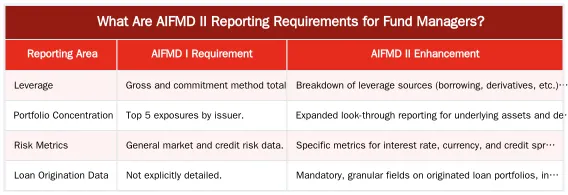
The table below highlights the evolution of reporting fields from the original directive to the current framework.
Calculating Leverage for AIFMD II Purposes
Leverage calculation is a central component of AIFMD II reporting. AIFMs must report leverage using two methodologies to give regulators a comprehensive view of fund risk. The gross method calculates exposure as the sum of all positions, showing the total notional value managed. The commitment method allows for hedging and netting arrangements, providing a view of net market risk. The RTS provides specific guidance on which instruments can be netted, so managers of complex strategies need a clear and defensible calculation policy.
Mitigating AIFMD II Reporting Challenges for Private Credit Funds
For managers in markets like private credit, non-performing loans (NPL), and distressed debt, aifmd ii reporting requirements present unique challenges. The illiquid and bespoke nature of these assets makes data collection and valuation more complex than for public market funds.
Primary difficulties include standardizing data for privately negotiated loans and valuing assets without a daily market price. Managers must establish internal valuation policies and provide detailed supporting documentation to regulators. The updated framework targets the direct lending market, demanding transparency on loan portfolios to monitor systemic risk in the non-bank lending sector. Explore the AIFMD II impact on European private credit funds.
Specific Reporting Fields for Loan Origination Funds
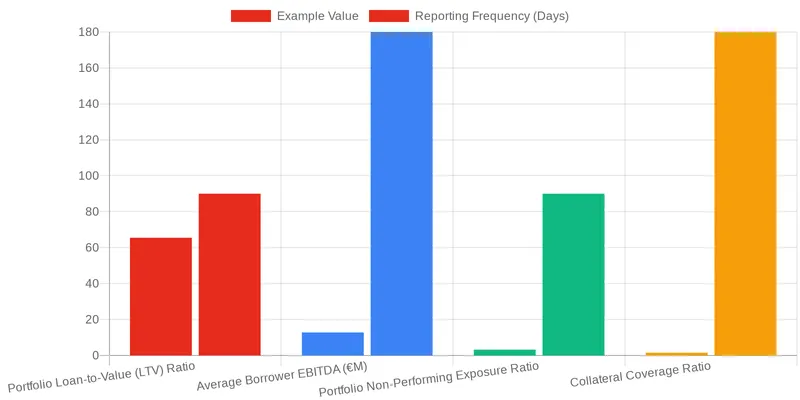
AIFMD II introduces a dedicated reporting template section for funds engaged in loan origination. This requires AIFMs to report granular details on the loans they originate. Key data fields include borrower concentration, loan-to-value (LTV) ratios, the non-performing portion of the loan portfolio (per EBA standards), and details on loan seniority and collateral. This information helps regulators assess the credit quality and risk profile of direct lending activities across the EU.
Ensuring AIFMD II Compliance: What Fund Managers Need to Know
Compliance with AIFMD II disclosure rules is an ongoing operational commitment. Fund managers need durable systems and controls to meet their obligations. Best practices include implementing a dedicated regulatory reporting solution or enhancing existing systems to handle the increased data load and complexity. Regular training for compliance and operations teams is critical to stay current with evolving interpretations and guidance from ESMA and NCAs.
Engaging with national regulators, such as the CSSF in Luxembourg or the Central Bank of Ireland, can clarify expectations. These bodies often publish guidance and FAQs that supplement ESMA’s technical standards. A strong data governance framework is the foundation of sustainable compliance, ensuring data is accurate, timely, and auditable. For guidance on structuring funds, see our overview of direct lending fund structures.
Consequences of Non-Compliance with AIFMD II Reporting
Failing to comply with AIFMD II reporting obligations can have severe consequences. National competent authorities can impose significant financial penalties on AIFMs for late or inaccurate submissions. Non-compliance can also lead to regulatory sanctions, including public censures or the suspension or withdrawal of an AIFM’s license. The reputational damage from regulatory breaches can impact a manager’s ability to attract and retain investor capital, making proactive compliance a critical business function.
Stay Ahead of Regulatory Shifts: Join DDTalks’ Financial Conferences
DDTalks’ financial conferences provide a platform for fund managers, institutional investors, and legal advisors to connect and discuss the implications of regulatory changes like AIFMD II.
Our events feature expert-led panels and networking opportunities with industry leaders. Learn best practices for data management, technology adoption, and fund structuring. Request Agenda for our upcoming events.
Conclusion
The updated aifmd ii reporting requirements’ focus on data granularity, particularly for Annex IV reporting, requires fund managers to invest in data management systems and internal processes. Understanding the key changes, creating a compliance checklist, and addressing strategy-specific challenges helps AIFMs navigate this landscape. Proactive preparation ensures accurate, timely reporting and mitigates non-compliance risks.
To learn how industry leaders are adapting, contact us or Request Agenda for our next European private credit conference.
Frequently Asked Questions
What is the primary challenge for GPs regarding the aifmd ii reporting requirements?
The main challenge is the increased data granularity demanded by Annex IV. GPs must implement robust data collection and aggregation systems to accurately report on portfolio exposures, risk metrics, and leverage calculations, which is an operationally intensive part of the new aifmd ii reporting requirements.
What new data points are introduced by the aifmd ii reporting requirements?
The updated framework introduces more detailed reporting on delegation arrangements, liquidity management tools, and specific data fields for loan-originating funds. Managers must provide this comprehensive information to satisfy the new aifmd ii reporting requirements.
How frequently must reports be submitted under the aifmd ii reporting requirements?
Reporting frequency under the AIFMD II framework depends on the Assets Under Management (AUM) of the AIFM. Larger managers typically report quarterly, while smaller managers may report semi-annually or annually, with strict deadlines enforced by national regulators as part of the aifmd ii reporting requirements.
Is there a specific format for AIFMD II regulatory submissions?
Yes, all reports must be submitted in a specific XML format based on the European Securities and Markets Authority (ESMA) schema. Fund managers cannot use standard formats like PDF or spreadsheets and must use software or a service provider that can generate the correct machine-readable file for compliance.
Does the updated AIFMD II framework apply to both EU and non-EU fund managers?
Yes, these reporting obligations apply to any Alternative Investment Fund Manager (AIFM) that markets funds within the EU. This includes non-EU AIFMs who utilize a national private placement regime (NPPR), as they are often required to comply with the same transparency and reporting rules.
How can fund managers stay updated on the practical impact of these regulatory changes?
Staying current on regulatory shifts is crucial for compliance. Attending specialized industry events, like those hosted by DDTalks, provides direct access to expert analysis and discussions on the real-world impact of regulations. You can request an agenda for our upcoming private credit conferences to learn more from industry leaders.




0 Comments