

Questions for Lps to Ask Gps: Elevating Due Diligence & Partnership Selection
Strategic questions for LPs to ask GPs during networking breaks are crucial for effective initial due diligence, moving beyond generic inquiries to uncover a General Partner’s true investment strategy and operational resilience. LPs can assess risk management approaches, evaluate team dynamics, and understand specific private credit fund strategies. These targeted inquiries efficiently filter potential partners, revealing market perspective and suitability for long-term collaboration, ultimately enhancing fund manager evaluation and investor relations. Asking the right questions for LPs to ask GPs transforms brief interactions into valuable data-gathering opportunities.
DD Talks specializes in premium B2B financial conferences, facilitating high-value deal-making and industry networking across European private credit and structured finance markets. Our events connect top-tier GPs and LPs, fostering substantive dialogues for informed investment decisions.
To explore your options, contact us to schedule your consultation. You can also reach us via: Request Agenda
Setting the Stage: Why Strategic Questions Elevate LP-GP Networking
During networking breaks at financial conferences, Limited Partners (LPs) have a finite window to assess General Partners (GPs). Moving beyond generic inquiries is essential for effective initial due diligence. The right questions cut through rehearsed presentations, revealing a GP’s real-time market perspective, operational mindset, and suitability as a long-term partner. This approach transforms a handshake into a data-gathering opportunity.
Well-formulated inquiries signal an LP’s sophistication and respect for the GP’s time, fostering a more substantive dialogue. These initial conversations do not replace formal due diligence but efficiently filter potential partners and identify those meriting a deeper look. The most effective questions for lps to ask gps are those that probe for insight, not just information.
The Power of the Opening Question: Beyond the Pitch
A powerful opening question can immediately shift a conversation’s dynamic. Instead of asking “What’s your strategy?”, which invites a standard pitch, a more insightful query sets a different tone. Consider opening with: “Beyond your presentation, what is the most significant challenge or opportunity you see in your target market right now?”
This question acknowledges you’ve done basic homework, bypasses the pitch deck, and prompts the GP to share their current, on-the-ground perspective. Their answer can reveal their depth of market understanding and how they think about unforeseen risks and emerging trends. This is a critical first step for LPs looking to source top-performing GPs at private credit events and build a portfolio.
Beyond the Pitch Deck: Uncovering a GP’s True Investment Strategy
A GP’s pitch deck presents an idealized version of their investment strategy. During a networking break, the goal is to understand the reality behind the slides. This involves asking questions that test the durability and distinctiveness of their approach in the current market.
Probing Market Outlook & Niche Focus
Understanding how a manager views the evolving landscape is key to assessing their adaptability. Their perspective on macroeconomic headwinds, interest rate sensitivity, and regulatory shifts reveals their strategic thinking. With regulations like AIFMD II impacting fund structuring, a GP’s preparedness indicates their operational foresight.
Effective inquiries include:
- “Which specific sub-sector within European private credit do you believe is currently mispriced, and why?”
- “How has your deal sourcing or underwriting process changed in the last 12 months to reflect the current credit cycle?”
- “How are you positioning your portfolio to navigate the operational and reporting changes under AIFMD II?”
Evaluating Strategic Alignment with LP Goals
An investment strategy that is sound on paper may not align with a specific LP’s risk tolerance or portfolio construction. Use hypothetical scenarios or questions about past decisions to understand their philosophy in practice.
Consider asking:
- “Can you describe a recent deal that best exemplifies your stated strategy and one that was a close pass? What was the deciding factor?”
- “How do you define your ideal portfolio company, and what is your typical holding period?”
- “Where do you see the most significant potential for value creation in your target assets, beyond simply providing capital?”
How Do GPs Manage Risk? Essential Questions for Due Diligence
A GP’s approach to risk management is a cornerstone of their ability to preserve capital and deliver consistent returns. During a brief interaction, the objective is to assess their risk philosophy and frameworks. The focus should be on practical application rather than theoretical policies.
Understanding Risk Mitigation Frameworks
Every GP will claim to have a risk management process. The key is to ask for concrete evidence of that process in action. Questions that prompt storytelling can be effective at revealing how a team behaves under pressure and whether their stated process holds up.
Helpful questions include:
- “Could you walk me through a deal where your initial assumptions were wrong, and how your risk framework helped you pivot?”
- “What is the single biggest non-obvious risk to your current portfolio that keeps you up at night?”
- “How is the risk management function structured within your team? Is it independent from the deal team?”
Scenario Planning & Crisis Response
A manager’s character is often revealed during a crisis. Understanding how they have navigated past downturns or prepare for future ones reveals their resilience. This line of inquiry helps differentiate between managers who are reactive and those who proactively stress-test their portfolios.
To gauge their preparedness, ask:
- “What were the key lessons your team learned from the 2020 market dislocation, and what specific changes did you implement as a result?”
- “What key indicators do you monitor to signal a potential downturn in your sector, and what is your pre-planned response?”
Assessing Team Dynamics & Operational Excellence: What to Ask
A fund’s long-term success depends on the people and processes behind the portfolio. Track records can be misleading if key personnel have left or if the operational infrastructure is weak. These aspects are often overlooked in quick conversations, yet they are vital for a successful partnership. The right questions for lps to ask gps can uncover potential red flags related to team stability and governance.
Evaluating Team Cohesion & Decision-Making
Understanding how a team interacts, makes decisions, and handles dissent is fundamental. High team turnover or a concentrated decision-making structure can introduce significant key-person risk. Inquiries should aim to uncover the firm’s culture and governance.
Questions to assess team dynamics:
- “How is your investment committee structured, and can you describe a time when there was a significant debate over a deal?”
- “What is your approach to succession planning for senior partners?”
- “How are junior and mid-level team members involved in the decision-making process and incentivized for the long term?”
Operations & Transparency
A GP’s back-office and reporting capabilities are as important as their front-office deal-making. Weak operations can lead to reporting errors, compliance breaches, and a frustrating experience for LPs. A GP’s commitment to transparency and institutional-quality infrastructure is a positive signal. Fund operations are critical for investor confidence and regulatory compliance.
Inquire about their operational setup:
- “Who is your fund administrator, and what is the cadence and detail of your LP reporting?”
- “How does your firm leverage technology in its portfolio monitoring and risk management functions?”
Leveraging Conference Insights: Beyond the Formal Meeting
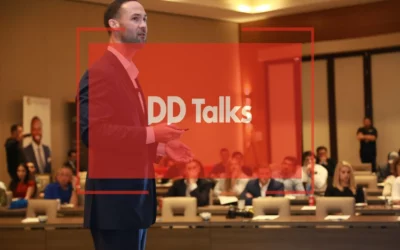
B2B financial conferences, such as events hosted by DDTalks in London and Madrid, provide an efficient environment for initial due diligence. The concentration of GPs and LPs creates opportunities for interactions difficult to replicate elsewhere.
Maximizing Brief Encounters for Deeper Understanding
At a conference, time is the most valuable commodity. To maximize each interaction, LPs should practice active listening, paying attention not only to what is said but also to how it is said. Non-verbal cues and the GP’s willingness to engage in a substantive, two-way conversation can be revealing. A brief, focused conversation at an event like Private Credit Days Europe can yield more insight than a lengthy introductory call.
Identifying Top-Tier GPs in a High-Value Setting
The curated nature of specialized industry events means attendees are pre-vetted to a degree. This allows LPs to focus on evaluating strategy and fit, rather than sourcing names. Comparing how different managers answer the same questions in quick succession provides a powerful real-time benchmark.
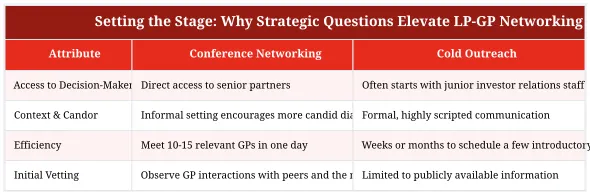
View data as table
| Attribute | Conference Networking | Cold Outreach |
|---|---|---|
| Access to Decision-Makers | Direct access to senior partners | Often starts with junior investor relations staff |
| Context & Candor | Informal setting encourages more candid dialogue | Formal, highly scripted communication |
| Efficiency | Meet 10-15 relevant GPs in one day | Weeks or months to schedule a few introductory calls |
| Initial Vetting | Observe GP interactions with peers and the market | Limited to publicly available information |
Navigating Fund Terms & Fees: Key Inquiries for LPs
While detailed negotiations happen later, initial conversations can indicate a GP’s philosophy on alignment and partnership. Asking direct questions about fund economics can save significant time later. These inquiries speak directly to the alignment of interests.
Understanding Fee Structures & Alignment of Interests
Fees are a critical mechanism for aligning the interests of the GP with those of the LPs. A structure that rewards capital preservation and outperformance indicates a partner-centric firm. Research on private equity fund structures highlights the importance of hurdles and clawback provisions in creating this alignment.
Key questions on fees include:
- “What is your philosophy on management fees? Are they calculated on committed or invested capital?”
- “Can you describe your waterfall and carried interest structure, including the preferred return hurdle and any clawback provisions?”
- “How are deal-related fees (e.g., transaction fees, monitoring fees) treated? Are they offset against the management fee?”
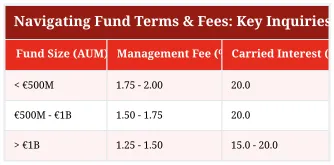
View data as table
| Fund Size (AUM) | Management Fee (%) | Carried Interest (%) |
|---|---|---|
| < €500M | 1.75 – 2.00 | 20.0 |
| €500M – €1B | 1.50 – 1.75 | 20.0 |
| > €1B | 1.25 – 1.50 | 15.0 – 20.0 |
Co-Investment Rights & LP-Friendly Terms
The availability of co-investment opportunities and other LP-friendly terms can be a significant differentiator. These provisions demonstrate a GP’s confidence in their deal flow and their commitment to treating LPs as partners. Inquiring about these options early can help identify managers willing to build collaborative relationships.
Ask about partnership terms:
- “What is your firm’s approach to offering co-investment rights to LPs? Is it pro-rata?”
- “Do you have a GP commitment to the fund, and what is the size of that commitment?”
Ready to Connect? Secure Your Access to Elite GP-LP Networking
Putting these strategies into practice requires the right venue. DDTalks organizes conferences for the European private credit, NPL, and distressed debt markets, creating an environment for face-to-face deal-making and due diligence. Our events in London and Madrid bring together the industry’s leading GPs and institutional investors.
Join Europe’s Leading Private Credit & NPL Conferences
Connect with fund managers and uncover your next investment. Explore our upcoming agenda and secure your place among Europe’s financial leaders. Special passes are available for institutional investors. Request your LP pass today and start asking the questions that matter.
Conclusion
The networking window at a financial conference is a powerful, often underutilized, tool for initial due diligence. The goal is to move beyond a GP’s polished narrative to understand their real-world judgment, operational integrity, and cultural fit. By preparing incisive inquiries, LPs can efficiently identify promising managers and lay the groundwork for a transparent long-term partnership. The key decision criterion is not finding a GP with the perfect pitch, but one with a credible process and a demonstrable alignment of interests.
To put these insights into action at Europe’s leading industry gatherings, Request Agenda for our upcoming events or contact us to learn more.
Frequently Asked Questions
Beyond the pitch deck, what is a crucial opening question for an LP to ask a GP?
A powerful opener is, ‘What is the most significant challenge or opportunity you see in your target market right now that isn’t widely discussed?’ This moves beyond the standard pitch, revealing their real-time market perspective and ability to identify non-consensus ideas. A strong answer might reference a specific regulatory change, like the implications of AIFMD II, or a niche sub-sector opportunity.
How can an LP effectively probe a GP’s risk management in a brief conversation?
Ask, ‘Can you walk me through a deal that didn’t go as planned and what your team learned from it?’ This question tests transparency and process more than a theoretical query about risk. A quality response will detail the specific issue, the steps taken to mitigate losses, and a concrete change in their underwriting or monitoring process as a result.
What is a subtle question for LPs to ask GPs about team stability and culture?
A strategic question is, ‘How is the team incentivized beyond base salary, and what is the firm’s approach to key-person risk?’ This opens a discussion about carry distribution, succession planning, and overall team alignment. Look for answers that detail a broad distribution of carry beyond just the founders and a clear, documented succession plan for senior partners.
Which question best clarifies a GP’s unique competitive edge or ‘alpha’?
One of the most important questions for lps to ask gps is, ‘In a competitive market like European direct lending, what does your firm do differently at the sourcing and underwriting stage that gives you an edge?’ A compelling answer will provide specifics, such as proprietary relationships with regional advisory firms or a data-driven underwriting model that analyzes over 100 specific covenants.
When is it appropriate to ask about fund terms and co-investment rights?
It is entirely appropriate in a first meeting to ask, ‘What is your firm’s philosophy on co-investments and how are those opportunities allocated among LPs?’ This shows you are a serious investor. A good follow-up is to inquire about their typical fee structure for co-investments, as many top-tier firms now offer these on a no-fee, no-carry basis to their key LPs.
How can an LP gauge a GP’s alignment with ESG principles during a short networking break?
Ask, ‘How do you integrate ESG considerations into your investment decision-making process, and can you give a recent example?’ This practical question avoids vague statements and pushes for a concrete illustration. A strong answer will reference specific frameworks like the SFDR (Sustainable Finance Disclosure Regulation) and detail how an ESG factor led to a specific decision, either to invest or to pass on a deal.

0 Comments