

Red Flags in a GP Pitch: Enhancing LP Due Diligence
Identifying red flags in a gp pitch is crucial for institutional investors conducting thorough LP due diligence. This article outlines critical warning signs in fund manager evaluation, moving beyond surface-level metrics. Readers will learn to recognize investment red flags related to strategic inconsistencies like style drift, financial issues such as track record inflation, and operational weaknesses. Understanding these indicators enables more informed GP selection and robust risk assessment in private credit investments, ensuring greater transparency and mitigating key person risk.
DDTalks specializes in facilitating high-value deal-making and industry networking within European private credit and structured finance markets. Our content draws on extensive experience observing GP pitches at elite B2B conferences, providing practical insights for LPs.
To explore your options, contact us to schedule your consultation. You can also reach us via: Request Agenda
Decoding the Pitch: What Are Red Flags in a GP’s Presentation?
In a General Partner’s (GP) presentation, red flags are warning signs of potential issues with the investment strategy, team, or operational integrity. These indicators range from subtle inconsistencies to overt evasiveness and are a key part of a Limited Partner’s (LP) risk assessment.
A lack of clarity is a significant warning signal. If a GP cannot articulate their investment thesis, risk management framework, or value creation strategy coherently, it may indicate a flawed approach. These are critical red flags in a gp pitch requiring deeper scrutiny before capital commitment.
The Critical Role of Transparency in GP Pitches
Transparency is fundamental to the GP-LP relationship; its absence is a definitive investment red flag. A transparent pitch provides verifiable data on track records, details valuation methodology, and openly discusses past failures. GPs who are forthcoming about losses often demonstrate a disciplined investment process.
Transparency issues manifest as vague answers, jargon to obscure details, or refusal to provide granular portfolio data. Unwillingness to discuss attribution analysis—what specific actions led to successful exits—can indicate an inflated or luck-driven track record.
Beyond the Numbers: Key Red Flag Categories for LPs
LPs must evaluate fund managers beyond headline IRR figures by categorizing potential issues. Warning signs fall into four domains: strategic, financial, operational, and team-related. Recognizing these patterns structures the due diligence process, especially at conferences.
Each category presents distinct risks. Strategic issues like style drift can expose a portfolio to unintended market risks, while operational weaknesses may lead to compliance failures or an inability to manage portfolio assets effectively.
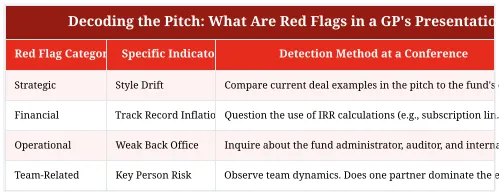
View data as table
| Red Flag Category | Specific Indicator | Detection Method at a Conference |
|---|---|---|
| Strategic | Style Drift | Compare current deal examples in the pitch to the fund’s original mandate and prior fund investments. |
| Financial | Track Record Inflation | Question the use of IRR calculations (e.g., subscription line impact) and ask for net multiples (TVPI, DPI). |
| Operational | Weak Back Office | Inquire about the fund administrator, auditor, and internal compliance resources. Note any hesitation. |
| Team-Related | Key Person Risk | Observe team dynamics. Does one partner dominate the entire presentation and Q&A session? |
Spotting Style Drift and Track Record Inconsistencies
Style drift occurs when a GP deviates from their stated investment strategy, often chasing trends or moving into unfamiliar areas. This is a concern because the team may lack expertise in the new area. LPs can spot this by comparing recent deal examples to the fund’s offering memorandum. A private credit fund focused on senior secured loans pitching a venture debt deal is a classic example.
Track record inflation presents performance in the most favorable light, masking potential issues. This includes cherry-picking deals, using favorable valuation marks for unrealized assets, or over-relying on subscription credit lines to flatter IRR figures. LPs should ask for gross and net performance metrics and inquire about the valuation policy for illiquid Level 3 assets.
Assessing Key Person Risk and Team Stability
Key person risk is a fund’s dependency on a few individuals. If a lead partner from the track record is not fully dedicated to the new fund, performance may suffer. LPs should inquire about the roles and time commitments of all senior team members. High turnover among junior or mid-level staff can also indicate cultural issues or firm instability.
Probing Deeper: Practical Strategies for Identifying Red Flags at Conferences
Industry conferences are a unique forum for LP due diligence. Networking breaks and Q&A sessions are opportunities to observe a GP’s candor and knowledge. Comparing multiple pitches in one day lets LPs benchmark responses and identify outliers.
A prepared LP arrives with targeted questions to test the GP’s strategic coherence and performance integrity. This approach is essential for sourcing top-performing GPs and avoiding those with weaknesses. The goal is not confrontation but clarity and consistency.
Strategic Questioning and Observational Cues
Questioning should go beyond the pitch deck. Instead of “What is your strategy?” ask, “Walk me through a deal that went wrong and what your team learned.” The response reveals more about risk management and culture than a slide. Another question, “Which of your stated competitive advantages is the most difficult to maintain?” tests for self-awareness and strategic foresight.
Observational cues are also important. During a Q&A, note how the GP team interacts. Do they defer to each other based on expertise, or does one person dominate? Is their body language open or defensive when challenged? Inconsistencies between the presentation and the spontaneous Q&A are revealing.
DDTalks Insight: Common Pitfalls Observed in Private Credit GP Pitches
At our European private credit forums in London and Madrid, we observe recurring pitfalls from hundreds of GP-LP interactions. A common issue in private credit is a lack of specificity on credit underwriting standards. GPs often speak broadly about “disciplined underwriting” without detailing criteria for leverage multiples, covenant packages, or industry exposure limits. This vagueness is a subtle but important red flag in a gp pitch.
Another concern is over-emphasizing origination networks without detailing post-investment portfolio management. Sourcing a deal is only half the battle; actively monitoring credits, managing workouts, and navigating restructurings separates top-quartile managers. LPs should press for details on the portfolio management team’s size and experience relative to the fund’s asset count.
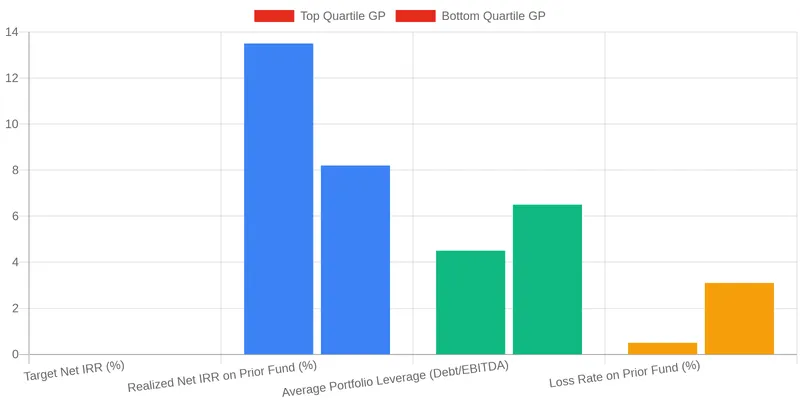
View data as table
| Metric | Top Quartile GP | Bottom Quartile GP |
|---|---|---|
| Target Net IRR (%) | 12-15% | 12-15% |
| Realized Net IRR on Prior Fund (%) | 13.5% | 8.2% |
| Average Portfolio Leverage (Debt/EBITDA) | 4.5x | 6.5x |
| Loss Rate on Prior Fund (%) | 0.5% | 3.1% |
Navigating Valuation Methodologies and Exit Strategies
Valuation in private credit, especially direct lending and distressed debt, is complex. A red flag is using aggressive or opaque valuation marks for illiquid assets. LPs should ask who is responsible for valuation—an internal committee or a third-party firm—and how frequently assets are marked-to-market. Guidance from the European Securities and Markets Authority (ESMA) states that robust and transparent valuation policies are critical for investor protection under frameworks like AIFMD II.
Unrealistic exit strategies are another concern. A GP planning to exit illiquid loans through quick syndication or securitisation in a tight credit market may be overly optimistic. A credible strategy includes a plan for holding loans to maturity while identifying plausible refinancing or M&A opportunities for borrowers.
Mitigating Risk: The Long-Term Impact of Thorough GP Due Diligence
Overlooking warning signs during GP selection has lasting negative consequences for an LP’s portfolio. Committing to a fund with an undisciplined strategy or poor risk controls can lead to capital loss, reputational damage, and years of underperforming capital. A compelling story must be tempered by rigorous LP due diligence.
A robust risk assessment does more than avoid losses; it forms the foundation of a transparent GP-LP partnership. LPs who understand a manager’s process, challenge assumptions, and verify claims are more likely to select partners aligned with their long-term objectives who can navigate market cycles. This diligence is a core component of sound European private credit risk management frameworks.
Building Resilient Portfolios Through Informed GP Selection
Informed GP selection builds a resilient private credit portfolio. A diversified portfolio of managers vetted for strategic consistency, operational robustness, and team stability is better equipped to withstand economic downturns. Identifying red flags is not about finding a perfect manager, but about understanding the specific risks of each opportunity.
Systematically evaluating potential partners allows LPs to make informed trade-offs, ensuring risks are understood and compensated. This disciplined approach to GP selection leads to more predictable returns and a portfolio that can achieve its goals across market environments.
Elevate Your Due Diligence: Join Europe’s Elite Private Credit Forums
Seeing numerous GPs present their strategies back-to-back is the most effective way to spot warning signs. At DD Talks events, you gain direct access to Europe’s leading fund managers in private credit, distressed debt, and structured finance. This concentrated exposure provides an ideal environment to compare, question, and conduct due diligence.
Engage with managers during presentations, challenge assumptions in Q&A sessions, and build relationships during networking breaks. To put these principles into practice and meet your next investment partner, secure your LP pass for our upcoming conferences in London and Madrid. Request Agenda to see the full lineup of speakers and sessions.
Conclusion
Identifying red flags in a GP pitch is an exercise in critical thinking and pattern recognition, requiring LPs to move beyond marketing materials to scrutinize the underlying strategy, process, and people. A key decision criterion is the alignment and transparency demonstrated by the GP. A manager who welcomes tough questions and provides clear, evidence-backed answers is a more reliable long-term partner than one offering a flawless but unsubstantiated story. To meet vetted GPs, contact us or Request Agenda for our next event.
Frequently Asked Questions
How should an LP react if a GP is evasive about a specific fund’s underperformance?
Directly ask for the attribution analysis for that particular fund’s performance. A refusal or inability to provide this data, which goes against the transparency principles advocated by bodies like the Institutional Limited Partners Association (ILPA), is a significant governance concern and a clear warning sign.
What specific documents should an LP cross-reference to detect potential style drift in a pitch?
An LP should compare the deals and sectors discussed in the conference pitch against the investment strategy detailed in the fund’s original Private Placement Memorandum (PPM). Any significant deviation in geography, sector, or deal size that isn’t proactively explained by the GP could indicate a lack of strategic discipline.
If a GP’s track record seems too consistent, what specific metric can reveal potential risk?
An overly smooth track record can be one of the most subtle red flags in a gp pitch. Request the dispersion of returns (the standard deviation) across all portfolio companies; an unusually low dispersion might indicate aggressive valuation smoothing rather than genuine, consistent alpha generation.
What is a key operational red flag often missed in a GP’s presentation slides?
Look for high key-person dependency or recent, unexplained senior team turnover, which is often buried in an appendix slide. According to multiple Preqin investor reports, GP team stability is a top-three factor for LPs during fund selection, making any ambiguity here a major concern for long-term alignment.
How can you verify a GP’s claim of ‘proprietary deal flow’ during a conference Q&A?
Ask the GP to describe the specific sourcing channel for their last 3-5 closed deals. If the majority originated from competitive, banker-led auctions rather than direct, off-market relationships, their claim of proprietary access may be overstated, revealing a potential weakness in their origination strategy.
When a GP blames macro factors for poor returns, what is a good follow-up question?
Acknowledge the macro environment, then ask, “How did your risk management framework and hedging strategy specifically perform against those headwinds compared to your initial underwriting?” This shifts the focus from external excuses to internal process, a critical area for identifying red flags in a GP’s approach to risk.

0 Comments