

Speaking for Lead Generation: Transforming Conference Slots Into Deal Flow
Strategic speaking for lead generation transforms public speaking opportunities into tangible business development. This article details how to leverage B2B financial conferences to attract high-value institutional investors and NPL servicers. It covers crafting thought leadership content tailored to specific audience needs, maximizing engagement during presentations, and effectively integrating speaking engagements into your sales funnel. Learn to move beyond brand awareness, focusing on actionable strategies for measurable ROI and initiating direct deal-making conversations within premium European financial markets.
DDTalks specializes in organizing elite B2B financial conferences across Europe, focusing on private credit, NPL, and distressed debt markets. Our events facilitate high-value deal-making and industry networking, connecting top-tier GPs and LPs with critical market insights.
To explore your options, contact us to schedule your consultation. You can also reach us via: Request Agenda
What is Strategic Speaking for B2B Lead Generation?
Strategic speaking for B2B lead generation is delivering a presentation at a targeted industry event to identify and attract potential clients. It transforms a public speaking opportunity from a brand awareness exercise into a measurable top-of-funnel activity that initiates high-value business development conversations.
Unlike general public speaking, this approach is a calculated component of a B2B marketing strategy. The process—from topic selection to post-event follow-up—is engineered to address the specific pain points of a curated audience, such as institutional investors or NPL servicers. It establishes authority, builds trust, and creates a clear pathway for audience members to enter your sales pipeline. Success is measured not by applause, but by the quality and quantity of qualified leads generated.
Crafting Your Message: Tailoring Content for High-Value Financial Leads
Successful lead generation through speaking requires content with genuine value. For a financial audience, a sales pitch is ineffective. Focus on thought leadership marketing that solves a problem, offers a unique perspective, or clarifies a complex market dynamic. This positions your firm as a resource, not just a service provider.
Understanding Your Audience: From LPs to NPL Servicers
Before writing a single slide, research the event’s attendees. At a forum on European NPLs and distressed debt, the audience will include General Partners (GPs), Limited Partners (LPs), investment bankers, workout professionals, and legal advisors. Each has distinct objectives.
An LP seeks differentiated returns and manager expertise. A workout professional looks for innovative restructuring playbooks. Your content must address these specific needs. Analyze the conference agenda, review the delegate list if available, and understand their current market pressures, such as regulatory changes like AIFMD II or shifts in capital availability.
Developing Thought Leadership That Drives Interest
Your presentation should offer insights attendees cannot easily find elsewhere. Instead of listing your fund’s features, present a data-driven analysis of a niche market, such as the revival of private securitisation in the Iberian Peninsula. Share a case study (with anonymized details) that illustrates a successful approach to a complex capital restructuring.
Providing actionable intelligence and a forward-looking perspective demonstrates expertise and builds credibility for follow-up conversations. As noted in Harvard Business Review, thought leadership offers a novel point of view and practical utility, driving engagement and lead conversion in a B2B setting.
Maximizing Engagement & Capturing Leads During Your Presentation
A compelling message requires effective delivery and a clear mechanism for capturing interest. Maintain audience engagement and make it simple for interested parties to take the next step using dynamic presentation techniques and strategic calls-to-action.
Designing Engaging Presentations for Financial Professionals
Financial audiences appreciate data and clarity. Avoid text-heavy slides. Use clean data visualizations, charts, and graphs to illustrate market trends and performance metrics. Incorporate brief, relevant case studies to ground abstract points in real-world scenarios. Posing strategic questions to the audience or facilitating a brief Q&A session can break the passive listening format and create a more interactive environment. Present complex information in a digestible manner to demonstrate your firm’s command of the subject.
Implementing Low-Friction Calls-to-Action (CTAs)
A call to action (CTA) links your presentation to lead capture. For this audience, the CTA must offer significant value with minimal effort. Offer something tangible instead of a generic “contact us.” You can learn more about leveraging speaking opportunities at European debt summits to refine your approach. A QR code on the final slide can direct attendees to a landing page to download the presentation, access an exclusive research report, or request a 15-minute follow-up call.
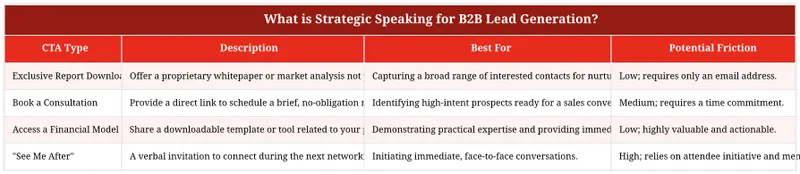
View data as table
| CTA Type | Description | Best For | Potential Friction |
|---|---|---|---|
| Exclusive Report Download | Offer a proprietary whitepaper or market analysis not publicly available. | Capturing a broad range of interested contacts for nurturing. | Low; requires only an email address. |
| Book a Consultation | Provide a direct link to schedule a brief, no-obligation meeting. | Identifying high-intent prospects ready for a sales conversation. | Medium; requires a time commitment. |
| Access a Financial Model | Share a downloadable template or tool related to your presentation. | Demonstrating practical expertise and providing immediate utility. | Low; highly valuable and actionable. |
| “See Me After” | A verbal invitation to connect during the next networking break. | Initiating immediate, face-to-face conversations. | High; relies on attendee initiative and memory. |
Beyond the Podium: Leveraging Premium Conference Environments for Deal Flow
The presentation is one component of a lead generation strategy. Premium B2B financial conferences, like those from DDTalks in London and Madrid, are designed to facilitate deal-making. Business development value is often realized during networking sessions surrounding the main agenda.
Strategic Networking: Converting Connections into Conversations
Your speaking slot elevates your visibility and provides a conversation starter. Use coffee breaks, lunches, and evening receptions to engage interested attendees. Refer to your presentation to initiate dialogue. The goal is to qualify interest and schedule a follow-up, not to close a deal on the spot. These environments transform audience engagement into pipeline opportunities. You can explore how to build strategic partnerships through networking at these events.
Pre- and Post-Event Engagement Strategies
Engagement starts before the event and continues after. Promote your speaking session on networks like LinkedIn, tagging the organizer and mentioning your topic to build anticipation and connect with attendees beforehand. After the event, follow up promptly with all contacts. Send a personalized email referencing your conversation or their question and deliver on your CTA. This systematic approach translates conference momentum into measurable business outcomes.

View data as table
| Phase | Key Activity | Objective | Tool/Platform |
|---|---|---|---|
| Pre-Event | Announce speaking slot; share teaser content. | Build awareness and schedule pre-event meetings. | LinkedIn, Company Blog, Email Signature |
| During Event | Deliver value-driven presentation; active networking. | Establish authority, capture leads, and qualify interest. | Presentation Slides (with QR code), Conference App, Business Cards |
| Post-Event | Personalized email follow-up; share requested resources. | Nurture leads and move them into the sales funnel. | CRM, Email Marketing Platform, LinkedIn |
Measuring Your ROI: Tracking Success from Speaking Engagements
Measure the conference ROI from your speaking engagement to justify the investment. Track metrics beyond lead counts, focusing on prospect quality and sales funnel progression. A data-driven approach refines your strategy for future events.
Key Metrics for Assessing Lead Generation Effectiveness
The primary goal is generating qualified leads, which your KPIs should reflect. Track the Lead Capture Rate (number of leads collected / total attendees) and assign a Lead Quality Score (LQS) based on the prospect’s firm, title, and engagement. Critical metrics include Pipeline Contribution (the value of opportunities created) and the Deal Closure Rate from event-sourced leads.
Integrating Speaking Leads into Your Sales Funnel
A seamless handover to your business development team is crucial. Enter all captured leads into your CRM immediately, tagged with the event, for systematic tracking and nurturing. Define clear next steps for each lead based on their quality score and interaction. This structured process cultivates initial interest into long-term business relationships and measurable revenue.
Unlock Exclusive Opportunities at European Debt Summits
A strategic approach transforms a speaking slot into a business development engine. Crafting a thought leadership message, engaging the audience, and leveraging the conference networking environment generates a pipeline of high-value financial leads. Speaking for lead generation connects you with key decision-makers in the private credit, NPL, and structured finance markets.
Share your expertise and drive deal flow. For speaking and attendance opportunities at our European financial conferences, contact us or Request Agenda.
Conclusion
Success in speaking for lead generation hinges on selecting the right venue. Audience quality is paramount. A presentation to relevant, pre-qualified decision-makers, like the LPs and GPs at DDTalks events, yields a greater return than one to a generalist crowd. Before committing, scrutinize the event’s delegate profile and reputation for deal-making. This criterion determines whether your efforts result in valuable connections or wasted time. To reach Europe’s leading institutional investors, contact us or Request Agenda for our next summit.
Frequently Asked Questions
How can a panelist on a distressed debt panel generate leads without being overtly promotional?
Focus on delivering unique market insights that naturally lead to your firm’s expertise. Instead of a sales pitch, offer a tangible asset like a proprietary analysis of NPL transaction volumes in the Iberian Peninsula via a QR code. This value-exchange approach, common at elite forums, positions you as a resource and prompts qualified prospects to initiate contact.
What type of call-to-action resonates best with institutional investors at a conference?
High-value, data-driven content is most effective for this sophisticated audience. Offer exclusive access to a research report on the European ABS revival, a compliance checklist for a new regulation like AIFMD II, or the detailed data set behind a chart you presented. The CTA must promise a strategic advantage, making the exchange of contact details a logical next step for serious deal-makers.
What is the most effective way to follow up with a potential LP or GP after a speaking engagement?
A personalized, multi-channel approach is crucial for high-value B2B relationships. Within 24 hours, send a LinkedIn connection request referencing a specific point from your conversation or their question during the Q&A. Follow this with a brief email that provides the promised resource and suggests a specific, low-commitment next step, such as a 15-minute call to discuss a particular market trend.
How should I structure my presentation on private credit to maximize lead generation?
Use a “Problem-Insight-Solution” framework tailored to your audience of LPs and GPs. Start by defining a critical market problem, such as yield compression in public markets. Then, provide a non-obvious insight backed by data—for example, on direct lending performance in the DACH region—before briefly outlining how your firm’s strategy provides a solution, compelling interested parties to seek more detail.
Besides the talk itself, what is the single most important activity for speaking for lead generation at a B2B finance summit?
Strategic use of the pre-event networking portal or delegate list is paramount. Before arriving, identify 5-10 key individuals, such as specific LPs or capital allocators, you want to meet. Use your status as a speaker to request brief meetings during designated coffee breaks, transforming a broad brand-building exercise into a targeted deal origination opportunity.
How can I measure the ROI of speaking at a specialized event like an NPL forum?
Track metrics beyond simple lead counts by using a dedicated CRM campaign for the event. Monitor the number of qualified meetings scheduled, the pipeline value generated from those meetings, and the ultimate deal conversion rate over the following 6-12 months. This allows you to attribute tangible revenue back to the speaking engagement, justifying the investment in conference attendance and preparation.


0 Comments