

Debt for Equity Swaps: Deleveraging for Distressed Company Turnarounds
Debt for equity swaps are a critical financial restructuring tool for distressed companies. This article details how these transactions convert debt into equity, enabling significant balance sheet restructuring and deleveraging to prevent insolvency. Readers will learn the mechanics, motivations for both debtors and creditors, and the complexities of valuation and potential dilution. It also provides insights into their application within the European distressed debt market, offering a pathway for corporate turnaround and improved financial health through strategic creditor ownership.
DDTalks specializes in European private credit, NPL, and distressed debt markets, facilitating high-value deal-making and industry networking. Our content draws on deep expertise from organizing premium financial conferences, connecting institutional investors and workout professionals with critical market insights.
To explore your options, contact us to schedule your consultation. You can also reach us via: Request Agenda
For companies facing severe financial pressure, debt for equity swaps offer a pathway to financial reorganization. This transaction allows a distressed company to convert debt into equity, cleaning its balance sheet and reducing insolvency risk. By exchanging debt for an ownership stake, debtors and creditors can navigate a corporate turnaround. This article examines the mechanics of these swaps, the motivations for all parties, the valuation process, and their application within the European distressed debt market.
What is a Debt-for-Equity Swap and How Does it Work?
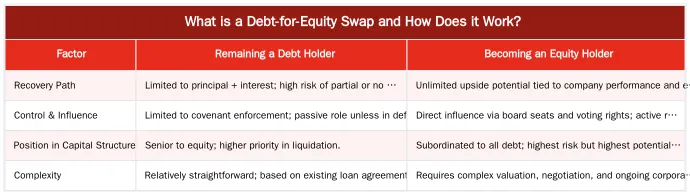
A debt-for-equity swap is a financial restructuring where a company’s creditors agree to cancel debt in return for an equity position. The goal is to reduce a company’s liabilities (deleveraging) to avoid bankruptcy and facilitate a turnaround. The transaction alters the company’s capital structure, converting lenders into owners.
The Core Mechanics of a Swap
The process begins when a company unable to service its debt negotiates with its creditors, often institutional investors like private credit funds or banks. If they agree the company has a viable recovery path, they may consent to a swap.
Key steps include:
- Negotiation: The debtor and creditors negotiate terms, including the amount of debt to be converted and the company valuation, which determines the equity percentage creditors will receive.
- Agreement: A formal agreement is drafted, often requiring approval from a majority of creditors and existing shareholders.
- Debt Cancellation: The agreed-upon debt is cancelled from the balance sheet.
- Equity Issuance: The company issues new shares to the former creditors, making them shareholders.
This balance sheet restructuring improves the company’s financial health by reducing its debt-to-equity ratio and eliminating interest payments, freeing up cash flow for operations and turnaround investment.
Why Do Distressed Companies Opt for Debt-for-Equity Swaps?
For a distressed company, a debt-equity conversion is often preferable to formal insolvency proceedings. It provides a recovery path without the value destruction, operational disruption, and reputational damage of bankruptcy. The primary driver is immediate balance sheet deleveraging.
Converting debt to equity reduces or eliminates cash outflows for interest and principal payments, which can be redirected to stabilize operations and fund growth. This improved financial stability can restore confidence among suppliers, customers, and employees. Developing effective corporate debt restructuring strategies requires understanding all options.
Benefits for the Debtor: Deleveraging and Turnaround Potential
A healthier balance sheet makes the company more attractive for new financing or strategic partnerships. Lenders and investors previously deterred by high leverage may provide fresh capital once the debt burden is manageable. This new investment is often crucial for executing a turnaround through operational improvements, market repositioning, or strategic acquisitions. The swap provides the financial room to implement a recovery plan.
Creditor Motivations: Why Exchange Debt for Ownership?
Creditors agree to a debt-for-equity transaction to maximize recovery. In a distressed situation, full debt repayment is unlikely. Formal bankruptcy could result in creditors receiving a fraction of their claim after a lengthy, costly process. By converting debt to equity, creditors exchange a low-probability debt claim for a high-potential ownership stake.
This transforms them from passive lenders to active owners with influence over the company’s strategic direction. Creditor ownership allows them to appoint board members, approve major decisions, and ensure the turnaround plan is executed. This control protects their investment and steers the company toward profitability. It represents a shift from loan recovery to participating in the upside of a business recovery. Analyzing these distressed investments and corporate restructuring scenarios is a core competency for investors.
Assessing Risks and Potential Upside for Lenders
The decision is a trade-off. Creditors give up their seniority in the capital structure and the contractual right to repayment. They gain the potential for a substantial return if the company’s value appreciates post-restructuring. The equity they receive could be worth far more than the original face value of their debt.
Navigating Valuation and Dilution in Debt-for-Equity Transactions
Determining the company’s value is a contentious aspect of a debt-equity conversion. The valuation impacts how much equity creditors receive and how much existing shareholders are diluted. For a distressed company, traditional valuation methods are unreliable due to uncertain cash flows and operational instability.
Valuing the Distressed Company for a Swap
Financial advisors use a combination of approaches for a defensible valuation. A Discounted Cash Flow (DCF) analysis relies on high-risk turnaround projections. An asset-based valuation provides a floor value based on the liquidation value of the company’s assets. Comparable company analysis provides a benchmark, but requires adjustments for the distress. For a deeper look at these methods, resources like Investopedia’s guide on DCF offer foundational knowledge.
Impact on Existing Shareholders: Understanding Dilution
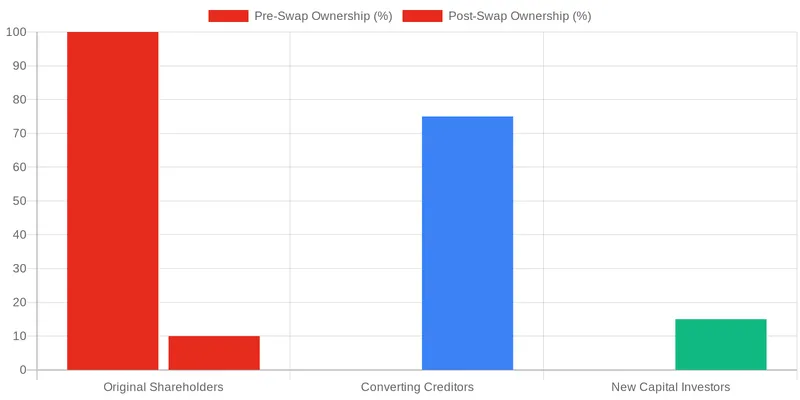
Issuing new shares to creditors causes significant dilution for original shareholders. Their ownership percentage and control are substantially reduced. While difficult for founders and early investors to accept, the alternative is often a total loss in bankruptcy. Negotiation centers on ensuring existing shareholders retain some stake, allowing them to participate in future upside if the turnaround succeeds.
European Market Insights: Debt-for-Equity Swaps in Practice
In the European distressed debt landscape, debt-for-equity transactions are an established tool for workout professionals and institutional investors. The market, with a significant volume of non-performing loans (NPLs) and distressed real estate assets, uses these structures to resolve complex capital structures. DDTalks’ forums in London and Madrid often feature panel discussions where servicers and fund managers share insights on executing these deals across different jurisdictions.
European regulatory frameworks influence how these swaps are implemented. For instance, directives like AIFMD II can impact how alternative investment funds manage such restructurings. The approach varies between countries like Spain, Italy, and Germany, each with its own legal and insolvency regimes. Investors must navigate these local nuances, making cross-border expertise essential. Exploring distressed investment strategies for debt and equity is crucial for success in this environment.
Strategic Role in NPL and Distressed Asset Workouts
For NPL portfolios acquired from banks post-financial crisis, debt-for-equity swaps are a primary strategy for maximizing value, especially for loans backed by commercial real estate or operating companies. For example, on the Iberian Peninsula, investors have used this tool to control and reposition distressed real estate developments. Instead of foreclosing and liquidating assets at a discount, the swap allows the new owner to invest capital, complete the project, and sell into a recovering market. According to Reuters on European markets, these workout strategies are critical for clearing legacy NPLs from bank balance sheets.
Key Considerations for a Successful Debt-for-Equity Swap
A successful debt-for-equity transaction requires careful planning and expert guidance. All parties must share a vision for the company’s future and understand the challenges. A clear turnaround plan is the foundation for the restructuring. The plan must be credible and supported by financial modeling to gain creditor and shareholder trust.
Negotiation and stakeholder management are paramount. The process involves multiple creditor groups with differing interests, alongside management and original owners. Aligning these interests requires transparency, compromise, and skilled advisors. Understanding the opportunities and challenges in corporate restructuring is vital for all participants.
Legal and Tax Implications of Swapping Debt for Equity
Legal and tax consequences are significant and vary by jurisdiction. Legally, the swap must comply with corporate laws on share issuance, shareholder rights, and creditor agreements. Tax implications can arise for the company and creditors. For the company, debt cancellation can sometimes be treated as taxable income. For creditors, exchanging a debt instrument for equity can trigger capital gains or losses. Engaging experienced legal and tax professionals, such as those at firms that publish resources on global debt restructuring, is non-negotiable to ensure compliance and optimize the financial outcome.
Connect with European Distressed Debt Leaders at DDTalks
Financial reorganization requires deep market knowledge and industry connections. These transactions result from negotiation and strategic alignment between investors, advisors, and corporate leadership. Understanding the nuances from industry gatherings is essential for executing successful deals in the European distressed debt market.
The topics in this article are central to the discussions at our forums. For direct insights from the general partners, limited partners, and workout professionals shaping these transactions, explore our upcoming events. Request Agenda to see how you can join the conversation.
Conclusion
Debt-for-equity swaps are a powerful tool in financial restructuring. For a distressed company, they help avoid insolvency, repair the balance sheet, and create a foundation for a turnaround. For creditors, they are an alternative to liquidation, offering greater potential returns through ownership and participation in the company’s recovery. While challenging, particularly around valuation and stakeholder alignment, a well-executed swap can unlock value and enable growth. To connect with the experts leading these deals, contact us or Request Agenda for our next European distressed debt forum.
Frequently Asked Questions
What are debt for equity swaps and how do they work?
A debt for equity swap is a financial restructuring transaction where a company’s creditors agree to cancel debt in exchange for an ownership stake. This process is a common tool for distressed companies to deleverage their balance sheets, reduce interest payments, and avoid insolvency. It effectively converts a liability into equity, strengthening the company’s financial position for a turnaround.
Why would a creditor agree to a debt-for-equity exchange?
Creditors agree to these arrangements primarily for the potential of a higher financial recovery compared to a liquidation scenario. If the creditor believes the company can be successfully turned around, the equity they receive could become far more valuable than the discounted cash amount they might recover in bankruptcy. This strategy turns a passive creditor into an active owner with an interest in the company’s future success.
What is the main risk for shareholders in debt for equity swaps?
The primary risk for existing shareholders is significant ownership dilution. When new shares are issued to creditors, the ownership percentage of the original equity holders is substantially reduced. In many distressed situations, particularly where the company’s liabilities exceed its assets, the original equity can be completely wiped out by the transaction.
How is valuation determined in debt for equity swaps?
The valuation of the company is a critical and heavily negotiated component of debt for equity swaps. Creditors push for a lower valuation to receive a larger equity stake for the debt they are forgiving. Conversely, existing shareholders and management argue for a higher valuation to minimize dilution and retain more ownership.
Are debt for equity swaps common in the European market?
Yes, these financial restructurings are a well-established tool within the European distressed debt and non-performing loan (NPL) markets. They are frequently used in out-of-court workouts and formal insolvency proceedings across jurisdictions like the UK, Spain, and Germany. The specific legal framework and creditor rights can vary by country, influencing how debt for equity swaps are structured and executed.
How can I connect with professionals who structure these deals?
Engaging with experts is key to understanding complex turnarounds and capital restructuring. DDTalks facilitates these connections at our NPL and Distressed Debt Forums, where leading investors, advisors, and workout professionals discuss market trends. You can learn more about these opportunities by requesting the official event agenda.




0 Comments