

Moody’s Vs S&P Rating Methodology: Unpacking Distressed Debt ABS
The moody’s vs s&p rating methodology for distressed debt ABS reveals distinct approaches to assessing credit risk. While both agencies evaluate collateral quality and transaction structure, their quantitative modeling, stress testing, and recovery rate assumptions differ significantly. These variations lead to divergent rating outcomes for similar structured finance products. Understanding these nuances is crucial for institutional investors and general partners navigating the European distressed debt markets, as ratings directly influence marketability, pricing, and perceived risk of these complex securities. This comparison highlights how each credit rating agency calibrates its analysis.
DDTalks specializes in hosting premium B2B financial conferences, providing a platform for industry leaders in European private credit, NPLs, and distressed debt. Our events facilitate high-value deal-making and offer critical insights into structured finance markets, including detailed analyses of credit rating agency methodologies.
To explore your options, contact us to schedule your consultation. You can also reach us via: Request Agenda
Setting the Stage: Moody’s vs. S&P in Distressed Debt ABS Ratings
The core difference in the moody’s vs s&p rating methodology for distressed debt asset-backed securities (ABS) lies in their quantitative modeling assumptions and the calibration of stress scenarios. While both agencies evaluate collateral quality, transaction structure, and legal frameworks, their distinct approaches to projecting cash flows and applying recovery rate haircuts under duress can lead to divergent rating outcomes for the same security.
Understanding these nuances is critical for institutional investors, servicers, and general partners (GPs) in the European distressed debt markets. The final rating assigned to a structured finance product directly influences its marketability, pricing, and perceived risk.
What is Distressed Debt ABS and Why Do Ratings Matter?
Distressed debt ABS are securities backed by pools of non-performing or sub-performing assets, such as defaulted corporate loans, non-performing real estate loans (NPLs), or other challenged credit obligations. Securitising these assets allows originators to transfer risk and generate liquidity. For investors, these instruments offer potentially higher yields with correspondingly higher risk.
Credit rating agencies like Moody’s Investors Service and S&P Global Ratings play a pivotal role in this market. Their ratings provide an independent assessment of a security’s creditworthiness and the likelihood of timely payment of interest and principal. This assessment is fundamental for regulatory capital requirements, investment mandates, and market confidence. A clear understanding of how rating agencies assess NPL securitisation transactions is the first step toward making informed investment decisions.
Moody’s Methodology: Deconstructing Distressed Debt ABS Ratings
Moody’s approach to rating structured finance, including distressed debt ABS, uses a framework that evaluates key risk factors. The analysis determines the potential loss an investor might face over the life of the transaction.
Key Pillars of Moody’s Structured Finance Analysis
The analysis begins with a review of the underlying collateral quality. For distressed assets, this involves scrutinizing the loan pool’s characteristics, the servicer’s workout strategies, and the legal environment for recoveries. Moody’s also emphasizes the transaction structure, including payment waterfalls and the legal integrity of the special purpose vehicle (SPV) holding the assets.
A critical component is the evaluation of the servicer’s capabilities. In distressed debt scenarios, the servicer’s ability to manage workouts and maximize recoveries is paramount. Moody’s assesses the servicer’s track record, operational capacity, and strategic approach to asset resolution.
Recovery Rate Assumptions and Credit Enhancement
Moody’s employs quantitative models to simulate the asset pool’s performance under various economic stress scenarios. A key input is the recovery rate assumption, which estimates the principal that can be recovered from a defaulted asset. These assumptions are derived from historical data but are adjusted based on the asset class, geography, and forward-looking economic outlook.
The agency analyzes the level of credit enhancement, which provides a buffer against losses. This can be overcollateralization, subordination (where junior tranches absorb initial losses), excess spread, or external guarantees. The adequacy of this protection is tested against the modeled losses to determine a final rating for each tranche.
S&P’s Rating Framework: How Do They Assess Distressed Debt ABS?
S&P Global Ratings uses a framework to assess the credit risk of distressed debt ABS. Their methodology focuses on the interplay between collateral risk and structural features to quantify the probability of default and loss severity for each rated tranche.
S&P’s Approach to Collateral and Cash Flow Modeling
S&P’s analysis relies on granular, asset-level data. The agency reviews the collateral pool to establish a base-case expectation for defaults and recoveries. This informs their cash flow modeling, which projects the flow of funds through the transaction’s priority of payments under different scenarios.
The agency often uses its proprietary models to simulate the asset pool’s performance. These models incorporate assumptions about default timing, recovery amounts, and prepayment rates, which are stressed to levels commensurate with the desired rating level (e.g., ‘AAA’ or ‘BBB’).
Stress Testing and Scenario Analysis in S&P’s Ratings
A cornerstone of S&P’s methodology is rigorous stress testing. The agency applies multiple adverse scenarios to the cash flow model to test the structure’s resilience. These scenarios might include a severe economic recession, a sharp decline in property values for real estate-backed assets, or prolonged workout timelines.
For each rating category, S&P defines specific default and recovery rate assumptions. For example, a security targeting a ‘AAA’ rating must withstand extreme stress levels without defaulting. The analysis determines how much credit enhancement is needed for each tranche to survive these targeted stress scenarios.
Core Differences: A Closer Look at the Moody’s vs. S&P Rating Methodology
While both agencies share the goal of assessing credit risk, the calibration of their models and qualitative judgments can differ. For investors and issuers, these differences can result in “split ratings,” where the agencies assign different ratings to the same security tranche.
Divergent Stress Scenarios and Recovery Rate Haircuts
A significant area of divergence is in the application of stress scenarios. Each agency develops its own view on the severity of a recession corresponding to a particular rating level. This can lead to different assumptions about peak default rates and the magnitude of recovery haircuts. For example, one agency might apply a more severe, front-loaded default curve, while another might assume a longer, more drawn-out period of distress.
Modeling Philosophies and Credit Enhancement Views
The underlying modeling philosophies can also vary. Some approaches may be more deterministic, applying a set of defined stresses, while others might incorporate stochastic elements (like Monte Carlo simulations) to capture a wider range of potential outcomes. The agencies may have different views on the effectiveness of certain types of credit enhancement, leading them to give more or less credit to features like servicer advance mechanisms or liquidity facilities.
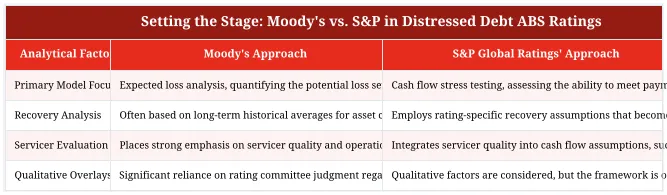
View data as table
| Analytical Factor | Moody’s Approach | S&P Global Ratings’ Approach |
|---|---|---|
| Primary Model Focus | Expected loss analysis, quantifying the potential loss severity for investors. | Cash flow stress testing, assessing the ability to meet payments under rating-specific scenarios. |
| Recovery Analysis | Often based on long-term historical averages for asset classes, adjusted for current conditions. | Employs rating-specific recovery assumptions that become progressively more stressful at higher rating levels. |
| Servicer Evaluation | Places strong emphasis on servicer quality and operational capabilities as a key qualitative overlay. | Integrates servicer quality into cash flow assumptions, such as workout timing and costs. |
| Qualitative Overlays | Significant reliance on rating committee judgment regarding transaction structure and legal risks. | Qualitative factors are considered, but the framework is often more quantitatively driven by scenario outcomes. |
Beyond the Initial Rating: The Role of Surveillance & Committees
An initial credit rating is not a static assessment. A rating’s integrity over time depends on continuous monitoring and a robust governance process, elements central to the operations of Nationally Recognized Statistical Rating Organizations (NRSROs), a designation overseen by regulators like the U.S. Securities and Exchange Commission (SEC).
The Importance of Rating Surveillance for Distressed Debt ABS
Once a security is rated, it enters a rating surveillance phase. Analysts at both Moody’s and S&P regularly monitor the performance of the underlying collateral pool and the payments made to bondholders. They track key metrics such as delinquency rates, default levels, and recovery amounts against their initial expectations.
If performance deteriorates or macroeconomic conditions change, the rating may be placed on review for a potential downgrade. This process ensures that ratings reflect the most current available information.
Inside the Rating Committee Process: A Deeper Look
The final rating decision is not made by a single analyst but is determined in a formal rating committee. This committee consists of senior analysts and credit experts who review the lead analyst’s recommendation, challenge assumptions, and vote on the final rating. This process introduces checks and balances, incorporating diverse perspectives and qualitative judgment to supplement the quantitative models, especially for complex assets like distressed debt.
Strategic Insights for Investors in Distressed Debt ABS Markets
For market participants, understanding the differences in rating agency approaches has direct implications for investment strategy, risk management, and deal structuring, particularly as European regulators consider adjustments to securitisation rules.
Navigating Rating Divergences in Investment Decisions
When faced with a split-rated security, investors can review the agencies’ pre-sale reports to understand the drivers of the rating difference. This analysis can reveal which agency’s assumptions align more closely with the investor’s own view of the collateral and the market. A rating divergence may signal an opportunity if an investor believes one agency is overly conservative in its assumptions.
The Impact on Deal Structuring and Market Liquidity
Issuers and investment bankers often structure transactions to meet the criteria of multiple rating agencies to broaden market appeal. The nuances of each agency’s methodology can influence the required levels of credit enhancement, the terms of servicer agreements, and the cost of funding. Understanding the evolving landscape of NPL securitization in Europe is key to successful deal execution.
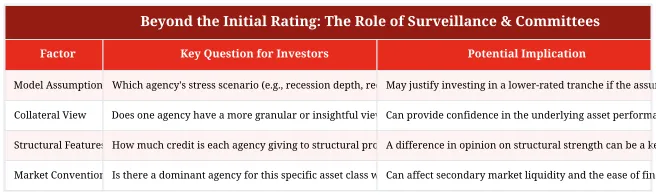
View data as table
| Factor | Key Question for Investors | Potential Implication |
|---|---|---|
| Model Assumptions | Which agency’s stress scenario (e.g., recession depth, recovery timing) is more plausible in the current economic cycle? | May justify investing in a lower-rated tranche if the assumptions are deemed excessively punitive. |
| Collateral View | Does one agency have a more granular or insightful view on the specific asset class or geography of the collateral? | Can provide confidence in the underlying asset performance, independent of the final rating. |
| Structural Features | How much credit is each agency giving to structural protections like liquidity reserves or interest rate caps? | A difference in opinion on structural strength can be a key driver of a rating split. |
| Market Convention | Is there a dominant agency for this specific asset class whose rating carries more weight with the broader market? | Can affect secondary market liquidity and the ease of financing the position. |
Elevate Your Strategy: Connect with Distressed Debt Experts
The details of the moody’s vs s&p rating methodology are a topic debated by decision-makers at our industry events. To gain insights from leaders in the European distressed debt and structured finance markets, direct engagement is essential.
Our forums provide a platform for GPs, LPs, and advisors to discuss these issues, network with peers, and originate deals. Gain knowledge from the experts who structure, rate, and invest in these securities. Request Agenda to see how our conferences can connect you with the market.
Conclusion
Neither Moody’s nor S&P’s rating approach is “better”; they are different analytical lenses to view the same risk. The key for an investor is to understand the assumptions that produced a rating, not just accept it at face value. By dissecting the methodologies, market participants can form their own informed opinions, identify relative value, and make better investment decisions in the distressed debt ABS space. To deepen your expertise and network with industry leaders, contact us to learn about our next European private credit and NPL forum or Request Agenda for our upcoming events.
Frequently Asked Questions
Why would an ABS backed by Italian NPLs get a split rating from Moody’s and S&P?
A split rating on an Italian Non-Performing Loan (NPL) ABS often stems from differing assumptions about the country’s legal and judicial timelines for asset recovery. One agency might apply a more pessimistic forecast for the time it takes to foreclose on and sell a property, based on recent court data from tribunals like the Court of Milan, leading to higher liquidity stress and a lower rating on the security’s junior tranches.
How does the moody’s vs s&p rating methodology treat credit enhancement structures differently?
The divergence often appears in the stress applied to structural features like overcollateralization (OC) and interest coverage (IC) tests. S&P might model a breach of these triggers under a specific, severe default timing scenario, whereas Moody’s analysis might focus on the erosion of subordination over the life of the deal under a wider range of correlated default scenarios.
Does S&P place more emphasis on servicer track records than Moody’s?
Both agencies view the special servicer as critical, but their focus can differ. S&P’s analysis often places significant weight on a servicer’s historical cure rates and liquidation timelines, assigning them a formal ranking (e.g., STRONG, ABOVE AVERAGE). Moody’s, while also assessing performance, may place a comparatively greater emphasis on the servicer’s operational scale, IT systems, and corporate governance framework.
When analyzing NPL securitisations, what specific macroeconomic overlays cause rating divergences?
A key difference is the forward-looking application of macroeconomic scenarios. Moody’s may more dynamically integrate their Chief Economist’s forecasts for unemployment or Home Price Index (HPI) declines into their cash flow models. In contrast, S&P might place a heavier weight on long-term historical recovery data for a given jurisdiction, resulting in different loss expectations.
How do Moody’s and S&P’s quantitative models, like CDOEdge and CDO Evaluator, differ in practice?
While both agencies use sophisticated portfolio models, their core algorithms and calibration differ. For instance, Moody’s CDOEdge platform often uses a binomial expansion technique to model default distributions. S&P’s CDO Evaluator has historically relied on a Monte Carlo simulation, which can lead to different assessments of tail risk for the same pool of distressed assets.
For institutional investors, what is the primary strategic value of analyzing rating methodology differences?
Sophisticated investors analyze the pre-sale reports from both agencies to understand the key risk drivers, not just the final letter rating. If Moody’s and S&P disagree on recovery rates for a specific asset pool, it signals an area for deeper due diligence. This allows the investor to form their own, more robust view on the security’s risk-return profile.




0 Comments