

Valuing Npl-backed Securities: Mastering Distressed Asset Investment
Effective valuing npl-backed securities primarily relies on discounted cash flow (DCF) analysis, projecting uncertain future recoveries from distressed loan pools. This process demands meticulous assessment of recovery rate assumptions, thorough collateral valuation, and robust stress testing to account for market volatility and servicing quality. Understanding secondary market dynamics and liquidity risk is also crucial for investors navigating NPL Asset-Backed Securities (ABS). This guide provides institutional investors with essential techniques for due diligence and advanced valuation, ensuring informed investment decisions in the complex NPL market.
DD Talks specializes in facilitating high-value deal-making and industry networking within European private credit, NPL, and structured finance markets. Our conferences provide unparalleled access to expert insights and practical strategies for institutional investors and distressed debt professionals.
To explore your options, contact us to schedule your consultation. You can also reach us via: Request Agenda
What are NPL-Backed Securities and How Are They Valued?
The primary method for assessing non-performing loan (NPL) backed securities is a discounted cash flow (DCF) analysis. This financial model forecasts expected cash collections from the underlying pool of distressed loans and discounts them to their present value using a rate that reflects the investment’s inherent risks. This approach provides a fundamental value based on the asset’s potential to generate future income.
Understanding the Basics of NPL Securitisation
Non-performing loans are bank loans that are in default or close to it. Financial institutions often pool these assets and sell them to investors through securitisation. This creates NPL-backed securities, also known as NPL Asset-Backed Securities (ABS).
These instruments are tradable financial assets whose value and cash flows derive from the underlying pool of non-performing debt. The collateral can range from residential mortgages and commercial real estate loans to unsecured consumer or corporate debt. Investors purchase these securities, taking on the risk for the potential of higher returns as loans are worked out and recoveries are made.
The Discounted Cash Flow (DCF) Approach for NPLs
A DCF model is fundamental to valuing npl-backed securities. Unlike traditional assets with predictable income streams, NPLs have highly uncertain cash flows. The analysis requires projecting the timing and amount of future collections, which can come from borrower repayments, asset sales, or legal settlements.
Analysts must build a detailed forecast for each loan or homogenous loan segment in the portfolio. A key component is the discount rate, which must be high enough to compensate for the credit risk, servicing costs, and market uncertainty. A higher perceived risk translates to a higher discount rate and a lower present value for the security.
Key Drivers & Metrics: What Factors Influence NPL ABS Valuation?
Recovery Rate Assumptions and Collateral Valuation
The most significant input in an NPL valuation model is the recovery rate. This metric represents the percentage of the outstanding loan balance expected to be recovered over time. Realistic recovery rate assumptions are critical; overly optimistic projections can lead to significant overvaluation and investment losses.
These assumptions are derived from historical performance data of similar asset pools, macroeconomic forecasts, and collateral valuation. For secured NPLs, this involves appraising the underlying real estate or other physical assets. The loan-to-value (LTV) ratio is a critical metric, indicating the buffer between the asset’s market value and the loan amount.
The Critical Role of Servicing Quality in NPL ABS Performance
The servicer—the entity responsible for managing and collecting on the non-performing loans—is pivotal to the performance of an NPL ABS. The servicer’s operational efficiency, legal expertise, and collection strategies directly impact the timing and amount of cash recovered. A high-quality servicer can materially increase the recovery rate, while an inefficient one can erode value.
When evaluating a servicer, investors should assess their track record with similar asset types, their technological infrastructure, regulatory compliance, and specific workout strategies. The servicer’s fee structure also impacts the net cash flows available to security holders, making it a key component in the valuation model.
Navigating Due Diligence and Risk in NPL-Backed Securities
Performing Comprehensive Due Diligence on NPL Portfolios
Due diligence begins with a granular analysis of the loan data tape, which contains detailed information on each underlying loan. This includes reviewing borrower details, loan balances, payment histories, collateral information, and the status of any legal proceedings to verify data accuracy and build a bottom-up cash flow projection.
The process includes a legal review to confirm the enforceability of loan contracts and security of collateral liens, an on-site assessment of the servicer’s operations, and a market analysis to contextualize the portfolio within the current economic and regulatory environment. This informs assumptions about asset prices and recovery timelines.
Assessing Liquidity, Credit, and Operational Risks
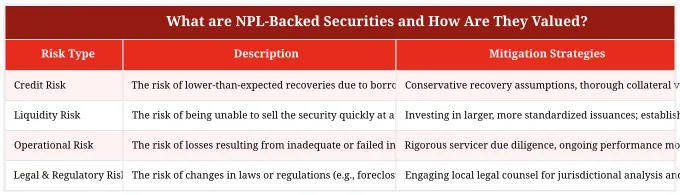
Investing in NPL-backed securities involves a distinct set of risks. Understanding these risks and their potential impact is fundamental to valuing npl-backed securities and managing a portfolio.
View data as table
| Risk Type | Description | Mitigation Strategies |
|---|---|---|
| Credit Risk | The risk of lower-than-expected recoveries due to borrower defaults or declining collateral values. | Conservative recovery assumptions, thorough collateral valuation, and portfolio diversification across geographies and asset types. |
| Liquidity Risk | The risk of being unable to sell the security quickly at a fair market price due to a lack of buyers. | Investing in larger, more standardized issuances; establishing relationships with specialized brokers; maintaining a longer investment horizon. |
| Operational Risk | The risk of losses resulting from inadequate or failed internal processes, people, and systems, particularly from the servicer. | Rigorous servicer due diligence, ongoing performance monitoring, and clear servicing agreements with performance incentives. |
| Legal & Regulatory Risk | The risk of changes in laws or regulations (e.g., foreclosure moratoriums, bankruptcy laws) that negatively impact collections. | Engaging local legal counsel for jurisdictional analysis and staying informed on potential regulatory shifts affecting creditor rights. |
Advanced Valuation Techniques & Market Insights for European NPLs
Advanced analytical methods refine valuation and risk assessment. The DD Talks network is a forum for discussing these techniques, particularly as they apply to regional market dynamics in areas like the Iberian Peninsula and Central and Eastern Europe (CEE).
Tranche Analysis and Stress Testing for Robust Valuation
Most NPL securitisations are structured with multiple tranches of varying seniority. Tranche analysis is essential to understand the risk and return profile of each bond. Senior tranches have first claim on cash flows and offer lower risk and yield, while junior and equity tranches are subordinate, offering higher potential returns for higher risk. A “waterfall” model projects how cash flows are distributed to each tranche under different scenarios.
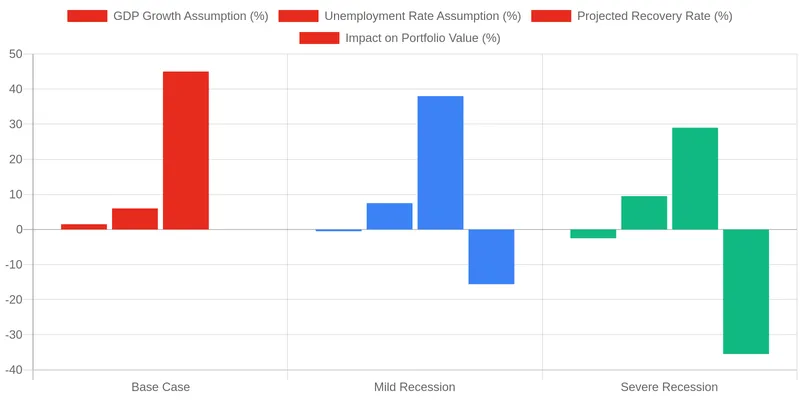
Stress testing assesses a portfolio’s resilience by modeling the impact of adverse economic scenarios—such as a sharp rise in unemployment or a fall in real estate prices—on recovery rates and cash flows. This analysis helps investors understand potential downside risk when valuing npl-backed securities.
View data as table
| Scenario | GDP Growth Assumption (%) | Unemployment Rate Assumption (%) | Projected Recovery Rate (%) | Impact on Portfolio Value (%) |
|---|---|---|---|---|
| Base Case | 1.5% | 6.0% | 45% | 0% |
| Mild Recession | -0.5% | 7.5% | 38% | -15.6% |
| Severe Recession | -2.5% | 9.5% | 29% | -35.5% |
European NPL Market Dynamics and Regulatory Impact
The European NPL market is a collection of distinct markets with unique legal frameworks and economic conditions. For instance, judicial processes for collateral enforcement in Italy differ significantly from those in Spain or Germany, directly impacting recovery timelines. Investors require specialized, local knowledge to accurately price risk.
Regulatory developments also shape the market. Frameworks like the EU’s NPL Directive and standards from the European Banking Authority aim to standardize the market and improve transparency. Understanding these regulations is crucial for compliance and for identifying opportunities, such as The Revival of European ABS and Private Securitisation Structures, which are discussed at our industry forums.
Trading NPL-Backed Securities: Secondary Market Dynamics
The secondary market for NPL-backed securities provides liquidity but also presents challenges like price volatility and information asymmetry.
Understanding the Secondary Market for NPL ABS
The secondary market for NPL ABS is primarily an over-the-counter (OTC) market, where transactions are negotiated directly between buyers and sellers, often through specialized brokers. Participants include hedge funds, private equity firms, and other institutional investors specializing in distressed assets.
Liquidity can be thin compared to more conventional fixed-income markets. Pricing is influenced by the performance of the underlying loan pool, shifts in the macroeconomic outlook, and changes in investor sentiment toward credit risk. Bid-ask spreads can be wide, reflecting the complexity and bespoke nature of these securities.
Strategies for Optimizing NPL ABS Trading and Portfolio Management
Active portfolio management involves continuously monitoring the performance of the underlying NPLs and the servicer’s effectiveness. Investors may sell a security if performance exceeds expectations and the price reflects this, or if they identify deteriorating credit quality.
Trading relies on market intelligence and re-underwriting capabilities to re-evaluate a security’s cash flow potential based on new information. For deeper insights into managing these assets, investors and bank executives can explore approaches in resources like Navigating NPL Portfolios: Strategies for Bank Executives and Investors.
Unlock Exclusive NPL Investment Insights at DD Talks Events
Valuing NPL-backed securities requires current market intelligence, industry connections, and access to experts. DD Talks is a platform for institutional investors, servicers, and advisors to connect and discuss the European NPL and distressed debt markets.
Our forums in London, Madrid, and across Europe facilitate deal-making and strategic discussions. Gain insights from GPs and LPs on capital restructuring and trends in private securitisation. To access networking opportunities, Request Agenda for our upcoming events or contact us to learn more about participation.
Conclusion
Valuing and trading NPL-backed securities requires fundamental analysis. The key criterion is risk-adjusted return, determined through due diligence, conservative cash flow forecasting, and understanding servicer capabilities. As the European market evolves in 2026, staying connected to deal flow and regulatory shifts is critical. To explore these topics, Request Agenda for our next NPL & Distressed Debt Forum or contact us for more information.
Frequently Asked Questions
Beyond a basic DCF, what specific inputs are most sensitive when valuing an NPL security?
The most sensitive inputs in a discounted cash flow (DCF) model are the recovery rate, the recovery timing, and the associated workout costs. For instance, a 10% change in the assumed recovery rate on a pool of unsecured loans can impact the valuation far more than a similar change in servicing fees. Analysts often stress-test these variables, modeling scenarios where recovery timelines extend by 12-24 months beyond the base case to account for potential delays.
How do rating agencies like Moody’s or S&P assess a servicer’s quality when rating an NPL securitisation?
Rating agencies such as Moody’s and S&P evaluate a servicer’s historical performance, focusing on their track record of recovery rates and timelines for similar asset pools. They scrutinize the servicer’s operational capacity, legal expertise in relevant jurisdictions like Spain or Italy, and the robustness of their IT and reporting systems. A servicer with a “STRONG” or “ABOVE AVERAGE” rating can positively influence the credit enhancement levels required for the security.
What is “re-performance risk” in an NPL portfolio and how does it affect valuation?
Re-performance risk is the uncertainty that a previously defaulted loan, which has resumed payments, will re-default in the future. When valuing npl-backed securities, this risk is modeled by applying a higher probability of default to these “cured” loans compared to consistently performing loans. A high concentration of re-performing assets introduces significant volatility to cash flow forecasts, often requiring a higher discount rate to compensate for the added uncertainty.
How does the ‘waterfall’ payment structure in an NPL ABS create value for senior tranche holders?
The waterfall structure dictates that cash collections from the NPL pool first pay senior expenses and interest to the highest-rated (e.g., AAA) tranches. Only after these senior obligations are met does cash “flow down” to the mezzanine and junior tranches. This subordination provides significant credit enhancement, protecting senior noteholders from initial losses and making their position much safer than the underlying asset pool’s average risk profile.
How do legal and jurisdictional differences within the EU impact the valuation of NPL portfolios?
Jurisdictional differences are a critical factor in the valuation of European NPL portfolios. For example, the average foreclosure timeline in Italy can be significantly longer than in Spain, directly impacting the recovery timing assumption in a DCF model. Investors must apply jurisdiction-specific legal cost assumptions and recovery rate haircuts, as local insolvency laws and court efficiency can alter final recoveries by as much as 20-30%, according to market analyses.
Why is the secondary market for NPL-backed securities often illiquid, and what is a typical bid-ask spread?
The secondary market is illiquid primarily due to the bespoke nature of each deal and the high complexity of the underlying assets, which requires extensive due diligence. Unlike more standardized securities, trading is conducted over-the-counter (OTC) between a small circle of specialized institutional investors. Consequently, bid-ask spreads can be wide, often ranging from 2% to 5% of the security’s price, reflecting the high search costs and information asymmetry.




0 Comments