

Networking at Financial Conferences: Mastering Deal Origination & Capital Raising
Effective networking at financial conferences is crucial for driving deal origination and capital raising within the institutional investment landscape. This guide outlines a strategic approach to B2B networking, from meticulous pre-conference planning to impactful on-site engagement and post-event follow-up. It details how general partners (GPs) can connect with limited partners (LPs) and how institutional investors can access proprietary deal flow. Emphasizing specialized markets like European private credit and distressed debt, the article provides actionable strategies for maximizing engagement and converting connections into concrete deals at industry events.
DDTalks specializes in organizing premium B2B financial conferences across Europe, focusing on private credit, NPL, and structured finance. These events facilitate high-value deal-making and strategic connections among top-tier institutional investors and fund managers, ensuring focused and productive interactions.
To explore your options, contact us to schedule your consultation. You can also reach us via: Request Agenda
Why is Networking at Financial Conferences Crucial for Deal-Making?
Strategic networking at financial conferences is the primary mechanism for building relationships that drive deal origination, capital raising, and market intelligence. For general partners (GPs), it connects them with limited partners (LPs) and helps source proprietary deals. For institutional investors, it offers direct access to fund managers and co-investment opportunities not publicly available.
These events compress months of outreach into a few focused days. They provide a neutral, efficient platform where decision-makers gather to transact and exchange information. The value extends beyond immediate deal-making to gathering real-time sentiment on market trends, understanding shifts in investor appetite, and benchmarking strategies against peers. In specialized markets like European private credit and distressed debt, where information is often fragmented, the insights from face-to-face interactions are indispensable for navigating complex transactions and forming durable partnerships.
Mastering Pre-Conference Strategy: Your Blueprint for B2B Networking Success
The success of B2B networking is determined before you arrive. A methodical pre-conference strategy transforms attendance from a passive experience into a targeted business development initiative.
Setting Clear Objectives & Identifying Key Targets
Define a successful outcome. Are you a GP aiming to secure three qualified LP meetings for a new direct lending fund? An NPL servicer looking to connect with two specific asset managers holding Iberian portfolios? An institutional investor seeking to understand trends in asset-backed finance? Your objectives should be specific and measurable.
Once goals are set, review the delegate list and agenda. Identify individuals and firms that align with your objectives. Research their current activities, recent deals, and stated investment mandates. This prioritizes your time and tailors your approach, ensuring every interaction is relevant and informed.
Crafting Your Value Proposition & Conversation Starters
With targets identified, refine your value proposition. This is not a generic pitch but a concise statement explaining the problem you solve or the opportunity you offer. For a GP, this might be a track record in a niche credit strategy. For an advisor, it could be expertise in navigating complex securitisation structures.
Prepare open-ended questions to initiate conversations. Instead of asking “What do you do?”, try “What are your thoughts on the current risk appetite for mid-market corporate debt in the DACH region?” or “How is the AIFMD II directive impacting your fund structuring?” This demonstrates interest and industry knowledge, setting the stage for a substantive discussion.
Effective On-Site Engagement: Strategies for Deal Origination & Capital Raising
On-site execution is where preparation meets opportunity. The environment of a financial forum requires strategic planning and adaptability. The goal is to move beyond casual conversations to initiate the trust-building process that underpins deal-making and capital allocation.
Navigating the Forum: From Panels to Private Meetings
A conference agenda is a roadmap for engagement. Attend panels not just for content but to observe speakers and identify participants in the audience. The Q&A session is an opportunity to ask a question that positions you as an expert. The most valuable interactions often occur during unstructured time—coffee breaks, lunches, and receptions. These are the moments for the targeted, one-on-one conversations you planned. For focused discussions, use the dedicated meeting areas that events like DDTalks provide, creating a professional setting for dialogue. You can learn more about how to build strategic partnerships at these events.
Approaching Investors & Initiating High-Value Conversations
When approaching a target investor or partner, be direct but respectful. A direct introduction is effective: “Ms. Sanchez, I’m John Doe from ABC Capital. I was impressed by your panel’s insights on NPL workout strategies in Spain. We are currently active in that market and I’d be interested to hear your perspective on…” This approach is informed, relevant, and opens the door for an exchange. The key is active listening. As noted in research from Harvard Business Review, effective listening involves understanding the other party’s challenges and objectives before presenting your own solution.
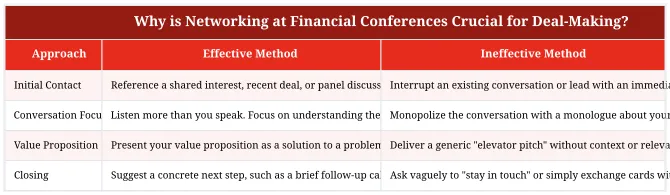
Below is a comparison of effective versus ineffective on-site networking approaches.
View data as table
| Approach | Effective Method | Ineffective Method |
|---|---|---|
| Initial Contact | Reference a shared interest, recent deal, or panel discussion. Ask a relevant question. | Interrupt an existing conversation or lead with an immediate, unsolicited pitch. |
| Conversation Focus | Listen more than you speak. Focus on understanding their mandate, challenges, and goals. | Monopolize the conversation with a monologue about your firm or fund. |
| Value Proposition | Present your value proposition as a solution to a problem they have mentioned. | Deliver a generic “elevator pitch” without context or relevance to the listener. |
| Closing | Suggest a concrete next step, such as a brief follow-up call to discuss a specific point. | Ask vaguely to “stay in touch” or simply exchange cards with no clear purpose. |
DDTalks’ Edge: Facilitating High-Value Connections in European Finance
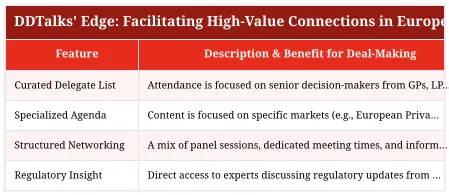
The architecture of a B2B financial conference is designed to create an environment for deal-making. Organizers like DDTalks curate senior decision-makers, ensuring productive interactions.
The delegate list is a key differentiator. By bringing together institutions such as Blackstone, Goldman Sachs, PIMCO, and Ares Management, these forums create a critical mass of capital and opportunity. The presence of general partners, limited partners, investment bankers, and workout professionals means all sides of a potential transaction are often in the same room. This concentration of expertise is invaluable for sourcing deals, raising capital, and validating investment theses in real time.
The Ecosystem of B2B Financial Conferences
The value of a forum extends to its content. The agenda is structured to address market issues, from navigating regulatory changes like the AIFMD II framework to exploring opportunities in private securitisation. Panels and workshops are led by active market participants, providing actionable intelligence rather than theoretical overviews. This focus on relevance ensures conversations are grounded in current market dynamics, making networking sessions more productive. You can explore a sample of these discussions on our NPL and distressed debt conference agenda page.
View data as table
| Feature | Description & Benefit for Deal-Making |
|---|---|
| Curated Delegate List | Attendance is focused on senior decision-makers from GPs, LPs, and advisory firms, increasing the relevance of each connection. |
| Specialized Agenda | Content is focused on specific markets (e.g., European Private Credit, NPLs), ensuring discussions are directly applicable to attendees’ business. |
| Structured Networking | A mix of panel sessions, dedicated meeting times, and informal breaks facilitates both broad engagement and one-on-one conversations. |
| Regulatory Insight | Direct access to experts discussing regulatory updates from bodies like the European Securities and Markets Authority (ESMA) provides context for structuring deals. |
Post-Conference Momentum: Converting Connections into Concrete Deals
A systematic, personalized follow-up process converts conversations into business opportunities. The goal is to build on the initial rapport and advance the dialogue toward a next step, whether a formal pitch, a due diligence process, or a partnership discussion.
Crafting Personalized Follow-Up & Next Steps
Timeliness is critical. Send a follow-up email within 24-48 hours. Avoid generic templates. Your message should be personalized, referencing a specific point from your discussion. For example: “It was a pleasure discussing the outlook for Spanish real estate NPLs with you at the DDTalks forum. As promised, here is the market report I mentioned on recent portfolio transactions.”
Your follow-up should propose a clear next step. Instead of “Let’s catch up sometime,” suggest a “brief 15-minute call next Tuesday to explore potential synergies between our credit strategies.” This removes ambiguity and makes it simple for the other party to engage.
Sustaining Relationships for Future Opportunities
B2B networking is about cultivating long-term relationships, not just closing immediate transactions. Even if there is no instant opportunity, the connection holds future value. Add new contacts to your professional network and find ways to provide value. This could involve sharing a relevant article, making an introduction, or offering insight on a market development.
This approach builds trust and keeps you top-of-mind. When a relevant deal or capital need arises, you will be one of the first calls they make. The relationships initiated at a conference can become part of your deal flow and capital base for years.
Maximizing Your ROI: The Tangible Benefits of Strategic Financial Networking
Measuring the return on investment from a financial forum goes beyond a cost-benefit analysis. While direct costs are clear, the benefits are multifaceted and compound over time. Effective networking at financial conferences yields qualitative returns in the institutional investment landscape.
The most direct return is in deal origination and capital raising. A single conversation can lead to a proprietary deal or secure an anchor investor for a new fund. Beyond transactions, the market intelligence gathered is invaluable. Understanding investor sentiment, competitive positioning, and emerging trends from the source provides a strategic advantage.
These events build your firm’s brand and reputation within a targeted community. Consistent participation establishes you and your organization as credible experts. The long-term partnerships formed—with co-investors, service providers, and strategic allies—create a professional ecosystem that supports growth and opportunity.
Ready to Elevate Your Financial Networking & Deal-Making?
The strategies outlined here provide a framework for approaching industry events. Active, strategic engagement improves deal-making and relationship building.
We invite you to explore upcoming DDTalks forums, where Europe’s figures in private credit, NPLs, and structured finance convene. To learn more and join this community, Request Agenda for our next event or secure your delegate pass today.
Conclusion
Success in networking at financial conferences hinges on prioritizing quality over quantity. Rather than collecting business cards, focus on building well-researched relationships. Shift your mindset from transactional to relational. The most valuable deals and partnerships are built on mutual trust and shared insight. Your next step is to identify events that gather the right decision-makers for your goals and commit to a strategic, prepared approach.
To discover where Europe’s deal-makers will be next, contact us or Request Agenda for our upcoming forums.
Frequently Asked Questions
How far in advance should you request the delegate list to plan your meeting schedule?
For premium B2B forums, aim to secure the delegate list at least two to three weeks prior to the event. This provides sufficient time to research key LPs or GPs, identify mutual interests, and send personalized meeting requests through the event’s official networking app before their schedules are fully booked.
What is the professional etiquette for approaching a senior partner from a firm like PIMCO or Oaktree?
Wait for a natural pause in their current conversation rather than interrupting. Approach with a specific, informed opening line that references their recent market activity or a point from their panel discussion, demonstrating you have done your research. The goal is a brief, value-led interaction, not an immediate, lengthy pitch.
How can you effectively use panel sessions for networking, not just for listening?
Use the Q&A portion to ask an insightful question that positions you as a knowledgeable peer, making you memorable to the panelists and audience. Afterwards, approach a panelist not with generic praise, but with a specific follow-up question related to their answer. This creates a substantive foundation for a later conversation.
What specific details should a follow-up email contain after networking at a financial conference?
Your follow-up, sent within 24-48 hours, must be highly specific to be effective. Reference the exact topic you discussed (e.g., “our conversation about NPL opportunities in the Iberian market”) and propose a clear, low-friction next step, such as “sharing our latest research on Spanish REOs” or “a brief 15-minute call next week.”
What is the key difference between networking at a large event versus a specialized forum on distressed debt?
At large events, the goal is often broad brand visibility. In contrast, a specialized forum, such as a European NPL summit, facilitates targeted deal-making where nearly every delegate is a relevant counterparty. This allows for deeper, more technical conversations on topics like complex capital restructuring from the very first interaction.
How can junior analysts best support their team’s strategic networking at financial conferences?
Junior professionals can act as force multipliers by monitoring the event app for meeting requests and managing the schedule in real-time. They can also attend concurrent sessions to gather intelligence and identify emerging managers or niche investors, providing valuable briefs to senior partners before key networking at financial conferences breaks.

0 Comments