

European Direct Lending Forecast: Sector Growth & Investment Insights
The european direct lending forecast for 2025-2026 projects sustained expansion, driven by a structural shift from traditional bank lending and the financing needs of middle-market companies. This analysis identifies technology, healthcare, and renewable energy as leading sectors for investment opportunities, fueled by digitalization, demographic shifts, and ESG mandates. Understanding these sector-specific dynamics and the evolving regulatory landscape is crucial for general partners and limited partners seeking to deploy capital effectively in the European private credit market.
DDTalks provides authoritative insights into European private credit markets, facilitating high-level discussions on market trends, deal flow, and regulatory impacts like AIFMD II. Our events connect institutional investors and industry leaders, fostering informed investment strategies.
To explore your options, contact us to schedule your consultation. You can also reach us via: Request Agenda
The european direct lending forecast for 2025-2026 indicates sustained expansion and investment opportunities for institutional investors and private credit professionals. This analysis explores the structural growth drivers, identifies key sectors for activity, and examines the regulatory landscape. Understanding these sector-specific dynamics helps general partners (GPs) and limited partners (LPs) deploy capital effectively in the European market.
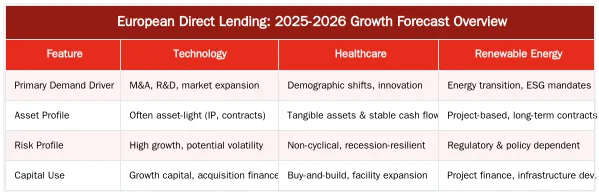
European Direct Lending: 2025-2026 Growth Forecast Overview
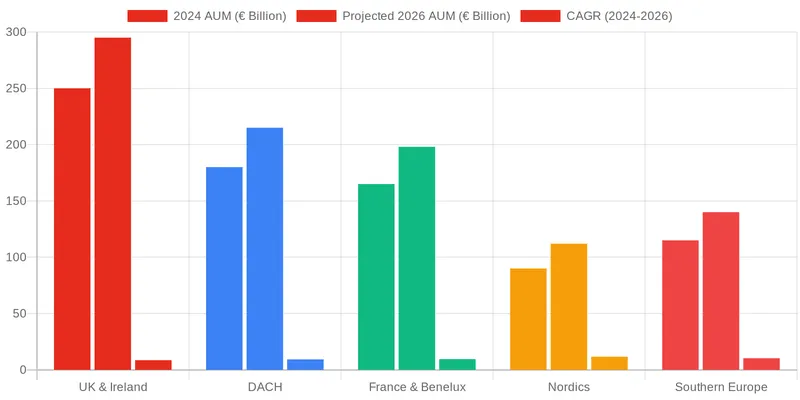
The outlook for European direct lending through 2026 is strong, with assets under management (AUM) projected to grow. This growth is driven by a financing gap for middle-market companies and a structural shift from bank lending. The most promising investment sectors are driven by non-cyclical demand and long-term secular trends.
Key sectors expected to lead direct lending growth include:
- Technology: Fueled by digitalization, software-as-a-service (SaaS) adoption, and M&A activity.
- Healthcare: Supported by aging demographics, medical innovation, and defensive cash flow profiles.
- Renewable Energy: Driven by ESG mandates and the continent-wide energy transition.
What is Driving the Current Market Expansion?
The expansion results from macroeconomic conditions and market changes. As banks face stricter capital requirements, private credit funds provide flexible, bespoke financing solutions. This trend is central to the future of European private credit and direct lending strategies, as institutional investors allocate capital to the asset class for attractive, risk-adjusted returns.
Key Drivers Fueling Private Credit Expansion in Europe
Fundamental factors are propelling the growth of Europe’s private credit market, creating opportunities for direct lenders to deploy capital in the underserved middle-market segment.
The Evolving Role of Banks and Capital Demand
European banks continue to deleverage their balance sheets in response to regulatory frameworks like Basel III and IV. This retrenchment has created a void in corporate lending for middle-market companies requiring complex or flexible financing. Direct lenders fill this gap, offering customized credit solutions for acquisitions, growth capital, and refinancings. This structural shift provides consistent deal flow for private credit funds.
Economic Outlook Europe and Investor Appetite
Despite potential macroeconomic headwinds, Europe’s economic outlook supports private credit. The European Commission’s economic forecasts project modest growth, supporting corporate performance and credit quality. Institutional investors, including pension funds and insurance companies, are increasing their allocations to private credit. This is driven by the asset class’s potential for higher yields than public debt, floating-rate structures that hedge against inflation, and lower volatility.
Top Sectors for Direct Lending Investment Opportunities
Certain sectors offer compelling risk-reward profiles for 2025-2026. Technology, healthcare, and renewable energy are notable for their secular growth drivers, defensive characteristics, and capital requirements. These industries are less correlated with the economic cycle, making them attractive for private credit deployment.
Technology: Innovation and Scalability
The European technology sector is a primary destination for direct lending. Capital demand is high, driven by M&A, buy-and-build strategies, and growth financing for SaaS, fintech, and cybersecurity firms. These businesses often have asset-light models with recurring revenue, suited for cash-flow-based lending. Lenders provide capital for software acquisitions and scaling sales teams, supporting the digitalization of the European economy.
Healthcare: Resilience and Demographic Shifts
Healthcare is a defensive sector with stable, predictable cash flows. The industry benefits from demographic trends like an aging population and innovation in pharmaceuticals, medical devices, and healthcare services. Private credit funds finance acquisitions of clinics, care homes, and specialized medical providers. The sector’s non-cyclical nature, detailed in our analysis of healthcare private credit opportunities, provides a buffer against economic downturns.
Renewable Energy: ESG and Energy Transition Financing
Decarbonization efforts across Europe create high capital demand in the renewable energy sector. ESG mandates are channeling funds into wind, solar, and energy storage projects. Direct lenders provide project finance and infrastructure debt to support this transition. These investments often feature long-term contracts and government support, creating stable, long-duration assets for institutional investors focused on energy transition financing.
Navigating Regulatory Shifts and Enhancing Deal Flow
The European regulatory environment shapes the private credit landscape. Fund managers must adapt to changes like the Alternative Investment Fund Managers Directive (AIFMD II). In a competitive market, disciplined deal origination and execution, particularly in sponsor-backed deals, are required.
The Impact of AIFMD II on Fund Structuring
AIFMD II introduces new rules for delegation, liquidity management, and reporting for EU fund managers. These changes, noted by the European Securities and Markets Authority (ESMA), require managers to adapt operational and compliance frameworks. The directive creates administrative hurdles but also aims to harmonize the market and enhance investor protection, potentially increasing institutional confidence in the asset class. These nuances are discussed at industry forums on fund structuring and compliance.
Optimizing Deal Flow and Sponsor-Backed Strategies
In a crowded market, strong deal flow is a differentiator. Relationships with private equity sponsors are a primary source of sponsor-backed transactions, which benefit from sponsor due diligence and a clear strategic plan. Effective origination involves building proprietary networks with corporate advisors, lawyers, and accountants to access off-market opportunities. A disciplined investment process and certainty of execution help win mandates.
Strategic Outlook: Challenges, Trends, and Future Opportunities
While the 2026 private credit forecast is positive, investors face potential challenges and emerging trends. Mitigating macroeconomic volatility risks while capitalizing on opportunities like geographic expansion and product innovation is key. The market’s maturity requires sophisticated portfolio construction and risk management.
Addressing Market Headwinds and Competition
Challenges include interest rate uncertainty, which impacts borrowing costs and valuations. Capital raised by private credit funds has intensified competition, potentially leading to spread compression and weaker covenants. Managers must maintain strict underwriting discipline, focus on sectors with strong fundamentals, and add value beyond capital.
Emerging Trends and Geographic Expansion
ESG factor integration is a growing trend in the investment process, becoming a core part of due diligence and value creation. Geographically, interest is growing in less saturated regions like the Nordics and Central and Eastern Europe (CEE), beyond established markets like the UK, France, and Germany. These markets offer potential for higher yields and diversification. Growth in the European private credit market size will also spur product innovation, including specialized strategies in asset-backed finance and distressed debt.
Unlock Exclusive Insights at DDTalks Private Credit Events
Navigating the European private credit market requires timely intelligence and connections. DDTalks’ B2B financial conferences provide a platform for institutional investors, GPs, and advisors to explore investment opportunities and build strategic partnerships.
Connect with Industry Leaders and Secure Deal Flow
Our events in European financial hubs like London and Madrid bring together industry decision-makers. Participants gain direct access to expert panels discussing trends, regulatory updates, and sector-specific forecasts to enhance deal flow. Request Agenda for our upcoming Private Credit Days Europe to connect with industry leaders.
Conclusion
The 2025-2026 european direct lending forecast shows a market of growth and increasing sophistication. Technology, healthcare, and renewable energy will drive deal flow, supported by secular trends. Success requires navigating regulatory changes, maintaining underwriting discipline, and leveraging strong networks. Contact us or Request Agenda for our next conference.
Frequently Asked Questions
Which sectors show the most promising growth in the european direct lending forecast for 2025-2026?
The strongest growth within the european direct lending forecast is anticipated in the technology, healthcare, and renewable energy sectors. These industries benefit from non-cyclical demand, robust secular growth trends, and a continuous need for specialized, flexible capital solutions that private credit can provide.
How does the macroeconomic outlook influence the european direct lending forecast?
The outlook for European private credit is significantly shaped by macroeconomic factors like interest rate policies, inflation, and overall business confidence. While potential headwinds exist, the structural retreat of traditional banks from mid-market lending provides a consistent tailwind for direct lenders, supporting a positive european direct lending forecast across various economic cycles.
What makes the technology sector particularly attractive in the european direct lending forecast?
The technology sector is a key component of the european direct lending forecast due to its prevalent recurring revenue models, such as Software-as-a-Service (SaaS). These models generate predictable cash flows ideal for servicing debt. The sector’s constant need for growth capital for R&D and M&A activity creates a steady stream of financing opportunities.
Will ESG-related sectors continue to be a major driver of the European private credit outlook?
Absolutely. ESG-aligned sectors are a critical growth driver for the European private credit market. The continent-wide energy transition and sustainability initiatives are creating massive capital requirements for projects in renewable infrastructure and green technology, underpinning positive long-term projections for direct lending.
What are the potential risks or challenges for the European direct lending market in 2025-2026?
Key challenges for the European direct lending market include increased competition among funds, which can compress yields, and the potential for a rise in default rates if economic conditions worsen significantly. Additionally, navigating the evolving regulatory landscape, such as the implementation of AIFMD II, requires careful due diligence from both GPs and LPs.
How can investors get deeper insights into the european direct lending forecast and connect with fund managers?
Investors can gain direct access to expert analysis and connect with leading fund managers by attending specialized industry events. DDTalks’ private credit conferences offer a premier platform to discuss the european direct lending forecast, evaluate sector-specific strategies, and facilitate high-value deal-making. You can request an agenda to see our upcoming speaker lineup.




0 Comments