

Servicer Quality NPL Securitisation: Impacting Credit Ratings and Recovery
Servicer quality npl securitisation critically influences credit ratings by directly impacting recovery rates and cash flow generation from distressed assets. This article details how a servicer’s operational capabilities, workout strategies, and due diligence processes are scrutinised by rating agencies. Understanding the distinction between master and special servicers, and their respective roles in maximising value from non-performing loan portfolios, is essential for investors and originators. Effective loan servicing directly correlates with higher expected recovery rates, leading to more favourable NPL securitisation ratings and enhanced investor confidence.
DDTalks provides expert insights into the European NPL and structured finance markets, facilitating discussions on critical factors like servicer performance. Our content draws from extensive experience in organizing premium B2B financial conferences, connecting industry leaders and informing strategic decisions in distressed debt and securitisation.
To explore your options, contact us to schedule your consultation. You can also reach us via: Request Agenda
What is Servicer Quality in NPL Securitisation and Why Does it Matter?
Servicer quality in non-performing loan (NPL) securitisation is a servicer’s ability to manage and recover value from a portfolio of distressed assets. This capability directly determines the timing and volume of cash flows from the underlying loans, which heavily influences the credit ratings assigned to the issued notes.
Unlike securitisations of performing loans with predictable payment streams, NPL transactions depend on the servicer’s proactive workout strategies. A high-quality servicer can enhance recovery values, while a subpar one can lead to diminished returns and rating downgrades. Understanding servicer quality npl securitisation is essential for investors and originators. For more on the rating process, explore how rating agencies assess NPL securitisation transactions.
Defining Key Servicer Roles: Master vs. Special Servicers
In structured finance, including commercial mortgage-backed securities (CMBS) and NPL transactions, servicing duties are often split between two roles:
- Master Servicer: The master servicer handles the day-to-day administration of the loan portfolio, focusing on performing loans. Duties include collecting payments, managing escrow accounts, and reporting to the trustee and investors. In a pure NPL deal, this role may be minimal or combined with the special servicer.
- Special Servicer: The special servicer is engaged when a loan becomes delinquent or enters default. Their role is to execute workout strategies to maximize recovery. This involves borrower negotiation, initiating legal proceedings, managing and disposing of real estate owned (REO) properties, and restructuring loan terms. In NPL securitisations, the special servicer’s function is central to the transaction from day one.
How Servicer Performance Directly Influences NPL Securitisation Ratings
An NPL servicer’s performance has a direct, measurable impact on a securitisation’s credit ratings. Rating agencies model expected cash flows based on recovery rates and timing, and these assumptions are informed by their assessment of the servicer. A servicer with a strong track record and operational infrastructure can justify more optimistic recovery assumptions, leading to higher initial ratings.
Conversely, perceived weakness in servicing capability introduces uncertainty, compelling agencies to apply more conservative assumptions, which can depress ratings.
Maximising Recovery Rates and Cash Flow Generation
A servicer’s primary objective is to maximise the net present value (NPV) of recoveries from the distressed loan pool. This is achieved through tailored workout strategies, such as forbearance, loan modification, discounted pay-offs, or asset foreclosure and sale. The servicer’s ability to choose and execute the optimal strategy for each asset dictates the recovery rate.
A servicer advance requires the servicer to advance scheduled principal and interest payments to the securitisation trust, even if the borrower has not paid. This provides liquidity and cash flow stability to the senior notes but also exposes the servicer to financial risk. A servicer’s financial strength and willingness to make these advances is a key factor in rating analysis. Learn more about effective loan servicing top practices.
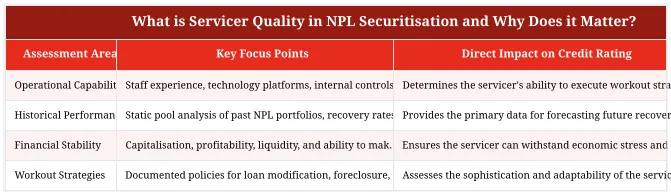
What Do Rating Agencies Scrutinise in NPL Servicer Due Diligence?
Credit rating agencies conduct extensive due diligence on servicers before assigning ratings to an NPL securitisation. The evaluation covers operational, financial, and strategic aspects of the servicing platform.
View data as table
| Assessment Area | Key Focus Points | Direct Impact on Credit Rating |
|---|---|---|
| Operational Capability | Staff experience, technology platforms, internal controls, call centre metrics, legal and compliance frameworks. | Determines the servicer’s ability to execute workout strategies efficiently and at scale, influencing recovery timing assumptions. |
| Historical Performance | Static pool analysis of past NPL portfolios, recovery rates by asset class, resolution timelines, cost-to-collect ratios. | Provides the primary data for forecasting future recoveries. Strong historical data supports more favourable rating assumptions. |
| Financial Stability | Capitalisation, profitability, liquidity, and ability to make servicer advances. Corporate credit rating of the servicer. | Ensures the servicer can withstand economic stress and meet its financial obligations to the trust, protecting noteholders. |
| Workout Strategies | Documented policies for loan modification, foreclosure, REO management. Use of data analytics for decision-making. | Assesses the sophistication and adaptability of the servicer’s approach to maximising value from distressed assets. |
Key Performance Indicators (KPIs) and Operational Risk Assessment
Agencies analyse specific KPIs to quantify servicer performance, including cure rates, re-default rates, loss severity, and the time taken to resolve assets. The analysis includes operational risk—the risk of loss from inadequate internal processes, people, or systems.
| Risk Category | Description | Mitigation Strategy |
|---|---|---|
| Technology & Systems | Risk of system failure, data breaches, or inadequate IT infrastructure to handle portfolio complexity. | Disaster recovery plans, regular system upgrades, third-party security audits, and scalable platforms. |
| Human Capital | Risk from high staff turnover, lack of experienced asset managers, or inadequate training. | Competitive compensation, ongoing professional development, clear succession planning, and strong management oversight. |
| Compliance & Legal | Risk of non-compliance with diverse and changing jurisdictional regulations, leading to fines or legal challenges. | Dedicated in-house legal and compliance teams, regular training, and use of external counsel for complex issues. |
| External Events | Risk from macroeconomic shocks, natural disasters, or political changes impacting recovery processes. | Geographic diversification of servicing operations, business continuity planning, and dynamic portfolio stress testing. |
Elevating Servicer Quality: Best Practices for Enhanced Ratings
NPL servicers can improve their standing with rating agencies by adopting best practices in portfolio management and workout strategy, moving from reactive collections to a proactive, data-driven approach. For investors, identifying servicers that use these practices is part of pre-investment due diligence.
High-quality servicers invest in technology and analytics to segment portfolios, predict borrower behaviour, and determine the most effective workout path for each loan. This strategic approach contrasts with a one-size-fits-all collections model and typically yields superior recovery outcomes, improving ABS deal performance.
Strategic Workout Strategies and Portfolio Management
Advanced servicers use data analytics to create detailed business plans for each asset upon acquisition. This involves forecasting recovery values under different scenarios (e.g., modification vs. foreclosure) and allocating resources to strategies with the highest expected NPV. Proactive portfolio management also includes continuous monitoring of asset performance against business plans and making dynamic adjustments as market conditions change.
Servicing platforms use technology for integrated case management, automated workflows, and advanced reporting. These tools enhance efficiency, improve decision-making, and provide the transparency that rating agencies and investors require. These techniques are demonstrated by how top firms are managing rising defaults.
Optimise Your NPL Securitisation Strategy with Expert Insights
The credit rating of an NPL securitisation reflects the market’s confidence in the assets’ ability to generate cash. Much of that confidence depends on the servicer. An experienced and financially sound servicer can increase value and provide stability, while a weak one introduces risk.
Understanding high servicer quality npl securitisation is fundamental to successful investment in this asset class. Engaging with industry experts and peers helps refine due diligence processes.
Conclusion
NPL servicer quality is a fundamental determinant of NPL securitisation credit ratings and investor confidence. Prioritizing servicer due diligence and performance metrics is paramount for successful investment outcomes in the European distressed debt market. Explore DDTalks’ upcoming conferences on private credit and NPLs. To learn more, contact us or Request Agenda.
Frequently Asked Questions
How do rating agencies like Fitch or Moody’s quantify servicer capabilities in their models?
Rating agencies apply specific stress scenarios and “haircuts” to a servicer’s projected cash flow collections based on their operational assessment. They analyze historical recovery data, such as cure rates and liquidation timelines, and benchmark them against the market. A servicer with a weaker, unproven track record will typically see its recovery assumptions stressed more heavily, which can directly limit the credit rating achievable for the senior tranches.
Beyond recovery rates, what operational factors do agencies scrutinise when assessing a servicer?
Agencies often conduct on-site due diligence to review a servicer’s IT infrastructure, data security protocols, and staffing levels, including the specific experience of key workout managers. They also evaluate the servicer’s established legal panel and its capacity to manage complex, multi-jurisdictional litigation. This holistic view of operational resilience is a critical component of the overall assessment of servicer quality npl securitisation.
What happens to a securitisation’s rating if the primary servicer is downgraded or replaced?
A material downgrade of the primary servicer’s own rating can trigger a formal review and potential downgrade of the NPL notes, as it signals increased operational risk. To mitigate this, transactions almost always include a highly-rated backup servicer who is contractually prepared to step in. The operational readiness and quality of this backup servicer are key considerations for rating agencies from day one.
How does a servicer’s approach to single-borrower concentration risk influence a rating?
A high-quality servicer will have a dedicated team and bespoke workout plans for the largest loans, which often pose the greatest risk to a portfolio’s performance. Rating agencies like S&P Global Ratings will scrutinise the servicer’s specific strategies for the top 10-20 largest exposures in the pool. A credible and well-documented plan for these key assets can positively influence the rating, even in a highly concentrated portfolio.
Why is local jurisdictional expertise in markets like Spain or Italy so vital for servicer evaluation?
Local expertise is critical because recovery processes are governed by distinct national laws, such as Spain’s “Ley Concursal” or Italy’s complex insolvency frameworks. A servicer must demonstrate a proven track record of successfully navigating these specific legal systems and local court procedures. Without this specialised knowledge, the workout timeline and recovery assumptions used by rating agencies would be significantly more conservative, negatively impacting the transaction’s rating.
Can a servicer’s technology platform directly impact an NPL securitisation’s credit rating?
Yes, significantly. Rating agencies assess the sophistication of a servicer’s IT systems for portfolio management, data analytics, and investor reporting. Advanced platforms that enable granular loan segmentation and predictive modelling of recovery outcomes provide greater confidence in the servicer’s business plan. This technological capability can support more favourable assumptions and, consequently, a better rating outcome.




0 Comments